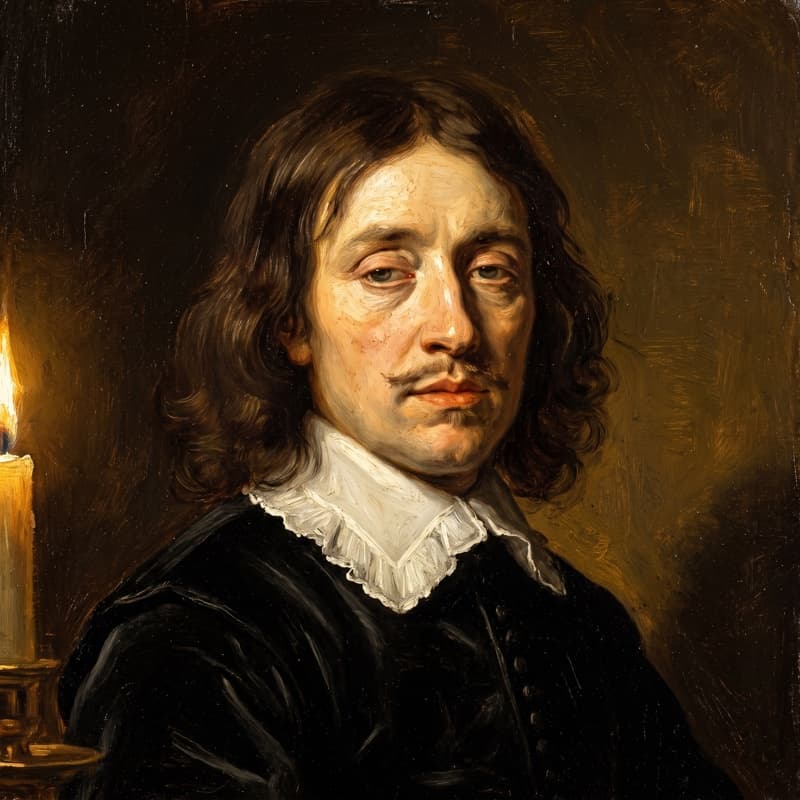
René Descartes died in Stockholm on February 11, 1650, at the age of fifty-three, of pneumonia (Stanford Encyclopedia of Philosophy; MacTutor History of Mathematics Archive; Wikipedia). He had been in Sweden only a few months. There was no duel, no rival, no grand philosophical martyrdom behind it — the proximate cause both MacTutor and Wikipedia point to is far more ordinary: a punishing new schedule, in a punishing climate, that his body could not absorb.
An invitation he probably shouldn't have accepted
By 1649, Descartes had spent roughly two decades in the Dutch Republic, moving house often but keeping, by all accounts, a settled and private working life (Stanford Encyclopedia of Philosophy). That year, Queen Christina of Sweden persuaded him to come to Stockholm and tutor her in philosophy. He went. It cost him the one habit he had kept since boyhood.
The habit of a lifetime, broken
At the Jesuit college of La Flèche, delicate health had won the young Descartes special permission to stay in bed until eleven in the morning rather than rise at five with the other students — "a custom he maintained until the year of his death," as MacTutor puts it (MacTutor History of Mathematics Archive). Christina wanted her lessons at five in the morning. MacTutor is blunt about what that meant: "the Queen wanted to draw tangents at 5 a.m. and Descartes broke the habit of his lifetime" — after roughly forty years of late rising, in a Stockholm winter. He walked to the palace before dawn, repeatedly, through cold his Dutch decades had never asked of him. He contracted pneumonia and never recovered (MacTutor History of Mathematics Archive; Wikipedia).
Not an argument. A schedule.
It is tempting to want a death that matches the reputation — the great doubter undone by some final, unanswerable doubt, or by a rival philosopher, or by the Church he'd spent a career quietly avoiding provoking. The sourced record offers none of that. It offers a man whose mind had spent thirty years arguing that the body is a machine, finally overruled by that same machine, worn down by weather and an early alarm. If there's an irony worth sitting with, it isn't tragic — it's exactly the kind Descartes himself might have logged clinically, in the margin of a notebook, and moved past.
From a conversation with our Descartes
An excerpt from a conversation with our AI Descartes persona — a stylized recreation, honestly labeled, not a historical quotation.
Caller: Doesn't it bother you that your own body is what finally wins?
Descartes: Bother is a word for surprises, and this was no surprise — only a body kept past its usual hour, in a colder country than it was built for. I spent a method proving the mind is not the machine. I never claimed the machine was immortal. A queen wanted her tangents before dawn; I gave them to her. That the giving cost something was arithmetic, not tragedy.
Ask what came before the winter
Our AI Descartes — an honestly labeled recreation, not the man himself — can't tell you what Stockholm's early mornings felt like; that isn't where his knowledge lives. He can tell you about the stove-heated room near Neuburg where the whole method first came to him, about the doubt that survived every test, and about what it costs to build a philosophy from scratch. Ask him what's left standing after you doubt everything you can.
More in this cluster: his verified quotes · biography · fact file · back to the Descartes hub.