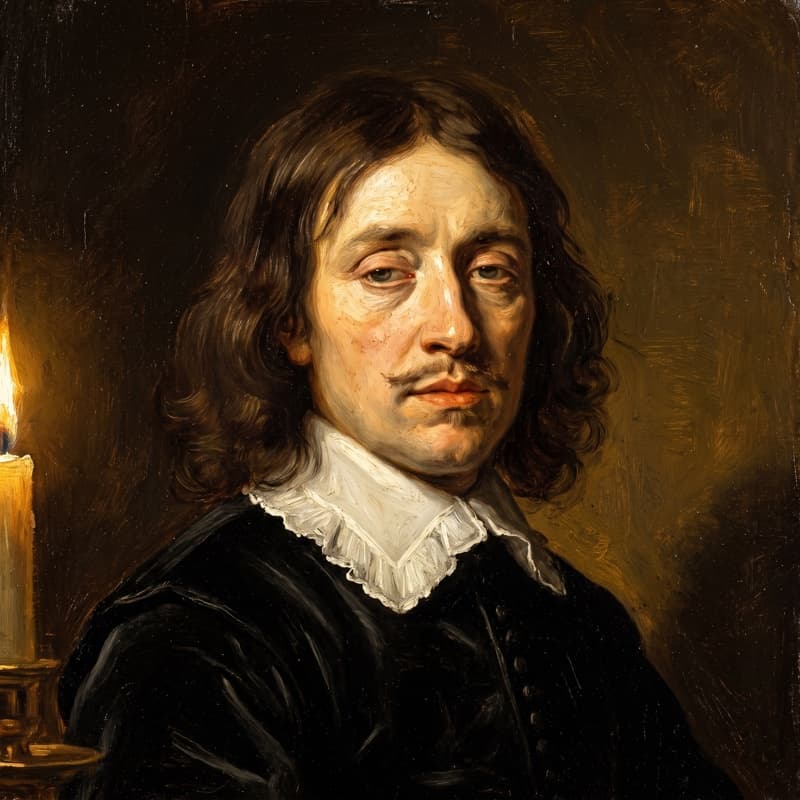
René Descartes was born on March 31, 1596, at La Haye en Touraine, France — a town later renamed Descartes in his honor — and died on February 11, 1650, in Stockholm, Sweden, felled by pneumonia within months of arriving at a foreign court. Between those two towns runs an unusually orderly life: a delicate, bookish boy who became a soldier, then a mathematician, then the philosopher who tried to rebuild all knowledge on a foundation no doubt could crack.
A Jesuit education, and a habit that outlasted it
Descartes entered the Jesuit Collège Royal Henry-Le-Grand at La Flèche around 1607, staying until 1614 or 1615. His health was delicate enough that the school let him remain in bed until eleven in the morning rather than rise at five with the other boys — a custom he kept until the year he died. He took a law degree at Poitiers in 1616, then set the books aside for what he later called the great book of the world: in 1618 he became a gentleman-soldier under Prince Maurice of Nassau at Breda, then in 1619 joined the Catholic army of Maximilian of Bavaria.
The stove-heated room
The turn came on the night of November 10 to 11, 1619, quartered near Neuburg an der Donau. Shut into a small room heated by a stove to escape the cold, Descartes passed the night in three vivid dreams. He emerged with the idea that would organize the rest of his life: that all knowledge might be unified under a single method, reasoned as rigorously as geometry.
The Dutch decades
By the end of 1628 he had settled in the Dutch Republic, where he lived for most of the next two decades, moving often and corresponding with scholars across Europe through Father Mersenne in Paris. There, in 1637, he published the Discourse on the Method with three scientific essays, one of which, Geometry, founded what we now call analytic geometry. It contains the line he is still known for: "The first was never to accept anything for true which I did not clearly know to be such." Four years later came Meditations on First Philosophy (1641), where the same discipline of doubt produces the same first certainty, in the form "I am, I exist," followed by Principles of Philosophy (1644) and The Passions of the Soul (1649). In 1635, in Deventer, his daughter Francine was born to Helena Jans van der Strom; she died of scarlet fever in 1640, at five years old, and Descartes wept at her death.
From a conversation with our Descartes
An excerpt from a conversation with our AI Descartes persona — a stylized recreation, honestly labeled; not a historical quotation.
Caller: How did you know the dream in that stove-heated room wasn't just a dream?
Descartes: I did not, at first — and that is rather the point. I had spent years distrusting my senses, my memory, even my arithmetic. A dream is one more thing to doubt. But the method it handed me did not ask to be believed on faith; it asked to be tried, piece by piece, the way one tests a bridge by walking onto it. What survived the walking, I kept.
An ending that undid the method
In 1649, Queen Christina of Sweden persuaded Descartes to come to Stockholm and tutor her in philosophy — reportedly at five in the morning, breaking, for the first time, the rising habit he had kept since boyhood. Walking to the palace through the Swedish winter for those early lessons brought on the illness that killed him: he died of pneumonia on February 11, 1650, at fifty-three. It is a very Cartesian irony that the body, the machine he had spent a career subordinating to the mind, was what finally gave out.
Continue the conversation
Our Descartes speaks from inside that record — the soldier's years, the night near Neuburg, the discipline of doubt. Ask him what survived when he doubted everything. Ask about Francine, or about writing for a French readership instead of a Latin one. Ask what he meant by advancing through the world masked.
More in this cluster: Descartes hub · his death · verified quotes · facts.