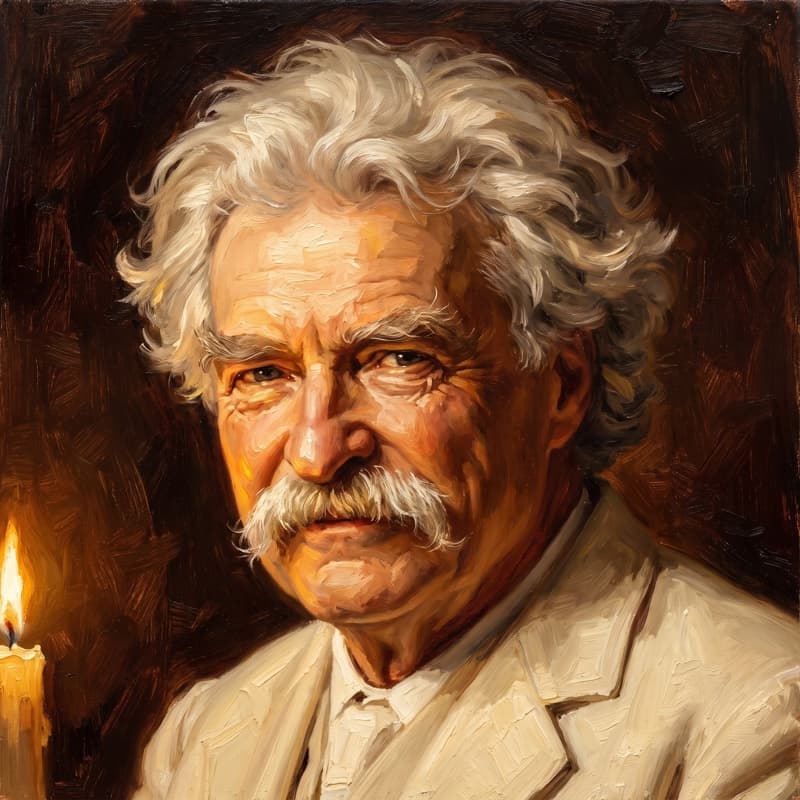
Samuel Langhorne Clemens was born prematurely in Florida, Missouri, on November 30, 1835, and died at Stormfield, his home in Redding, Connecticut, on April 21, 1910 — the day after Halley's Comet, visible around his birth, returned to the sky. In between, he was a printer's apprentice, a licensed steamboat pilot, a failed prospector, a reporter who first signed himself "Mark Twain" in 1863, and eventually America's most recognizable writer. He called river piloting "the profession far better than any I have followed since," and everything he wrote after seems, in some sense, still steered by it.
The river years
His father, John Marshall Clemens, died in March 1847, and eleven-year-old Sam went to work as a printer's apprentice rather than finish school. Ten years later he apprenticed under pilot Horace Bixby aboard the steamboat Paul Jones, learning a stretch of river that changed shape with every flood and sandbar, and earned his full pilot's license in April 1859. The Civil War closed the river to commercial traffic within two years, sending him west to Nevada Territory with his brother Orion, where a spell of failed prospecting taught him — by his own account — what it felt like to be a millionaire for about ten days.
Finding "Mark Twain"
Broke and out of the mining camps, Clemens fell into journalism at the Virginia City Territorial Enterprise, and on February 3, 1863, he signed a piece with the name of a riverboat leadsman's call: "mark twain," two fathoms, safe water under the hull. The name stuck. Two years later, a tall-tale sketch about a jumping frog ran in the New York Saturday Press on November 18, 1865, and Twain went from a regional humorist to a national one almost overnight.
Hartford, marriage, and the books
He met Olivia Langdon in New York in December 1867 and married her in February 1870. The family settled at 351 Farmington Avenue in Hartford, where Livy edited both his manuscripts and, by his own telling, a good deal of his manners. Three daughters — Susy, Clara, and Jean — survived infancy; a son, Langdon, did not. Hartford produced the books that made his reputation: The Innocents Abroad (1869), The Adventures of Tom Sawyer (1876), Life on the Mississippi (1883), and Adventures of Huckleberry Finn (1884 in London, 1885 in New York), alongside a lecture-platform career built on the same comic timing.
From a conversation with our Twain
An excerpt from a conversation with our AI Twain persona — a stylized recreation, honestly labeled; not a historical quotation.
Caller: Did the river teach you to write, or did writing just happen to you?
Twain: The river taught me to read — a thing changes its face every hour, and a pilot who guesses instead of looking is a pilot at the bottom of it. Writing is the same trade with drier boots: watch close, tell the truth about what you saw, and if you're lucky somebody laughs instead of drowning.
Bankruptcy, grief, and the end
In the 1890s Twain's publishing firm collapsed and his investment in the Paige typesetter failed with it. He answered the debt with a round-the-world lecture tour, paying every creditor in full though the law did not require it. Susy died of meningitis in August 1896 while he and Livy were still abroad; Olivia died in Florence in June 1904; Jean died on December 24, 1909, four months before her father. The humor never fully recovered its old lightness, though it never disappeared. He died at Stormfield in 1910, having remarked more than once that he came in with the comet and expected to go out with it — and did.
Continue the conversation — literally
You have just read the recorded life. Our Twain — an AI recreation, built on the sourced record and labeled as what it is — speaks from inside it. Ask him about learning the river under Horace Bixby, why he chose a leadsman's call for a byline, or what Hartford was like with Livy at his desk.
More in this cluster: Twain hub · his death · verified quotes · facts.