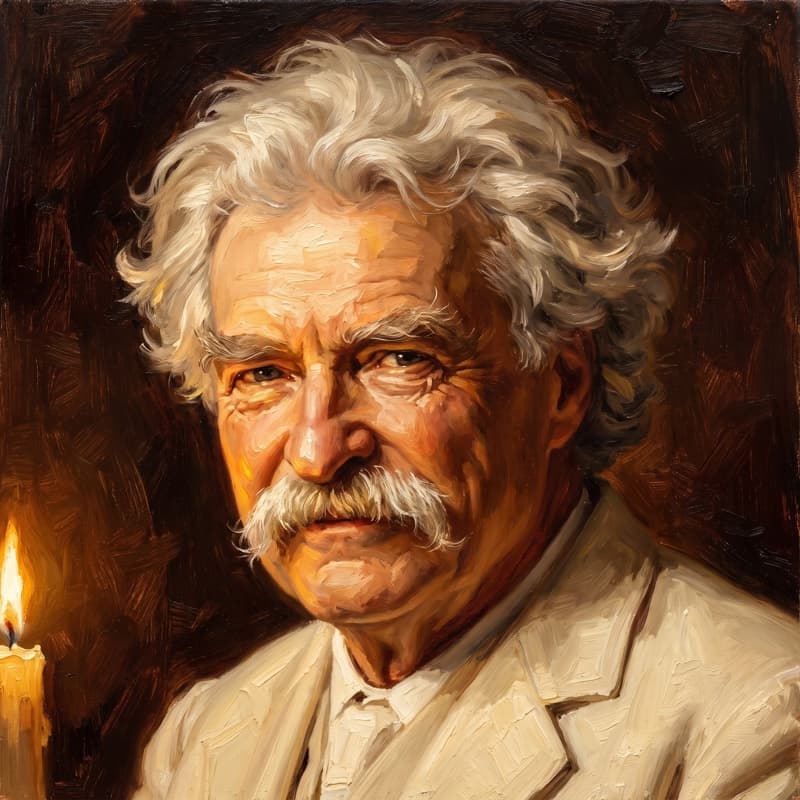
Mark Twain's pen name is itself a quotation of sorts: a Mississippi leadsman's call for two fathoms, twelve feet of safe water under the hull. He first signed it in 1863. Everything he wrote afterward invited the same test his river work did — is the water under this sentence actually safe, or does it just look that way from the deck? Below are lines that pass the test, chapter and verse, followed by a section most quote pages skip: the ones that don't.
Huckleberry Finn's conscience, in his own words
Huck's first brush-off of Sunday-school piety comes early, when the Widow Douglas tries to interest him in Moses:
"I don't take no stock in dead people."
The line that carries the whole novel's moral weight comes later, in Chapter XXXI, when Huck tears up the letter that would send Jim back into slavery:
"All right, then, I'll go to hell."
"You can't pray a lie—I found that out."
Both are Huck reasoning his way past everything he's been taught is right, in real time, without a lecture attached.
The economics of a whitewashed fence
Tom Sawyer's fence-painting con in Chapter II produces something closer to an actual theorem than a joke:
"Work consists of whatever a body is obliged to do, and that Play consists of whatever a body is not obliged to do."
The satirist turns on certainty itself
In Life on the Mississippi (1883), Twain extrapolates the river's shrinking length into geological deep time, then undercuts his own math:
"There is something fascinating about science. One gets such wholesale returns of conjecture out of such a trifling investment of fact."
Pudd'nhead Wilson's New Calendar
Following the Equator (1897) runs each chapter under an epigraph credited to a fictional almanac, "Pudd'nhead Wilson's New Calendar" — Twain's driest, most quotable register:
"It is by the goodness of God that in our country we have those three unspeakably precious things: freedom of speech, freedom of conscience, and the prudence never to practice either of them."
"Man is the only animal that blushes. Or needs to."
From a conversation with our Twain
An excerpt from a conversation with our AI Twain persona — a stylized recreation, honestly labeled; not a historical quotation.
Caller: Which of your own lines do you actually stand behind, years later?
Twain: The short ones, mostly. A long sentence is a place to hide; a short one has nowhere to go but true. "I'll go to hell" cost Huck nothing to say and cost me a good deal to write straight — that one I stand behind entire. The blushing line about the animal, now, that one I stand behind and enjoy standing behind, which is a different and lesser virtue.
Quotes he probably never said
Twain is the most misquoted man in American letters, and the Center for Mark Twain Studies runs a standing Apocryphal Twain archive to prove it. A few of the internet's favorites:
- "I have never let my schooling interfere with my education." Traced to novelist Grant Allen, used more than a decade before anyone credited it to Twain.
- "Never argue with stupid people. They will drag you down to their level and then beat you with experience." No Twain source exists; the saying traces elsewhere entirely.
- "Things we know that just ain't so." Likely closer to nineteenth-century humorist Josh Billings than to Twain, per the same archive.
Even his single most famous line gets misquoted. Reacting to a false 1897 report of his death, Twain actually wrote, "The report of my death was an exaggeration" — not the "greatly exaggerated" version sold on coffee mugs today. Quote Investigator traces the drift through his own later retellings and a 1912 biography that embellished it further.
If a "Twain quote" sounds like a fortune cookie or a LinkedIn post, be suspicious. The real ones argue, confess, or tell a joke with a working part inside it — they were never written to hang on a wall.
More in this cluster: Twain hub · his death · biography · facts.