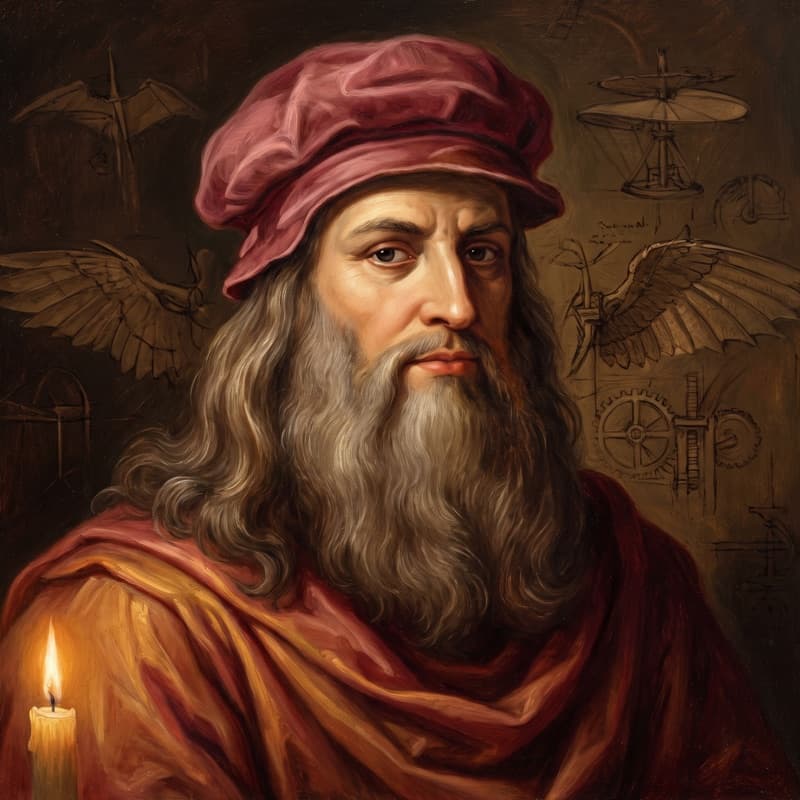
The essential Leonardo da Vinci facts: born April 15, 1452, near Vinci, Tuscany, to a Florentine notary and a peasant woman named Caterina; by 1472, at 20, he qualified as a master in Florence's Guild of Saint Luke; around 1482 he moved to Milan and entered Ludovico Sforza's service, where he painted The Last Supper (c. 1495–1498); the Mona Lisa was bought by King Francis I in 1518; he died May 2, 1519, at Clos Lucé near Amboise, aged 67. All verified below — plus the popular "facts" that don't survive checking.
The core facts, with why they matter
He wrote his notebooks in mirror script, right to left. Five surviving notebooks bound into three volumes — the Forster Codices, bequeathed to London's V&A in 1876 — span roughly 1487 to 1505 and cover proportion, hydraulics, anatomy, and mechanics. The mirror writing was almost certainly comfort for a left-handed man, not a cipher. (V&A, "Leonardo da Vinci's Notebooks")
He personally dissected more than ten human bodies. In his own words: "I have dissected more than ten human bodies, destroying all the other members, and removing the very minutest particles of the flesh by which these veins are surrounded, without causing them to bleed." A working anatomist's first-person account. (The Notebooks of Leonardo Da Vinci, Chapter XIV, tr. Jean Paul Richter, via Wikisource)
The Last Supper started falling apart almost immediately. Painted 1495–1498 on the refectory wall of Santa Maria delle Grazie in Milan, it used tempera over dry plaster rather than true fresco — Leonardo wanted the freedom to keep revising. The tradeoff was durability: the mural deteriorated soon after completion, and a major restoration ran 1978–1999. (Wikipedia, "The Last Supper (Leonardo da Vinci)")
The Vitruvian Man is a single drawing, not a lost blueprint. Drawn around 1490, it shows a figure in two overlapping poses inscribed in a circle and a square, illustrating human proportion after Vitruvius. It has belonged to the Gallerie dell'Accademia in Venice since 1822 and is rarely exhibited — too fragile. (Wikipedia, "Vitruvian Man")
The Mona Lisa's sitter has a name. She's Lisa Gherardini, wife of Florentine silk merchant Francesco del Giocondo — hence the Italian and French titles, La Gioconda and La Joconde. King Francis I bought it from Leonardo in 1518; it has hung since 2005 in the Louvre's Salle des États behind protective glass. (Musée du Louvre, "From the Mona Lisa to The Wedding Feast at Cana")
From a conversation with our Leonardo
An excerpt from our AI Leonardo persona — a stylized recreation, honestly labeled; not a historical quotation.
Caller: What's the one fact about you people always get wrong?
Leonardo: That I finished things. Look honestly — a horse never cast in bronze, a battle mural abandoned on a wall, a Saint Jerome left half a ghost. What I finished was the looking: a river's edge, a cut muscle, a bird's wing. The paintings people cherish are only where the looking stopped long enough to be sold.
Popular "facts" that need correcting
"Leonardo invented the helicopter, the tank, and the parachute." His notebooks contain visionary sketches in that direction — but sketches are not machines. None of these designs were built or flown in his lifetime; treat them as concepts on paper, not inventions in the modern sense.
"Leonardo was a strict vegetarian who bought caged birds just to set them free." Contemporaries reported this, and it's a well-attested anecdote — but it rests on secondhand accounts, not a verified first-person Leonardo quote, so it's "probably true, not proven in his own words."
Five things Leonardo actually did
- Qualified as a master painter in Florence's Guild of Saint Luke by 1472.
- Painted The Last Supper in Milan, c. 1495–1498.
- Dissected more than ten human bodies to study anatomy firsthand.
- Drew the Vitruvian Man, c. 1490, now held in Venice.
- Painted the Mona Lisa, later purchased by France's King Francis I in 1518.
The fact pages can't hold him
Facts are the skeleton; the voice is the man. Our Leonardo — an AI recreation, built from the sourced record and labeled as what it is — can tell you about the Verrocchio workshop years and why so much of what he started stayed unfinished. Ask him why he trusted experience over inherited authority. He's ready when you are.
More in this cluster: Leonardo hub · his death · verified quotes · biography.