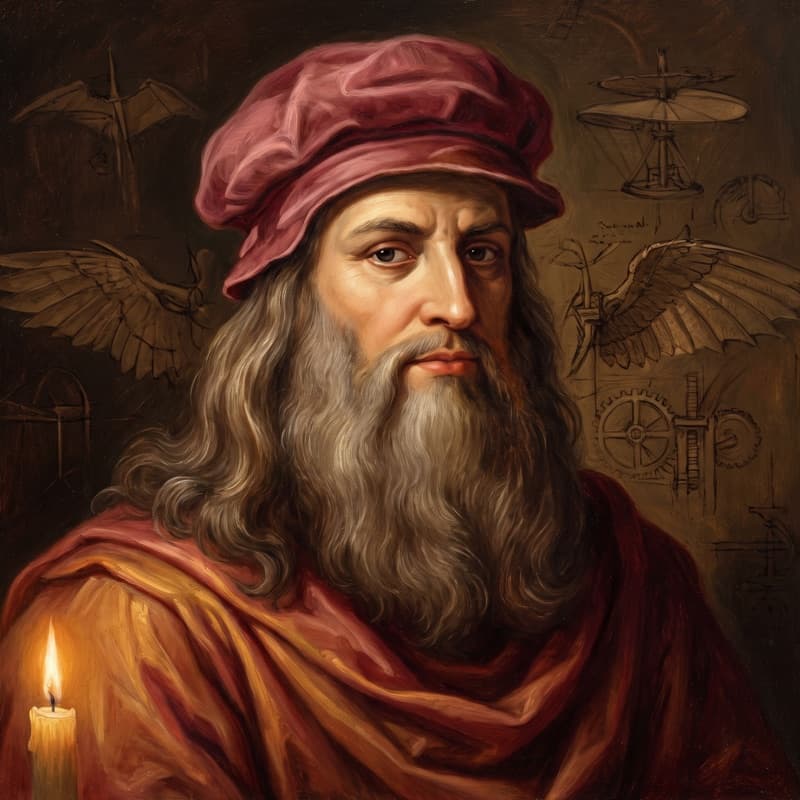
Leonardo da Vinci died on 2 May 1519 at Clos Lucé, the manor house near Amboise, France, where he had lived since 1516 as the invited guest of King Francis I (Wikipedia). He was 67, and the likely cause was a stroke (Wikipedia). He was not buried right away: more than three months passed before he was interred, on 12 August 1519, in the Collegiate Church of Saint-Florentin inside the Château d'Amboise (Wikipedia).
That answers the search-box question. What surrounds it is a slow decline, a will, and one famous scene the record treats with real suspicion.
A hand that had already gone quiet
By the time Leonardo reached France, his working life had been narrowing for years — his right hand weakened, a detail historians cite when explaining why so much of his late work stayed unfinished (Wikipedia). The pattern was familiar. The bronze horse he designed for the Sforza court in Milan was never cast, and the Battle of Anghiari, the mural he spent roughly 1504 to 1506 designing for Florence's Signoria, was abandoned and is now lost (Wikipedia). Before he died, Leonardo drew up a will giving his notebooks and manuscripts to his pupil Francesco Melzi, who later compiled Leonardo's writing on painting into the Treatise on Painting (Wikipedia).
Probably not held in a king's arms
The most vivid image attached to Leonardo's death — Francis I cradling the dying painter's head — is a scene most famously painted by Jean-Auguste-Dominique Ingres in 1818, and it has hardened into popular fact ever since. The documented record is far more cautious: historians generally treat the deathbed embrace as a later embellishment rather than an eyewitness account, layered onto a death that was, by the paper trail, quieter — a will, a named heir, and a burial three months on once arrangements were made. Treat the king's-arms version as legend, not documented history.
Where the work went
The Mona Lisa made the trip to France with him; Francis I bought it directly from Leonardo in 1518, which is how a portrait of a Florentine silk merchant's wife ended up owned by the French crown (Louvre). The notebooks took a longer road: five of them, bound into three codices, eventually reached London, where John Forster bequeathed them to what is now the Victoria and Albert Museum in 1876 — the Forster Codices, spanning roughly 1487 to 1505, written in the mirror script he used all his life (V&A). In those same notebooks, Leonardo had already written down the method behind everything the failing hand eventually stopped him from finishing: "I have dissected more than ten human bodies, destroying all the other members, and removing the very minutest particles of the flesh by which these veins are surrounded, without causing them to bleed" (Wikisource). That temperament — meticulous, first-hand, unwilling to take anyone's word for it — outlasted the hand that wrote it down.
From a conversation with our Leonardo
An excerpt from a conversation with our AI Leonardo persona — a stylized recreation, honestly labeled, not a historical quotation. Our Leonardo's knowledge ends before Amboise.
Caller: People love the story that a king held your head as you died. Does it bother you that we can't be sure it's true?
Leonardo: Not at all — I would rather you doubted a pretty story than believed it on authority alone. That is the whole of what I tried to teach my own hand: test it, do not merely repeat it. If the truth is quieter than the painting, so be it. A will and a named heir are less romantic than a king's embrace, but they are what the record actually shows, and I was always more interested in what actually happened.
Ask him about the work, not the ending
Our Leonardo — an AI recreation built from the notebooks and the documented record, labeled as exactly that — will not describe Amboise or the will; his knowledge stops short of that. But the restlessness behind it is exactly what he is built to talk about: the dissections, the water studies, the machines sketched and never built, the paintings reworked for years instead of called finished. Ask him why he trusted experience over inherited authority. Start the conversation whenever you're ready.
More in this cluster: Leonardo hub · biography · verified quotes · fact file.