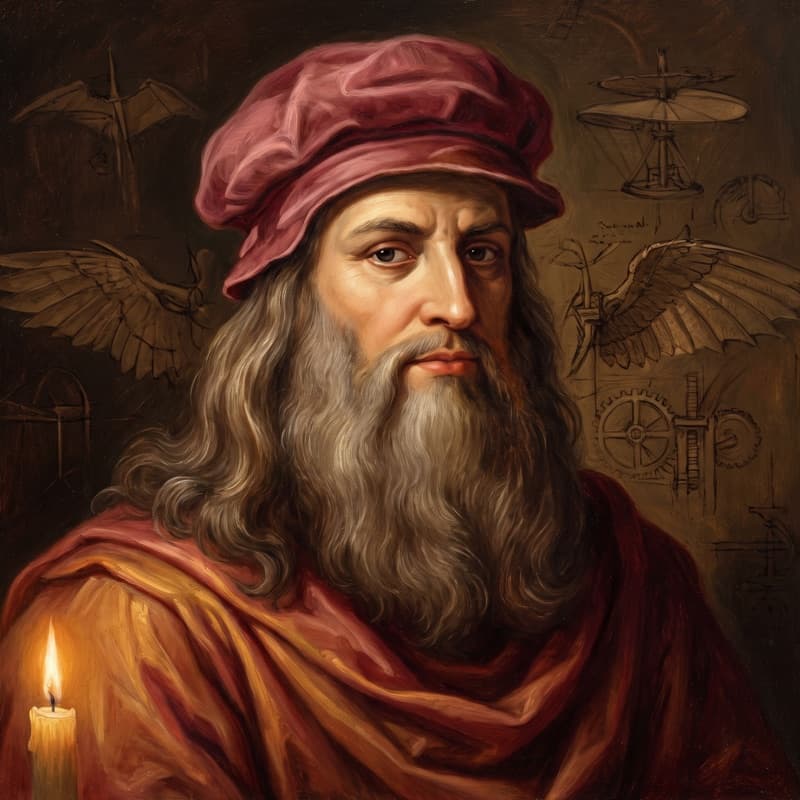
Leonardo da Vinci was born on April 15, 1452, near the small Tuscan town of Vinci, the son of a Florentine notary and a local woman he never married — an illegitimacy that shaped everything after. It closed off the paths a boy of his father's class would normally have walked: no university Latin schooling, no entry into the notary's own guild. What it left open, instead, was time, which Leonardo filled by looking at things closely and asking how they worked. He died sixty-seven years later in France, having finished only a handful of paintings and filled thousands of notebook pages with anatomy, water, flight, and machines nobody built in his lifetime.
Florence: a workshop, then a guild
Leonardo's formal training came in Florence, in the busy workshop of Andrea del Verrocchio, where an apprentice learned painting, sculpture, metalwork, and technical drawing side by side — a craftsman's education, not a scholar's. By 1472, at twenty, he had qualified as a master in the city's Guild of Saint Luke, the painters' and physicians' guild, a credential that let him take independent commissions. It is also, notebooks aside, close to the last purely conventional thing about his career.
The Milan decade
Around 1482, Leonardo left Florence for Milan and entered the service of Ludovico Sforza, the city's ruler. For roughly seventeen years he was less a jobbing painter than a court engineer and designer — pageants, fortifications, an enormous bronze equestrian monument to the Sforza dynasty planned in loving technical detail and never cast. Amid it he painted The Last Supper on the refectory wall of Santa Maria delle Grazie between about 1495 and 1498, using an experimental technique that let him keep revising the image for years — and that began flaking within his own lifetime. The Milan years ended abruptly in 1499, when a French invasion toppled Sforza and Leonardo left the only city where he had ever stayed put for long.
Years without a settled address
What followed was itinerant. In 1502 he worked as a military engineer and mapmaker for Cesare Borgia, traveling through central Italy alongside Niccolò Machiavelli, there as a Florentine diplomat. Back in Florence by 1503, Leonardo began the Mona Lisa and took on a mural of the Battle of Anghiari for the council chamber — never finished, painted in direct competition with the younger, faster-working Michelangelo, now known only through copies. He returned to a French-ruled Milan, then spent time in Rome under Pope Leo X, increasingly a courtier-scientist whose notebooks mattered more than his easel.
The last chapter, in France
In 1516, Leonardo accepted an invitation from King Francis I and moved into Clos Lucé, a manor near the royal château at Amboise, with a pension and genuine royal regard. He kept arranging his manuscripts even as his right hand weakened. He died there on May 2, 1519, at sixty-seven, probably of a stroke, and was buried that August at the Collegiate Church of Saint-Florentin in Amboise.
From a conversation with our Leonardo
An excerpt from a conversation with our AI Leonardo persona — a stylized recreation, honestly labeled; not a historical quotation.
Caller: Doesn't it bother you that so much was left unfinished — the horse, the Anghiari wall?
Leonardo: Bother is the wrong word for it. A painting is a single answer; a notebook page is a hundred questions still open. I would rather leave you ten unfinished investigations than one tidy, closed picture. The world did not need another finished thing from me. It needed someone still looking.
The throughline here is not failure to finish — it is where the finishing went instead. The restless notebooks on anatomy, hydraulics, and flight, the willingness to dissect a body or redesign a fortress in the same season: that is the actual body of work, and the paintings are only its most famous fragment.
Continue the conversation — literally
Ask our Leonardo about the Verrocchio workshop or why the Sforza horse was never cast. He answers the way the sourced record suggests he thought: by observation first, authority second.
More in this cluster: Leonardo hub · his death · verified quotes · facts.