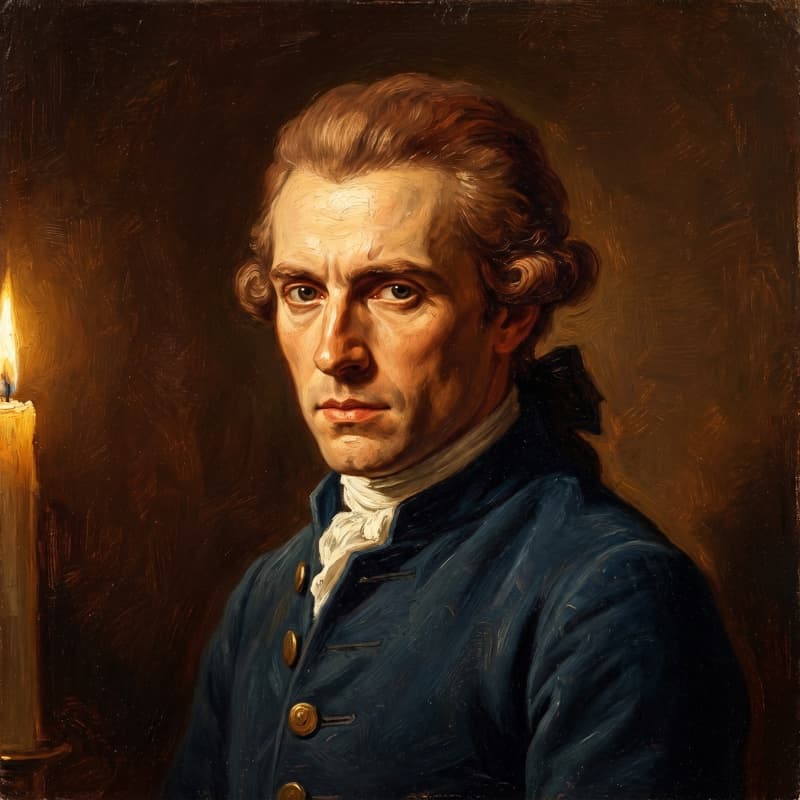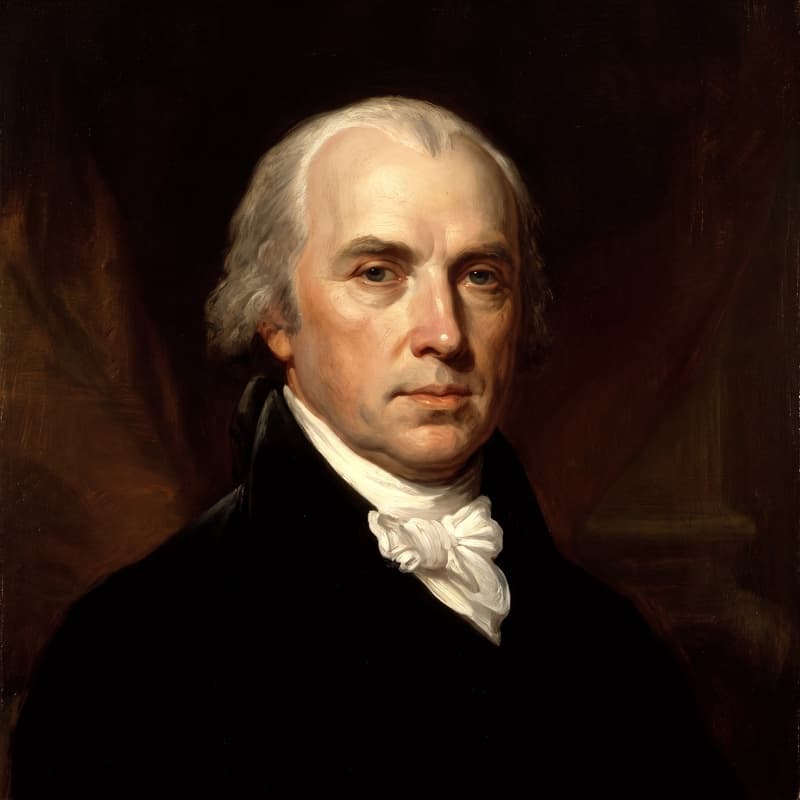
James Madison was the fourth president of the United States, but the presidency was not the point of him. The point was four months in the summer of 1787, when a small, sickly, soft-spoken Virginian walked into Philadelphia having already read every failed republic in recorded history and drafted a plan before anyone else had unpacked. He was born March 16, 1751, at Port Conway, Virginia, and died June 28, 1836, at Montpelier — the last of the framers left alive, buried two days later in an unmarked family grave. Between those dates he built the intellectual scaffolding of American government, co-wrote the arguments that sold it to a skeptical public, then spent the rest of his life explaining, defending, and occasionally correcting it.
That is the summary. The man, and the contradictions he carried, are more interesting than the summary.
The homework nobody else did
Madison's advantage was never charisma — by his own era's account he stood roughly five foot four and spoke so quietly that rooms had to lean in to hear him. His advantage was preparation. At the College of New Jersey, now Princeton, under the Scottish president John Witherspoon, he studied past exhaustion, working through Hume, Smith, and Montesquieu and mastering several languages before turning from ministry toward politics. He cut his teeth on Virginia's Committee of Safety in 1774, then the Virginia Convention of 1776, where he helped shape the Declaration of Rights — years before Philadelphia, he was already learning what made governments fail.
By 1786 he had turned that education into a method: catalogue every confederacy that ever collapsed, ancient and modern, and list the causes of death. He helped push the commerce dispute that produced the 1786 Annapolis Convention, which in turn called the Constitutional Convention into being. When the delegates gathered in Philadelphia in May 1787, Madison arrived with the Virginia Plan already drafted — a head start that let him shape the agenda before the debate even opened. He then sat through nearly every session for four months, keeping the only complete set of notes on how the Constitution was actually made, notes he kept locked away for decades and intended for publication only after the last delegate had died. He turned out to be that delegate.
The arguments that sold the republic
Alongside Alexander Hamilton and John Jay, writing as "Publius," Madison helped produce The Federalist — the essays that argued New York, and the country, into ratification. His own contributions are still the ones most quoted. In Federalist No. 10, he confronted the problem of faction head-on:
"Among the numerous advantages promised by a well constructed union, none deserves to be more accurately developed than its tendency to break and control the violence of faction." — The Federalist No. 10, 22 November 1787
His answer was not to suppress faction — he thought that impossible without destroying liberty itself — but to build a republic large and varied enough to dilute it. In Federalist No. 51, he laid out the design principle underneath the whole Constitution:
"If men were angels, no government would be necessary. If angels were to govern men, neither external nor internal controls on government would be necessary... Ambition must be made to counteract ambition." — The Federalist No. 51, 6 February 1788
That is Madison's whole political science in two sentences: design for the people you actually have, not the virtuous citizens you wish you had, and make each center of power a check on the next.
From a conversation with our Madison persona
What follows is an excerpt from a conversation with our AI Madison persona — a stylized recreation for readers, not a historical quotation.
Caller: You argued so hard against a Bill of Rights during ratification. Why did you turn around and write one?
Madison: Because a statesman keeps the promises he was argued into, not only the ones he volunteered. I thought the structure itself was the safeguard, and I still think that, mostly. But Mr. Jefferson wrote me from Paris that a bill of rights is what a free people are entitled to against any government, and enough of my Virginia neighbors agreed that ratification hinged on the promise. So in the first Congress I drafted the amendments I had called unnecessary. Changing one's mind in daylight, with reasons stated, is not weakness — it is the only kind of consistency worth having.
Not a marble statue
Madison did not sanitize his own record, and neither should an account of him. He co-founded, with Jefferson, the opposition movement that became the Democratic-Republican party — an odd inheritance for the man who warned against faction in Federalist No. 10. He publicly reversed himself not only on the Bill of Rights but later on the constitutionality of a national bank. And in 1801, on his father's death, he inherited Montpelier along with more than a hundred enslaved people; across his lifetime, nearly 300 enslaved people lived and labored there under Madison-family ownership, and he never freed them.
"These fingerprints remind us that nearly 300 enslaved people, of all ages, made their mark on Montpelier." — Montpelier Foundation, "The Mere Distinction of Colour"
He was capable of naming the wrong plainly, even while living inside it. Speaking at the Constitutional Convention on June 6, 1787, he said of the historical record of racial oppression: "We have seen the mere distinction of colour made in the most enlightened period of time, a ground of the most oppressive dominion ever exercised by man over man." The gap between that sentence and his own household is the unresolved center of his biography, not a footnote to it.
The presidency, the fire, and the long retirement
As Jefferson's secretary of state from 1801, Madison oversaw the Louisiana Purchase. Elected president in 1808, he asked Congress for war against Britain in 1812; British troops burned Washington in August 1814, and the war closed with the Treaty of Ghent on February 16, 1815 — a war that proved a republic could fight without becoming a despotism, whatever else it settled. He retired to Montpelier with his wife Dolley in 1817 and spent his final two decades farming, corresponding, and guarding his convention notes for a posterity he would not live to see react to them.
He was also, late in life, a man of plain public honesty about small myths as well as large ones — denying in an 1832 letter that he had ever been a Freemason, and, in 1834, waving off the title "Father of the Constitution" outright: it was, he insisted, "the work of many heads and many hands." He wanted credit distributed accurately even when the credit was his to keep.
Keep reading — or ask him yourself
Madison spent his life turning arguments over until he found their true shape, and he built an institution meant to outlast any one generation's mistakes — including his own. Our AI recreation of him, honestly labeled as such, takes calls at Montpelier in 1826: ask him how he built the Virginia Plan before the Convention even met, why he thinks ambition has to counteract ambition, or what he has to say about the parts of his own life the Constitution never fixed. He answers softly, and he has time for the question.