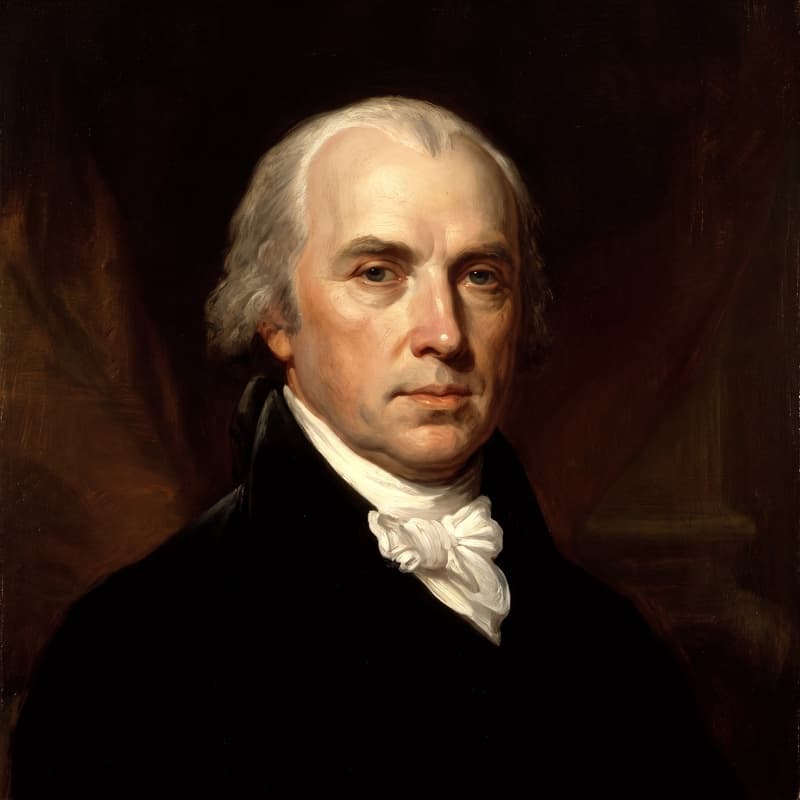
James Madison was born on March 16, 1751, at Port Conway, Virginia, and died on June 28, 1836, at Montpelier, at age 85 — the last surviving framer of the Constitution. Between those dates sits one of the most consequential careers in American political thought: a delegate who arrived in Philadelphia with a plan already drafted, an essayist who explained the Constitution to the public that had to ratify it, a congressman who turned promises into a Bill of Rights, and a president who governed through a war he had not sought.
A student of government
Madison was educated at boarding school, where he learned six languages, then studied Enlightenment philosophy at the College of New Jersey — Princeton. He returned to Virginia for the harder education of revolutionary politics: the Orange County Committee of Safety from 1774, the Virginia Convention by 1776, and the Continental Congress from 1780, watching the Articles of Confederation fail in real time. By the mid-1780s he was doing the unglamorous work that precedes reform — pushing, with John Tyler, for the congressional commerce power that led to the 1786 Annapolis Convention, which in turn produced the call for a full constitutional convention in Philadelphia.
The Convention and The Federalist
Madison arrived in Philadelphia in 1787 with the Virginia Plan already drafted, and he did not miss a single session, compiling the fullest surviving record of the debates himself. Once the Constitution was signed, he turned to persuading New York to ratify it, co-authoring The Federalist essays with Alexander Hamilton and John Jay under the pen name "Publius." His essays argued that faction was not a defect to be wished away but a permanent feature of free government: "Among the numerous advantages promised by a wellconstructed Union, none deserves to be more accurately developed than its tendency to break and control the violence of faction." The remedy, he wrote in Federalist No. 51, was structural rather than moral — "If men were angels, no government would be necessary" — resting on the premise that "ambition must be made to counteract ambition."
From a conversation with our Madison
An excerpt from a conversation with our AI Madison persona — a stylized recreation, honestly labeled; not a historical quotation.
Caller: You warned against faction, then helped found a political party yourself. Doesn't that undercut the argument?
Madison: It corrects it, rather than undercuts it. A theorist may see the disease clearly and still catch it. The Constitution was never built on the hope that men would stop forming factions — only that no single one could seize the whole machine. I joined that fight; I did not pretend to stand above it.
Congress, marriage, and the State Department
As a Virginia representative in the First Federal Congress, Madison introduced the amendments that became the Bill of Rights on June 8, 1789; ten were ratified on December 15, 1791. He married Dolley Payne Todd on September 15, 1794, and in 1801 became secretary of state under Thomas Jefferson through the Louisiana Purchase. That same year, his father's death left him Montpelier and its enslaved workforce — nearly 300 enslaved people labored there across Madison family ownership, a fact the record does not soften and neither should this one.
The war presidency and retirement
Elected the fourth president in 1808, Madison asked Congress to declare war on Britain in 1812. British troops burned Washington in August 1814 before the war ended with the Treaty of Ghent, signed February 16, 1815. He retired to Montpelier with Dolley in 1817, guarding his convention notes for publication only after his death, so they would not become ammunition in his own politics.
Continue the conversation — literally
You have just read the recorded life. Our Madison — an AI recreation, built on the sourced record and labeled as what it is — speaks from inside it. Ask him about drafting the Virginia Plan, why he thought liberty and faction were inseparable, how Federalist No. 10 squared with founding a party of his own, or about Montpelier and the people he enslaved there.
More in this cluster: Madison hub · his death · verified quotes · facts.