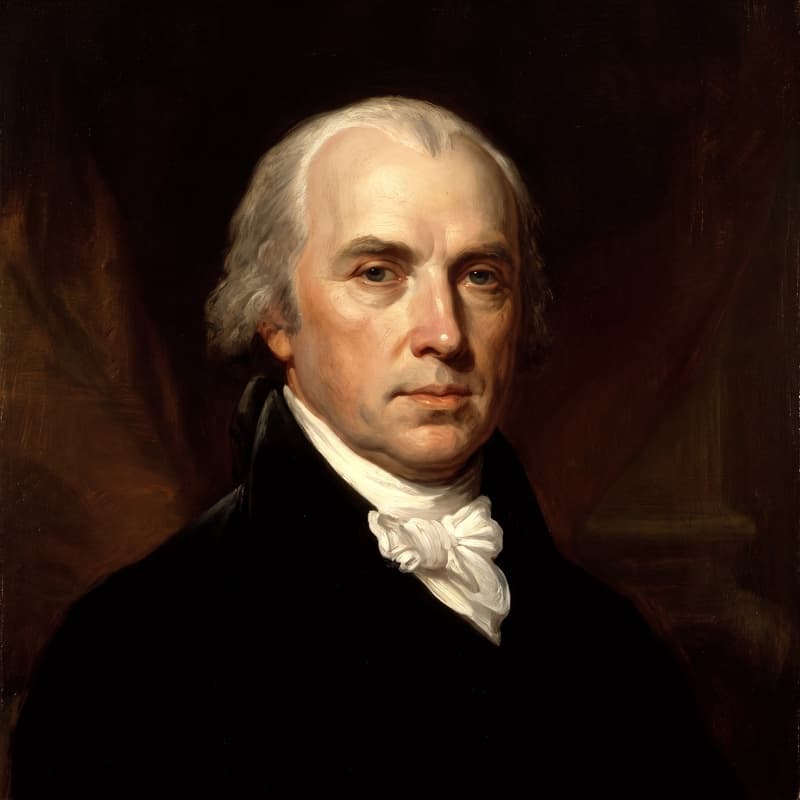
The core facts about James Madison, stated up front and sourced: born March 16, 1751, at Port Conway, Virginia, and died June 28, 1836, at Montpelier, the last surviving delegate to the Constitutional Convention (American Battlefield Trust; Montpelier Foundation); he attended every session of the 1787 convention and kept the fullest surviving notes of its debates (Montpelier); he co-wrote the Federalist essays with Alexander Hamilton and John Jay as "Publius" (National Archives); and in 1801 he inherited Montpelier and more than 100 enslaved people, part of the nearly 300 who lived and labored there under Madison-family ownership (Montpelier). This page is a fact file, not a listicle: every entry cites the institution that documents it.
Public record
- Educated at Princeton. Madison studied at boarding school from age ten, learning six languages, then graduated from the College of New Jersey (Princeton) in 1771 (American Battlefield Trust; Miller Center).
- The Virginia Plan and the convention. Madison arrived in Philadelphia in 1787 with the Virginia Plan already drafted and did not miss a single session or major speech (Montpelier).
- The Federalist essays. Madison, Hamilton, and Jay wrote the Federalist essays in late 1787 and 1788 to support ratification of the Constitution in New York, publishing as "Publius" (National Archives).
- The Bill of Rights. As a Virginia representative in the First Federal Congress, Madison introduced proposed amendments on June 8, 1789; ten were ratified as the Bill of Rights on December 15, 1791 (National Archives).
- Secretary of State, 1801. Madison served as Jefferson's secretary of state through the Louisiana Purchase of 1803 (Miller Center).
- Fourth president, War of 1812. Elected in 1808 and inaugurated in 1809, Madison asked Congress to declare war on Britain, which it did on June 18, 1812 (American Battlefield Trust).
Slavery at Montpelier
- Nearly 300 people enslaved across Madison-family ownership. Madison inherited Montpelier and enslaved people on his father's death in 1801; over the estate's history, nearly 300 enslaved people of all ages lived and worked there (Montpelier Foundation). He did not free them.
- He named the injustice plainly, once, on the record. At the Constitutional Convention on June 6, 1787, Madison told the delegates: "We have seen the mere distinction of colour made in the most enlightened period of time, a ground of the most oppressive dominion ever exercised by man over man" (Avalon Project, Yale Law School). The observation did not change how Montpelier was run.
War, retirement, and death
- The burning of Washington and the Treaty of Ghent. British forces burned the White House and other federal buildings in the Battle of Bladensburg in August 1814; the war ended with the Treaty of Ghent, signed February 16, 1815 (American Battlefield Trust).
- Retirement, 1817. Madison retired to Montpelier with Dolley after two presidential terms (American Battlefield Trust).
- Died June 28, 1836, age 85. He was the last surviving framer of the Constitution, buried two days later in the family cemetery in an unmarked grave (American Battlefield Trust; Montpelier).
Claims we decline to print
A fact file earns trust by what it refuses. Madison did not write "If tyranny and oppression come to this land, it will be in the guise of fighting a foreign enemy" — the line circulates on quote sites with no primary-source citation, and no one has traced it to a Madison document (Technoccult's sourcing review). It likely distorts a genuine but differently worded line from Madison's 1798 letter to Jefferson, on liberty lost at home being "charged against provisions against danger, real or pretended from abroad." Separately, Madison was not a Freemason, despite the recurring claim: in a January 24, 1832 letter he wrote, "I never was a mason, and no one perhaps could be more a stranger to the principles, rites and fruits of the institution" (Montpelier).
Continue
Biography for the narrative these facts hang on · Quotes for the verified-versus-spurious ledger · Death for June 28, 1836. Or test the file conversationally: our Madison AI persona — a clearly labeled reconstruction — will walk you through any of it, faction theory and Montpelier both, from his study.