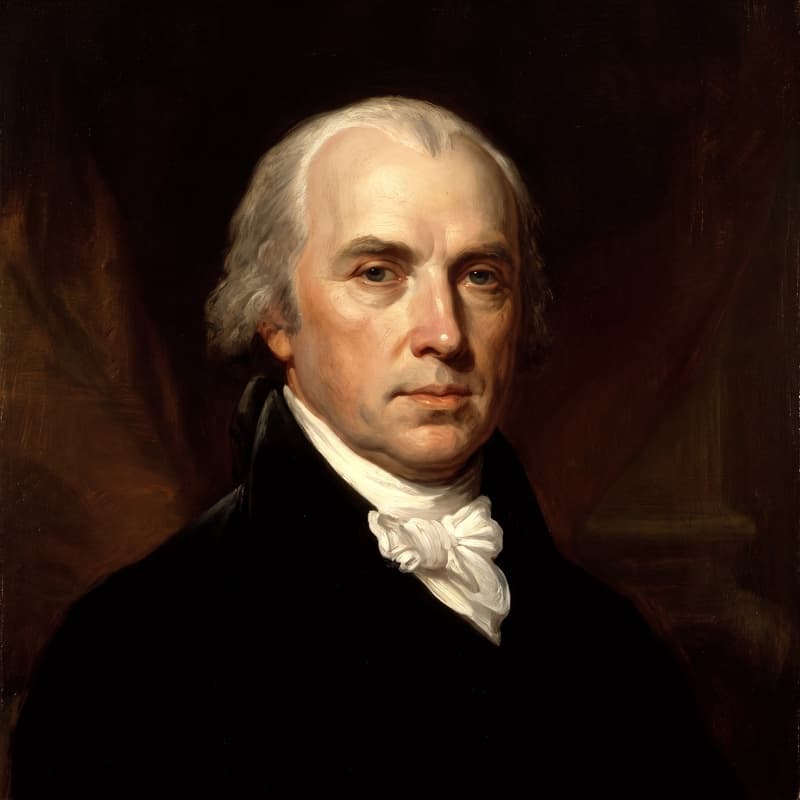
James Madison died at Montpelier, his Virginia home, on June 28, 1836, at the age of 85 (American Battlefield Trust). He was, by that point, the United States' last surviving founding father — the final man alive who had helped write the Constitution he'd spent his life defending (American Battlefield Trust). He was buried two days later in the family cemetery at Montpelier, in a grave that was not marked (Montpelier Foundation).
That's what the record supports. The rest of this page stays inside it.
Nineteen years at Montpelier
Madison and Dolley retired to Montpelier in 1817, after two presidential terms (American Battlefield Trust). He spent his final two decades there as a private citizen who had once run the country through a war that burned its own capital — a strange kind of quiet after 1814.
By the 1830s, the "last surviving framer" title wasn't a rhetorical flourish; it was simply true, and it grew heavier with each year he carried it alone. He was the sole man left who had sat through every session of the Philadelphia convention, who could say from direct memory what the delegates had actually argued and traded to get the document ratified.
What the record confirms, and what it doesn't
Madison's death has picked up the same kind of folklore that gathers around any founder's final hours — a memorable last line, a doctor's offer of stimulants to stretch his life to one more Fourth of July. Those stories circulate widely. This session's research pass could not confirm them against a primary source solid enough to quote here, so this page doesn't repeat them as fact. Where the record is thin, the honest move is to say so rather than borrow a tidy line from a quote site.
What is confirmed, and worth quoting directly, is the document historians call "Advice to My Country" — a note Madison left to be published only after his death, his final word to the country he'd spent fifty years arguing into being. In it, his last plea was that the "Union of the States be cherished and perpetuated" (Miller Center, University of Virginia). After a career spent designing machinery to keep factions from tearing a republic apart, it's the argument he chose to leave standing when he no longer had a vote in the matter.
From a conversation with our Madison
An excerpt from a conversation with our AI Madison persona — a stylized recreation, honestly labeled, not a historical quotation. Our Madison's knowledge ends before Montpelier's final years.
Caller: If this were your last chance to say one thing to the country, what would it be?
Madison: Guard the Union before you guard any faction within it — mine included. I spent a convention summer trying to build a government strong enough to act and restrained enough not to tyrannize. That balance doesn't hold itself once the builders are gone. It wants tending, generation after generation, by people who'd rather argue inside the structure than tear it down to win faster. Ambition doesn't retire when I do. It only finds new hands.
The grave that waited
Madison's unmarked burial is its own small irony: the man whose convention notes were the most complete record anyone kept of how the Constitution was actually built went into the ground with no stone naming him (Montpelier Foundation). The marker came later. The record he'd spent a lifetime compiling — and the "Advice to My Country" he left behind — did the work a headstone couldn't.
More in this cluster: Madison's verified quotes · his biography · fact file · back to the Madison hub.