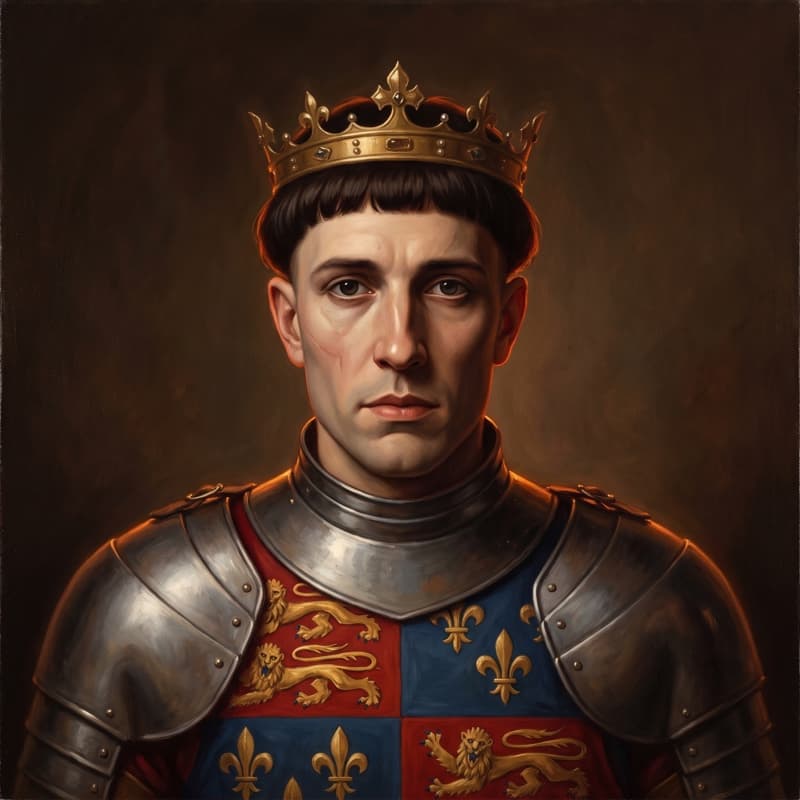
Genuine first-person material from Henry V is thin, and what survives was not written for an audience — it's a dispatch, not an oration. Compare that with the lines most people associate with him, "we happy few," "once more unto the breach," and you're comparing two centuries and two professions: a soldier-king against a very good Elizabethan playwright.
1415: the Harfleur letter — his own words, verified
On 22 September 1415, after besieging Harfleur since mid-August, Henry wrote home to London reporting the town's surrender. The letter survives in translation from the Norman French original, transcribed in Memorials of London and London Life and hosted by the University of Southampton's Agincourt600 project — the best-documented sample of his own wording that exists.
"We do greet you oftentimes, in signifying unto you, for your consolation, that we are in very good health as to our person."
"And to avoid the effusion of human blood on the one side and on the other, we inclined to their offer."
"The keys of the town were then fully delivered and rendered into our hand."
Formal, administrative, plain — a report to the city, not a battle cry (Letter of Henry V, Southampton Agincourt600).
Agincourt: the real reply behind "band of brothers"
The closest thing to a real Agincourt speech comes from the Gesta Henrici Quinti, an eyewitness Latin chronicle kept by a chaplain who marched with the army. On the morning of 25 October 1415, badly outnumbered, Henry's captain Sir Walter Hungerford reportedly wished aloud for ten thousand more archers from England. The Gesta records Henry's reply:
"I would not want to have even one more man than I have, even if I could. For these are the people of God I have here, and it is an honour for me to have them at this time."
This is a genuine eyewitness attribution of direct speech, and the documented root of Shakespeare's "band of brothers" tradition. Handle it carefully, though: the Gesta survives in Latin, and the English above is a modern scholarly translation, not Henry's exact wording (Gesta Henrici Quinti, new translation, Southampton Agincourt600).
From a conversation with our Henry V persona
An excerpt from our AI Henry V persona — a stylized recreation, clearly labeled; not a historical quotation.
Caller: People remember you for "band of brothers." Did you ever actually say anything like it?
Henry: I said less, and meant it more. A captain wished for ten thousand more men; I told him no — the men I had were God's, and enough. A soldier's sentence, not a stage one; the playwright dressed it for an audience that had never smelled a siege.
Quotes he never said
Two of the most famous lines attached to Henry V are Shakespeare's, not his. "We few, we happy few, we band of brothers" is spoken by King Henry in Act 4, Scene 3 of Henry V (Folger Shakespeare Library). "Once more unto the breach, dear friends, once more" opens Act 3, Scene 1 of the same play (Royal Shakespeare Company). Both date to around 1599, loosely built on the Agincourt exchange above, but the verse is the playwright's.
The popular image of Henry walking in disguise among his troops the night before Agincourt is the same kind of invention: the RSC notes that neither of Shakespeare's chronicle sources, Holinshed or Hall, records the king visiting his army incognito — a stock device from disguised-ruler scenes in 1590s plays.
One more to flag: "War without fire is like sausages without mustard," often credited to Henry via chronicler Jean Juvénal des Ursins. It circulates on quote sites, but no primary edition of that chronicler confirms it. Treat it as folklore, not a verified quote.
Ask him yourself
The real Henry V left a siege dispatch and a translated battlefield reply — plainer and harder than anything Shakespeare gave him. Our Henry V, an AI recreation, honestly labeled, will tell you the difference himself: ask him what he told Hungerford, or what he makes of the lines he never spoke.
More in this cluster: Henry V hub · his death · biography · facts.