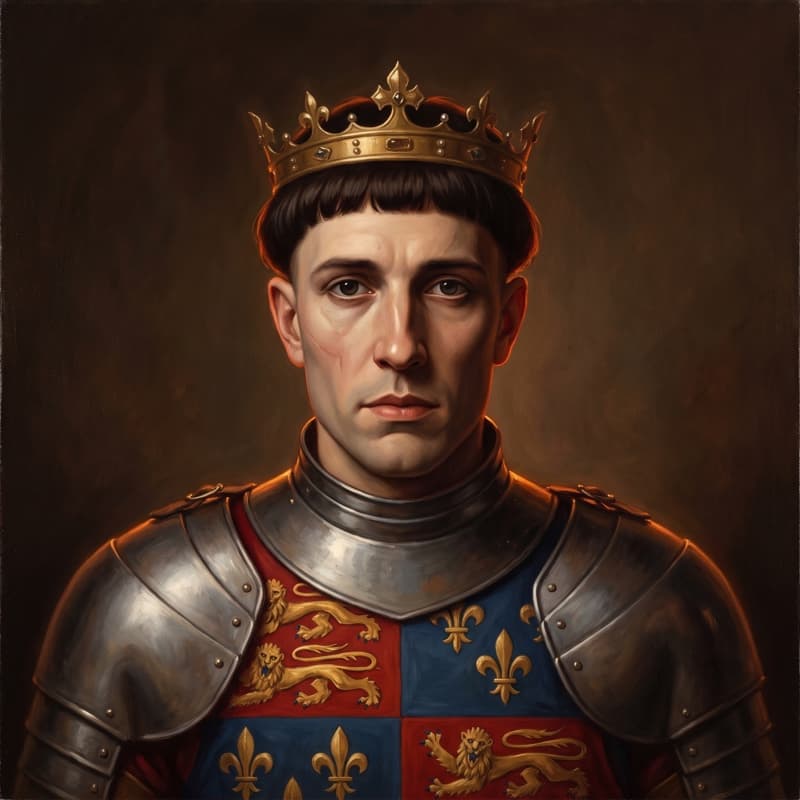
The essential Henry V facts, historical king, not Shakespeare's character: born at Monmouth Castle around 1386; crowned at Westminster Abbey on April 9, 1413; won the Battle of Agincourt on October 25, 1415, against a heavily outnumbered force; named heir to the French throne by the 1420 Treaty of Troyes and married to Catherine of Valois; and dead of probable dysentery at the Château de Vincennes on August 31, 1422, seven weeks before that French crown would have become his in fact, not just on paper (Wikipedia, Henry V of England; Westminster Abbey). Everything below is cited, because four centuries of verse have blurred where the king ends and the play begins.
The core facts, with why they matter
Wounded in the face by an arrow at Shrewsbury, 1403, at sixteen. Fighting alongside his father against the Percy rebellion, the prince took an arrow that lodged deep enough that a surgeon needed a purpose-built tool to draw it out (Wikipedia, Henry V of England). The warrior-king of legend started as a teenager who nearly didn't survive to be king at all.
Captured Harfleur, and his own letter describes it. Harfleur's defenders surrendered on September 22, 1415, after a monthlong siege. Henry's letter home is unusually plain for a king announcing a victory: "to avoid the effusion of human blood on the one side and on the other, we inclined to their offer," and "the keys of the town were then fully delivered and rendered into our hand" (Letter of Henry V, Memorials of London, University of Southampton). It's the closest surviving thing to Henry's own voice — administrative, not oratorical.
Won Agincourt outnumbered and exhausted. On October 25, 1415, after an eight-day forced march with a sick, hungry army, Henry's roughly six thousand men defeated a French force the era's own chroniclers numbered in the tens of thousands (Gesta Henrici Quinti, new translation, University of Southampton).
Ordered French prisoners killed mid-battle. When the French rearguard appeared to be regrouping for a fresh attack on his weary line, Henry had already-captured prisoners put to death — a documented, morally fraught command, not a later invention (Wikipedia, Henry V of England).
Conquered Normandy town by town. The 1417–1419 campaign culminated in the six-month siege of Rouen, which surrendered on January 19, 1419 (Historical Association).
The Treaty of Troyes made him heir, not king. Signed May 21, 1420, it named Henry regent and heir to Charles VI and sealed his marriage to Catherine of Valois on June 2, 1420 (Wikipedia; Westminster Abbey). He never reigned as France's crowned king.
Died before the crown he'd won could be his. Henry died at Vincennes on August 31, 1422; Charles VI outlived him by seven weeks. Henry's nine-month-old son, Henry VI, inherited both thrones instead (Wikipedia; Westminster Abbey).
From a conversation with the Calls From The Past Henry V persona — an AI reconstruction, not a historical quotation:
"You want to know what I actually said. Fair enough — most of it was letters. A king writes more than he shouts. The keys of a town delivered into your hand read quieter on paper than they felt in the hand itself."
The lines he never said
"We few, we happy few, we band of brothers." Shakespeare's dialogue for the king, Henry V, Act 4, Scene 3 — no chronicle records Henry saying it (Folger Shakespeare Library). The real seed is thinner: per the Gesta Henrici Quinti, when Hungerford wished aloud for ten thousand more archers, Henry answered he wouldn't want one more man, "for these are the people of God I have here" — a translated chronicle line, not verse.
"Once more unto the breach, dear friends, once more." Also Shakespeare, Act 3, Scene 1 (Royal Shakespeare Company).
Henry walking incognito among his troops before Agincourt. A dramatic invention — the RSC notes neither of Shakespeare's chronicle sources contains such an account.
Keep pulling the thread
The fuller narrative is on the Henry V hub; his final months are on the death page; the debunked quotes get fuller treatment on the quotes page. Or skip the footnotes and ask him directly — our Henry takes questions from a camp outside Harfleur.