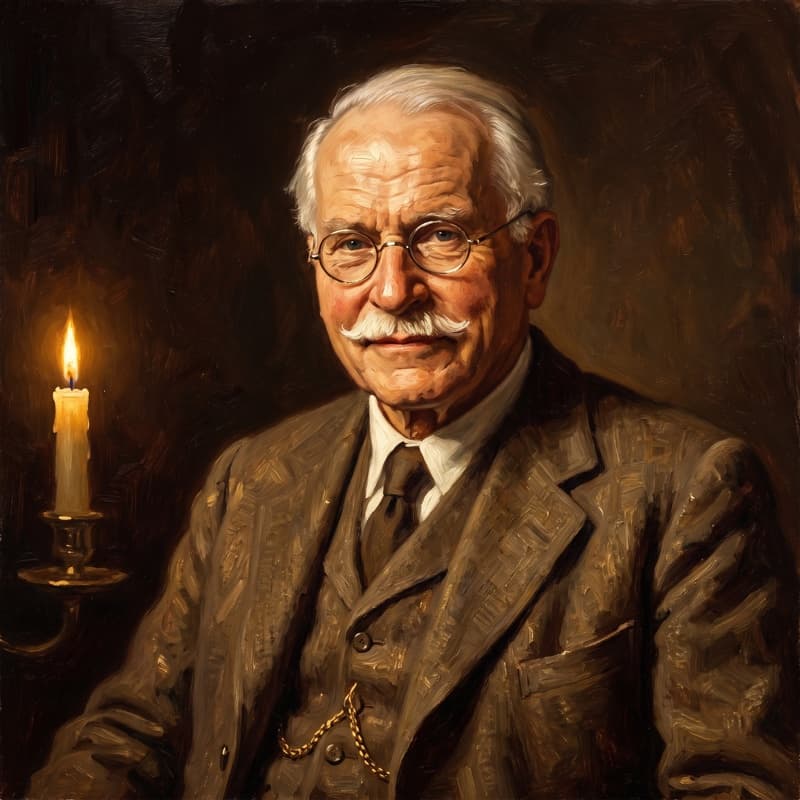
The load-bearing facts first: Carl Gustav Jung was born July 26, 1875, in Kesswil, Switzerland, and died June 6, 1961, in Küsnacht — eighty-five years, nearly all of them spent thinking about the mind. He began medical studies at Basel in 1895, took his doctorate in 1902, and worked under Eugen Bleuler at Zurich's Burghölzli psychiatric hospital from December 1900. He married Emma Rauschenbach in 1903; they had five children. He collaborated closely with Sigmund Freud from their first meeting in Vienna in 1907 until the break that followed their final in-person meeting at the September 1913 Munich congress. What came after — Psychological Types (1921), the tower at Bollingen, the institute founded in his name in 1948 — is the part most quote lists skip.
Training and the early psychiatric years
Jung entered the University of Basel's medical program in 1895 and completed his doctorate there in 1902 (German Wikipedia; C. G. Jung Institute of San Francisco). Before finishing, he had already begun working at Burghölzli in December 1900, the hospital post that produced his early word-association research and put him in Bleuler's orbit (Wikipedia). He left staff work at Burghölzli in 1909 to open a private practice at his home in Küsnacht, on Lake Zurich (Wikipedia).
The Freud years, precisely dated
Jung and Freud met in person for the first time in Vienna on March 3, 1907, and became close collaborators for several years — Freud reportedly saw him as an eventual successor. The collaboration ended after their last in-person meeting, at the psychoanalytic congress in Munich in September 1913 (Wikipedia). Seven years, not a lifetime — a useful correction for anyone who assumes Jung was simply "Freud's student."
What he published, and when
Psychological Types, Jung's account of introversion, extraversion, and the psychological functions, appeared in 1921 (C. G. Jung Institute of San Francisco). Modern Man in Search of a Soul, a collection of his lectures, followed in 1933 (Internet Archive). Aion: Researches into the Phenomenology of the Self — Collected Works volume 9ii — came out in 1951 (Internet Archive), and his essay on Flying Saucers followed in 1959, later folded into Collected Works volume 10 (Internet Archive). Two of his best-known books never had his direct hand on the final manuscript: Memories, Dreams, Reflections, recorded and edited by Aniela Jaffé, was published in 1962, after his death (Internet Archive); The Red Book, his private illustrated manuscript, stayed unpublished for another forty-seven years, reaching print only in 2009 (Wikipedia).
Bollingen and the institute
In 1922 Jung bought land at Bollingen, on the upper shore of Lake Zurich, and began building a stone tower there by hand, adding to it for decades (Wikipedia). Institutionally, the school he founded — analytical psychology, built on the collective unconscious, archetypes, and individuation (C. G. Jung Institute of San Francisco) — was formalized on April 24, 1948, when the C. G. Jung Institute Zurich was co-founded as a nonprofit training and research foundation (German Wikipedia).
The "fact" that isn't: fake Jung quotes
Jung's real Aion §126 sentence says an inner situation left unconscious "happens outside, as fate" — a translated technical line, not the aphorism "Until you make the unconscious conscious, it will direct your life and you will call it fate" that circulates under his name (Internet Archive). It's one of several widely shared "Jung quotes" with no traceable source in his Collected Works, Letters, or Memories, Dreams, Reflections; the full list, with the real lines alongside the fakes, lives on our quotes page.
More in this cluster: Jung hub · his death · verified quotes · biography.