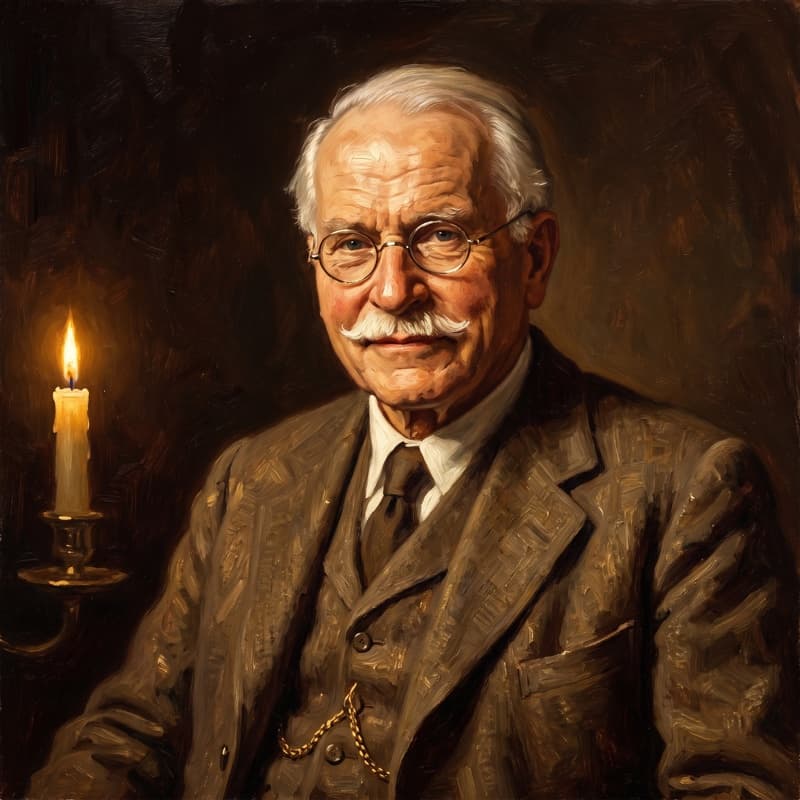
Carl Gustav Jung was born on July 26, 1875, in Kesswil, on the Swiss shore of Lake Constance, the son of a Reformed pastor. He died on June 6, 1961, in Küsnacht, having spent the intervening eighty-five years founding an entire school of psychology and, in his spare hours, building a stone tower on the lake with his own hands. Nothing about the parsonage childhood predicted either.
The frontier of the mind
Jung began medical studies at the University of Basel in 1895. In December 1900 he took a post at the Burghölzli psychiatric hospital in Zurich under Eugen Bleuler, one of the era's most serious clinical minds, and completed his medical doctorate in 1902. The word-association experiments he ran there — timing how patients stumbled over certain words, reading the hesitation as a window onto material the patient could not or would not say directly — were what first made his name outside Switzerland. In 1903 he married Emma Rauschenbach; they would have five children together.
The Freud years, and the break
Jung met Sigmund Freud in person in Vienna on March 3, 1907, and for several years was treated as the movement's most promising heir — the two corresponded constantly, toured the United States together, and built the young science of psychoanalysis in tandem. Jung left his staff position at Burghölzli in 1909 to build a private practice in Küsnacht. The partnership did not survive its own theoretical disagreements: Freud and Jung met for the last time at the September 1913 Munich psychoanalytic congress, and the collaboration that had defined Jung's first decade in the field ended there.
The descent, and a school of his own
What followed was not public. In the years after the break, Jung entered what he later called a confrontation with the unconscious — a sustained, private practice of recording his own dreams, visions, and active imaginings, illustrated by hand in the manuscript that would eventually become known as The Red Book. He kept it to himself for the rest of his life. What he built out of it in public was the vocabulary of analytical psychology: the collective unconscious, archetypes, and psychological types, the last of these arriving as a full published theory in 1921's Psychological Types — the book that gave modern psychology the terms introvert and extravert. Jung would later write, of the descent itself, that "one does not become enlightened by imagining figures of light, but by making the darkness conscious."
Bollingen and the mature decades
In 1922 Jung bought land at Bollingen on the upper shore of Lake Zurich and began building a stone tower there, a project he kept extending by hand over the following decades as his own thinking changed. It became the counterweight to Zurich: consulting rooms and lectures on one side of the lake, stonework and solitude on the other. His practice and writing continued through the 1930s and into the alchemical studies of his later career, and on April 24, 1948, the C. G. Jung Institute was founded in Zurich to carry the work of training and research forward under his own name, thirteen years before his death.
From a conversation with our Jung persona
An excerpt from a conversation with our AI Jung persona — a stylized recreation, honestly labeled; not a historical quotation.
Caller: I keep having the same dream, and I don't know what it means.
Jung: Then let us not rush to mean anything yet. Tell me the dream again, slowly, and tell me what in it frightens you, and what in it you did not want to wake from. A dream repeated is not a message waiting to be decoded so much as a visitor knocking a second time because the house did not answer. We cannot live the afternoon of life according to the programme of life's morning — so before we ask what the dream wants of you, let us ask what hour of your life it is knocking on.
Late life and an unfinished record
Jung kept seeing patients and reading deep into alchemical texts well into his eighties. Near the end of his life he dictated his memories to his collaborator Aniela Jaffé, work that became Memories, Dreams, Reflections — published in 1962, the year after he died, not before. The Red Book, the private manuscript at the center of his own self-analysis decades earlier, stayed unpublished far longer still: it did not appear publicly until 2009, forty-eight years after his death. Jung died at his home in Küsnacht on June 6, 1961. His two most personally revealing books were both handed to the world only once he could no longer speak for them himself.
Continue the conversation — literally
You have just read the recorded life. Our Jung — an AI recreation, built on the sourced record and labeled as what it is — speaks from inside it. Ask him about the dream that will not let you go, or about the parts of yourself you keep meeting in other people. Ask what broke between him and Freud, or why he spent his afternoons stacking stone at Bollingen. He answers the way the record says he thought: slowly, in images, circling a question until it opens.
More in this cluster: Jung hub · his death · verified quotes · facts.