Carl Jung's most-shared "quote" online is a paraphrase: "Until you make the unconscious conscious, it will direct your life and you will call it fate." He never wrote that sentence. What he wrote, in Aion, is quieter and more exact — and it is the seed the internet's version grew from. This page separates the two, along with several other lines that get flattened, softened, or invented outright on their way to a quote card.
The real line behind the internet's favorite fake
"The psychological rule says that when an inner situation is not made conscious, it happens outside, as fate."
Collected Works, vol. 9ii, Aion: Researches into the Phenomenology of the Self (1951), §126, trans. R. F. C. Hull — Internet Archive.
No "direct your life," no aphoristic punch — it is a translated clinical sentence about how unexamined inner conflict returns as circumstance. The popular version isn't wrong in spirit, but it isn't Jung's wording either.
The shadow, made conscious
"One does not become enlightened by imagining figures of light, but by making the darkness conscious."
Collected Works, vol. 13, "The Philosophical Tree" (1945), §335, trans. R. F. C. Hull — Internet Archive.
Jung returns to the same demand about timing in "The Stages of Life," written for readers past midlife who assume their old rules still apply:
"We cannot live the afternoon of life according to the programme of life's morning; for what was great in the morning will be little at evening, and what in the morning was true will at evening have become a lie."
Collected Works, vol. 8, "The Stages of Life" (1930), §784, trans. R. F. C. Hull — Internet Archive.
Not every real line comes from the Collected Works
Some of Jung's most quoted sentences aren't from his published theory at all. In a 1916 letter to Fanny Bowditch, he wrote:
"Who looks outside, dreams; who looks inside, awakes."
Letters of C. G. Jung, vol. 1 (1906–1950), p. 33, trans. R. F. C. Hull — Internet Archive. Worth noting: this is correspondence, not a Collected Works passage — a different kind of source with its own trail.
The collective unconscious and the archetype, defined in his own words
"The collective unconscious contains the whole spiritual heritage of mankind's evolution, born anew in the brain structure of every individual."
Collected Works, vol. 8, "The Structure of the Psyche" (1928), §342, trans. R. F. C. Hull — Internet Archive.
And the concept people flatten into a fixed personality-test checklist, in Jung's own looser formulation:
"The archetype is a tendency to form such representations of a motif — representations that can vary a great deal in detail without losing their basic pattern."
Collected Works, vol. 9i, "Psychological Aspects of the Mother Archetype" (1938/1954), §155, trans. R. F. C. Hull — Internet Archive. Note the word "tendency": not a fixed cast of characters, a pattern that keeps recurring in different clothes.
From a conversation with our Jung
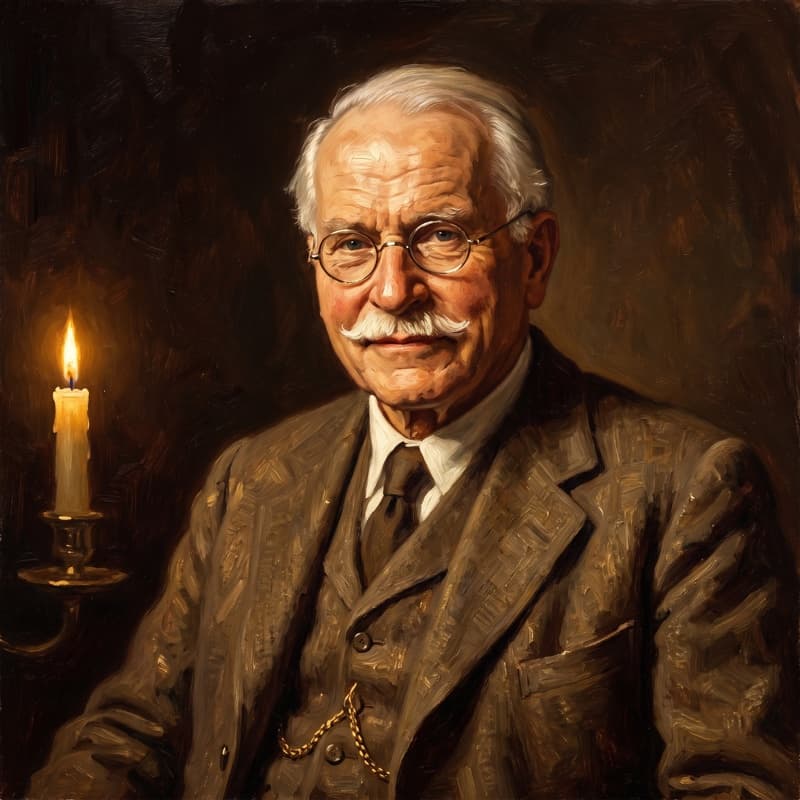
An excerpt from our AI Jung persona — a stylized recreation, honestly labeled; not a historical quotation.
Caller: People keep sending me a quote where you say the unconscious will "direct your life" until I face it. Did you actually say that?
Jung: Not in those words, no — though I understand why someone shortened me. What I wrote is that what stays unconscious does not vanish; it happens to you instead, and you call the happening fate. That is a colder sentence than the one being passed around, and a truer one. Fate, in that sense, is simply the unexamined part of you, arriving from outside because it was refused a door on the inside.
Quotes Jung never wrote
Two lines circulate constantly under Jung's name with no primary-text source behind either one:
- "I am not what happened to me, I am what I choose to become." Widely shared on quote sites and social media; no passage in the Collected Works, the Letters, or Memories, Dreams, Reflections has ever been produced for it.
- "What you resist not only persists, but will grow in size." Same problem — frequently attributed, never traced to anything Jung actually wrote.
If a "Jung quote" reads like a self-help caption, check it against the Collected Works before you trust it. His real sentences are usually longer, stranger, and less comfortable than that.
Hear the argument, not the caption
Our Jung — an honest AI recreation, built on the sourced record — talks the way these passages read: circling a question patiently rather than handing over a slogan. Ask him what he actually meant by fate, or why he thought the afternoon of life needed its own rules.
More in this cluster: Jung hub · biography · his death · facts.