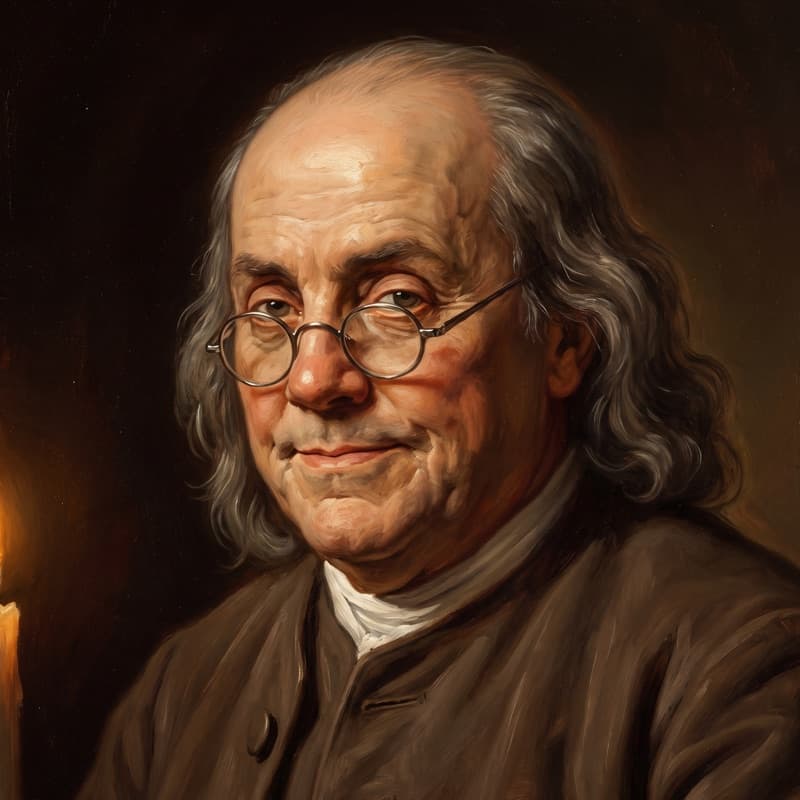
Benjamin Franklin died in Philadelphia on April 17, 1790, at age 84, from complications of pleurisy — an inflammation of the lining around the lungs (The Franklin Institute). He had been born in Boston on January 17, 1706 (National Archives), and by the time illness confined him to his bed on Market Street, he had outlasted nearly every man he'd signed the Declaration and the Constitution beside. No shooting, no accident, no dramatic scene — just an old printer's lungs finally giving out, in a house full of grandchildren. That's the whole answer. The life around it is worth five minutes.
The last thing he sent to Congress
Franklin's final public act wasn't a speech or a treaty. As president of the Pennsylvania Society for Promoting the Abolition of Slavery, he signed a petition on February 3, 1790 — about ten weeks before his death — and sent it to the newly seated Congress, asking it to "devise means for removing the Inconsistency from the Character of the American People" (National Archives). It's easy to let "Founding Father dies" flatten the record. Franklin spent his last strength arguing that the country he'd just helped build wasn't finished with its own contradictions — a position he came to late, and said so.
Not the kite
People often reach for the kite when they picture Franklin brushing against death, but that story belongs to 1752, not 1790, and it's frequently told wrong besides. The kite he flew with his son William in a Philadelphia thunderstorm was never struck directly — it collected ambient electrical charge, carried down the wet string to a house key and into a Leyden jar for study; a direct hit would very likely have killed him on the spot (The Franklin Institute). By 1750 he'd already worked out the practical version of that idea: a grounded iron rod meant to draw a charge out of a cloud silently, before it could strike a building at all (The Franklin Institute). His actual death, four decades later, was ordinary illness — no lightning involved.
The oldest man in every room
By his final years, Franklin had become, quite literally, the elder of the founding generation. At the 1787 Constitutional Convention he was 81 — the oldest delegate present, by a wide margin — and too frail to walk to sessions, so he was carried there in a sedan chair (National Archives). He'd already served on the committee that drafted the Declaration of Independence (National Archives) and spent roughly nine years in France securing the alliance that helped win the war (The Papers of Benjamin Franklin, Yale University), then came home and kept working, right to the petition. In his Autobiography he called his own early wrongs "errata," misprints in a life he was still trying to correct (Autobiography of Benjamin Franklin). He kept correcting proofs almost to the end.
From a conversation with our Franklin
An excerpt from a conversation with our AI Franklin persona — a stylized recreation, clearly labeled, not a historical recording. Our Franklin's knowledge ends in his sickroom in April of 1790; he doesn't know how his own story ends.
Caller: You've outlived nearly everyone you started this country with. Does that weigh on you?
Franklin: Weigh on me? No, friend — it instructs me. A man who buries enough friends learns which arguments were worth having. I sent Congress a petition on the slave trade a few weeks back, and one or two colleagues wished I'd left an old man's business to a younger fellow. But usefulness doesn't retire when the body does. I've always meant to be printed in a second edition — corrected, amended, the errata struck out. Whether Providence grants me the reprint is none of my affair. I only had to get the proofs right before I sent them to press.
Ask him about the parts he did see
Franklin's actual death sits past the edge of what our AI Franklin knows; his memory ends abed on Market Street, the Constitution ratified, Washington newly in office. But everything that got him there, he'll discuss happily: the kite and the key, nine years talking France into an alliance, the thirteen virtues he tracked and mostly failed, and the late, hard-won turn against slavery he wishes he'd made decades sooner. Ask him what he'd still change. He's got opinions, and time.
More in this cluster: Franklin hub · verified quotes · biography · facts.