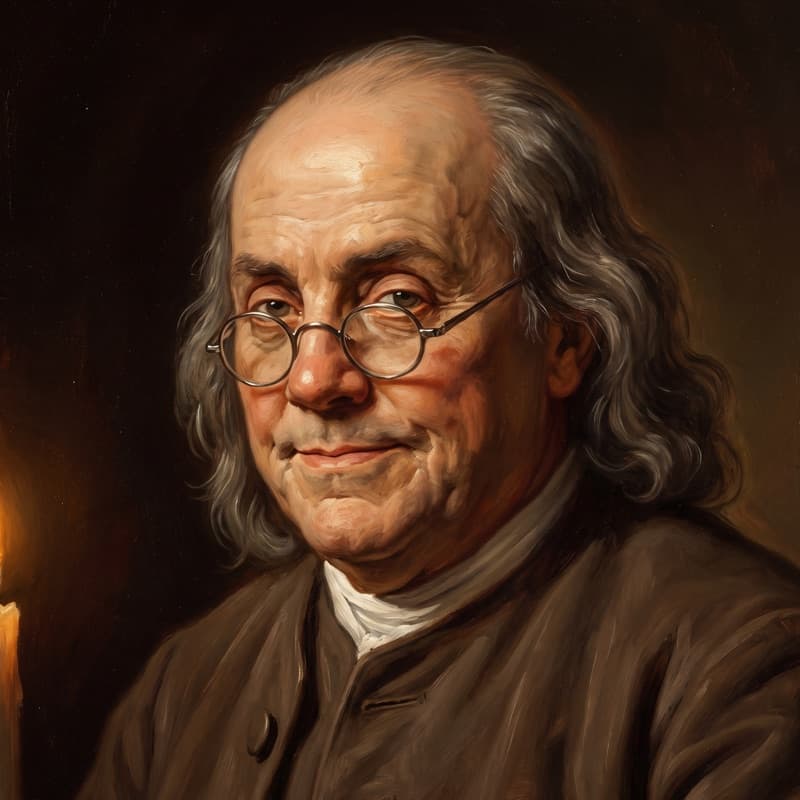
The essential Benjamin Franklin facts: born in Boston on January 17, 1706, died in Philadelphia on April 17, 1790, at 84; a printer who retired from the trade in 1747 at 42; publisher of Poor Richard's Almanack under the pen name Richard Saunders, 1732–1758; credited with the lightning rod, bifocals, the Franklin stove, and the glass armonica, none of which he patented; a Declaration drafting-committee member who later spent roughly nine years in France as an American diplomat; and never president of the United States. All verified — and this page also flags the popular "facts" that don't survive checking.
The core facts, with why they matter
Born January 17, 1706, in Boston; died April 17, 1790, in Philadelphia, at 84. Long enough to run a printing business, found civic institutions, help win a revolution, and sign the Constitution.
Apprenticed to his brother James, a Boston printer, 1718–1723; ran off to Philadelphia; co-founded his own printing office with Hugh Meredith in 1728; retired from the trade in 1747 at about 42, still drawing shop profits. No college — just a print shop and an early exit funding the rest of his life.
Published Poor Richard's Almanack annually from 1732 to 1758 under the pseudonym Richard Saunders. The almanac is where most of the real "Franklin quotes" come from — and where fake ones get wrongly credited too (more below).
Founded the Library Company of Philadelphia in 1731 — the first successful subscription lending library in the colonies. Franklin and fellow Junto members pooled money to buy books none could afford alone.
Credited with the lightning rod, bifocals, the Franklin stove, and the glass armonica — and never patented any of them, believing useful inventions should be shared freely.
In June 1752 he flew a kite in a Philadelphia thunderstorm to show that lightning is electrical — but the kite itself was never struck. It collected ambient charge from the storm, carried through a wet string and house key to a Leyden jar; a direct strike would likely have killed him. He'd already worked out the lightning rod by 1750: an iron rod 8 to 10 feet long, sharpened to a point, meant to draw a charge out of a cloud before it could strike a building.
Served on the five-person committee that drafted the Declaration of Independence in 1776 (Jefferson did the writing; Franklin and John Adams reviewed it), then spent roughly nine years in France securing the assistance — including the 1778 Treaty of Alliance — that helped the Revolution succeed.
At the 1787 Constitutional Convention, 81-year-old Franklin was the oldest delegate present, carried to sessions in a sedan chair. He's also the only person to sign all three founding instruments: the Declaration, the Treaty of Paris, and the Constitution.
From 1787 he was president of the Pennsylvania Society for Promoting the Abolition of Slavery; one of his last public acts, on February 3, 1790, was signing a petition asking Congress to act against slavery and the slave trade. A late-life position, not a lifelong one.
Popular "facts" that need correcting
"Franklin was a U.S. president." He wasn't — he served as president of Pennsylvania's Supreme Executive Council, a state office, never the presidency.
"Beer is proof that God loves us and wants us to be happy." Not his line — his real remark, from a letter around 1779, is about wine and vineyards, not beer.
"A penny saved is a penny earned." His actual 1737 wording was "A penny saved is two pence clear" — close, but not the same maxim.
"Tell me and I forget. Teach me and I remember. Involve me and I learn." No evidence Franklin said this; variants trace to Confucian philosopher Xun Kuang, centuries earlier.
The fact pages can't hold him
Facts are the skeleton; the voice is the man. Our Franklin — an AI recreation, built from the sourced record and labeled as what it is — can walk you through the print shop years, the kite-and-key afternoon, and the late-life reckoning with slavery. He's ready when you are.
More in this cluster: Franklin hub · his death · verified quotes · biography.