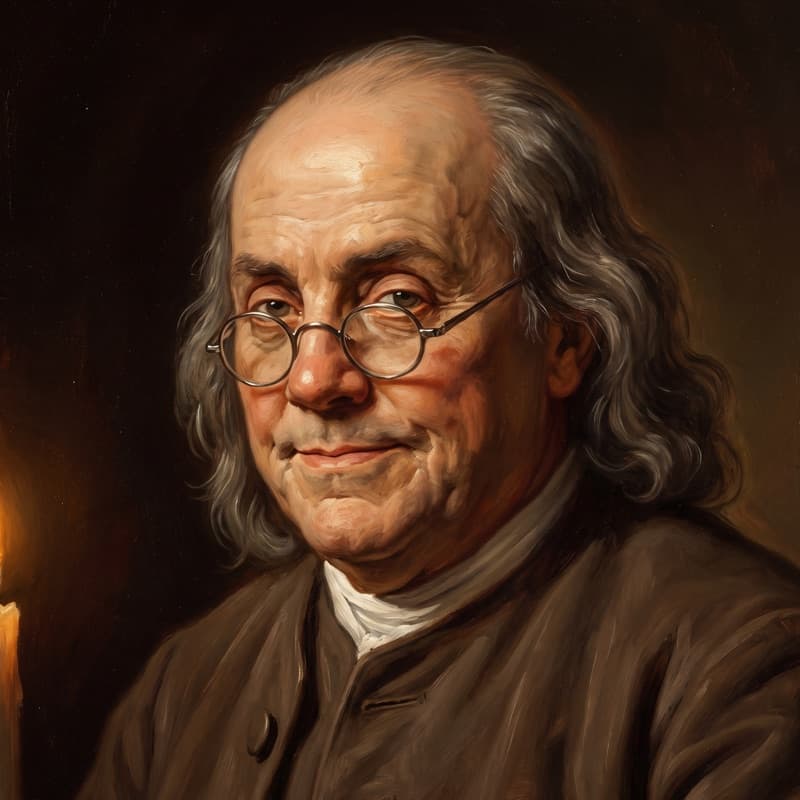
Benjamin Franklin was born in Boston on January 17, 1706, and died in Philadelphia on April 17, 1790, at 84 — a printer's apprentice who became a publisher, civic organizer, internationally famous scientist, and the only person to sign the Declaration of Independence, the Treaty of Paris, and the Constitution. No single title covers him; he kept adding jobs to his own life the way other men add rooms to a house.
The runaway apprentice
At twelve, Franklin was bound as an apprentice to his older brother James, a Boston printer, under an arrangement meant to run until he turned twenty-one. It didn't. By 1723, seventeen and fed up with James's temper, Franklin broke the indenture and left Boston for Philadelphia with almost nothing, finding work fast in the print trade he already knew.
A printer who kept founding things
By 1728, Franklin had his own Philadelphia printing office, in partnership with Hugh Meredith. Four years later, under the pen name Richard Saunders, he began publishing Poor Richard's Almanack, running annually from 1732 to 1758 and making his quotable style — "early to bed, and early to rise, makes a man healthy, wealthy, and wise," as Poor Richard put it — a staple of colonial life. But Franklin's real talent was institutions, not just aphorisms. In 1731 he organized the Library Company of Philadelphia, the colonies' first successful subscription library, growing out of the Junto discussion club he'd started earlier. He retired from active printing in 1747, at about forty-two, still drawing shop income while turning to science and public life.
Lightning, and the uses of usefulness
Franklin had conceived the lightning rod by 1750, reasoning that a grounded metal point could draw a charge from a cloud silently, before it could strike a building. In June 1752 he tested his theory of atmospheric electricity by flying a kite in a Philadelphia thunderstorm — the kite gathered ambient charge rather than taking a direct strike, which would likely have killed him. It made him internationally famous, and true to form, he never patented the rod or any invention, arguing they should be shared freely.
From a conversation with our Franklin
An excerpt from a conversation with our AI Franklin persona — a stylized recreation, honestly labeled; not a historical quotation.
Caller: Weren't you afraid, flying a kite in a storm?
Franklin: Afraid enough to be careful, which is a different animal from afraid enough to quit. Curiosity is a fine engine, friend, but it wants a governor on it, same as any other — else it runs you straight into the ground.
Statesman, in the second half of a long life
The Revolution pulled Franklin, by then in his seventies, into a second career. He served on the committee that drafted the Declaration of Independence in 1776, then spent roughly nine years in France securing the support — including the 1778 alliance — that helped the war succeed. At the 1787 Constitutional Convention he was eighty-one, the oldest delegate present, sometimes carried to sessions in a sedan chair. He is the only person to have signed the Declaration, the Treaty of Paris, and the Constitution.
His last public act argued against his century's great injustice: as president of the Pennsylvania Society for Promoting the Abolition of Slavery, he signed and sent Congress a petition on February 3, 1790, asking it to act against slavery and the slave trade. Ten weeks later, on April 17, 1790, he died in Philadelphia of complications from pleurisy — a life that ran from a runaway's escape to a founding generation's last, unfinished argument.
Continue the conversation — literally
You have just read the recorded life. Our Franklin — an AI recreation, built on the sourced record and labeled as what it is — speaks from inside it. Ask him about breaking his apprenticeship and arriving in Philadelphia broke. Ask what the kite actually proved, and what it didn't. Ask about the Library Company, the Junto, or why he refused to patent the stove bearing his name.
More in this cluster: Franklin hub · his death · verified quotes · facts.