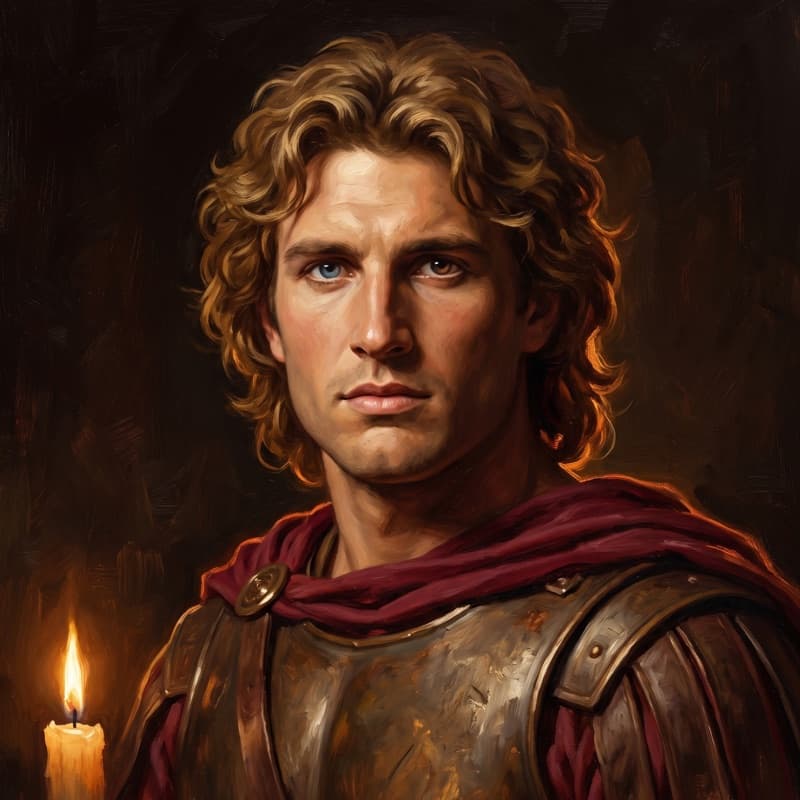
Every fact below is checked against Wikipedia, Wikidata, the World History Encyclopedia, and the ancient texts themselves at the MIT Internet Classics Archive, with each citation shown inline. Short version: born 356 BC at Pella; king of Macedon from 336 BC at about twenty; undefeated across a string of pitched battles from Greece to the Indus valley; responsible, along the way, for sieges that ended in mass killing and enslavement and for a city burned in a night of drunken feasting; dead in Babylon in 323 BC at 32, cause unresolved. Details and sources below, then two claims that circulate as settled fact but don't hold up.
Ten verified facts
- Born 20 or 21 July 356 BC at Pella, the Macedonian capital, son of Philip II and Olympias (Wikipedia).
- At thirteen he was tutored by Aristotle, whom Philip installed at the Temple of the Nymphs at Mieza as a private classroom (Wikipedia).
- He became king at about twenty, on 25 October 336 BC, after Philip II was assassinated by Pausanias (Wikipedia; World History Encyclopedia).
- He never lost a pitched battle. Granicus (May 334 BC) opened the Asian campaign; Issus (333 BC) and Gaugamela (1 October 331 BC) broke Darius III's larger Persian armies; Hydaspes (May 326 BC) defeated King Porus in present-day Punjab (World History Encyclopedia).
- Tyre's fall in 332 BC was not a clean victory. After a seven-month siege and a causeway built across open water to reach the island city, "the inhabitants of the city were slaughtered and the survivors sold into slavery" — the human cost belongs in the record alongside the engineering feat (World History Encyclopedia).
- He founded more than twenty cities, most prominently Alexandria in Egypt in 331 BC (Wikipedia).
- Persepolis burned in May 330 BC, after a drunken victory feast at which a woman named Thais reportedly urged setting the Persian palace complex alight (World History Encyclopedia).
- He married three times: Roxana from around 328 BC, then Stateira and Parysatis II both in 324 BC at the mass wedding at Susa meant to fuse Macedonian and Persian elites; all three marriages ended with his death in 323 BC (Wikidata).
- His closest companion, Hephaestion, died of a fever in October 324 BC at Ecbatana. Alexander "spent the next two days in tears," cut his own hair and had horses' manes trimmed in mourning, and had Hephaestion's physician impaled (World History Encyclopedia).
- He died at Babylon on 10 or 11 June 323 BC, aged 32, after roughly ten days of fever; whether illness or poisoning killed him is still medically and historically unresolved, and his empire fragmented among his generals afterward (World History Encyclopedia; Wikidata).
Two claims, corrected
"Alexander cut the Gordian Knot with one stroke of his sword." That is one ancient version, not a settled fact. Plutarch records it as the story "most authors tell," then preserves an alternative from Aristobulus in which Alexander simply pulled the pin from the pole and loosened the yoke by hand. The sources disagree; a fact page shouldn't pretend they don't (Plutarch, Life of Alexander, MIT Internet Classics Archive).
"I am indebted to my father for living, but to my teacher for living well." This popular line does not appear in Plutarch's Life of Alexander in that wording. What Plutarch does record, in his account of the Aristotle years, is close but distinct: that Alexander "loved and cherished Aristotle no less... than if he had been his father, giving this reason for it, that as he had received life from the one, so the other had taught him to live well" (Plutarch, Life of Alexander, MIT Internet Classics Archive). The internet's tidy aphorism is very likely a modern compression of that longer original — worth knowing which one you're actually quoting.
Frequently asked, quickly answered
Was Alexander the Great undefeated in battle? Yes, by the conventional count of his major pitched battles — Granicus, Issus, Gaugamela, and Hydaspes among them — though "undefeated" says nothing about what those campaigns cost the people on the other side (World History Encyclopedia).
Who succeeded Alexander the Great? No one, cleanly. He left no settled heir, and his empire was carved up by his generals, the Diadochi, in the wars that followed (World History Encyclopedia).
Related pages
Alexander the Great hub · his death · verified quotes · biography.
For what a fact list can't hold — what conquest actually looked like from inside a besieged city, how a tutor's ideas sat next to a king's ambitions, why "greatest general" is an incomplete verdict — this site hosts a conversational AI recreation of Alexander, grounded in the sources cited above and labeled plainly as an AI persona.