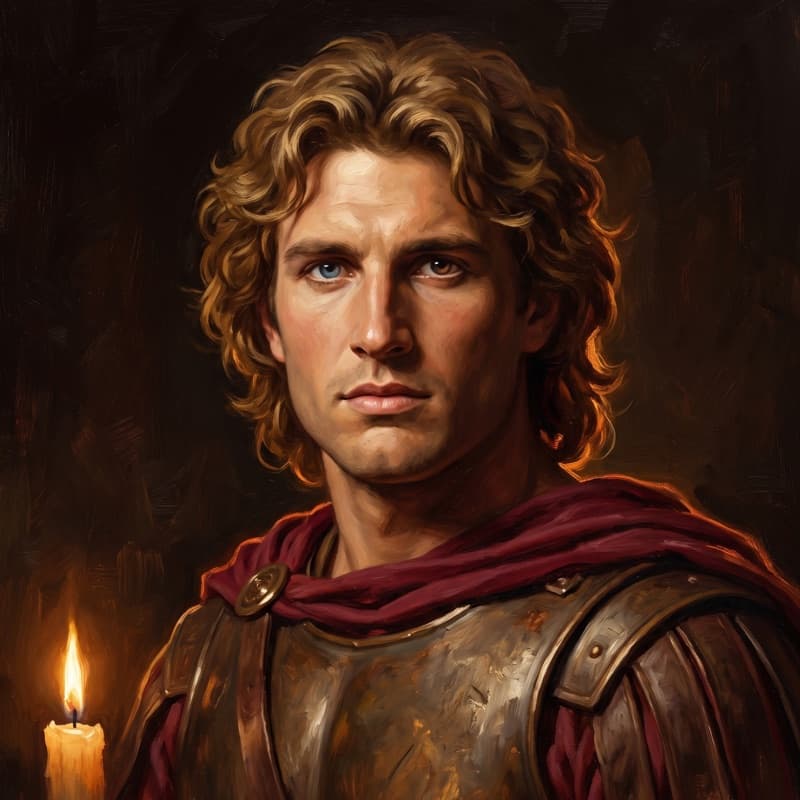
Alexander III of Macedon was born on 20 or 21 July 356 BC in Pella, and died in Babylon on 10 or 11 June 323 BC, not yet thirty-three. In between lies eleven years of campaigning that carried a Macedonian army from the Greek mainland to the Indus valley — and, at nearly every stop along that route, cities burned, populations enslaved, and kingdoms erased to make room for his. This is a biography of conquest, told as conquest, not as a redemption story.
A king's son, a philosopher's pupil
Alexander was the son of King Philip II and Queen Olympias, and grew up inside a court that already prized his claimed descent from Achilles and Heracles. At thirteen, Philip brought in Aristotle to tutor him at the Temple of the Nymphs at Mieza — an education in logic, ethics, and Homer that stayed with Alexander for the rest of his life. Plutarch later wrote that Alexander loved and cherished Aristotle "no less... than if he had been his father," explaining that "as he had received life from the one, so the other had taught him to live well." Around the same age, Alexander tamed the horse Bucephalus, which no one else in Philip's court could ride — a boyhood set-piece that ancient biographers treated as an early sign of the man he would become.
Accession and the price of order
Philip II was assassinated in 336 BC, and Alexander became king of Macedon at about twenty. He moved fast to secure his throne, and when Thebes revolted against Macedonian authority the following year, he destroyed the city almost entirely — a deliberate act of terror meant to keep the rest of Greece in line. It worked. With Greece subdued, he crossed into Asia Minor in 334 BC and won his first major battle against Persian forces at the Granicus.
Into the Persian Empire
The campaign that followed reads as an unbroken string of victories, and it was also a trail of destroyed cities. At Gordium, Alexander confronted the legendary Gordian Knot; ancient sources disagree on whether he cut it with his sword or worked the pin loose, and the neat "sword-stroke" version is a later simplification, not settled fact. In 333 BC he defeated Darius III at Issus despite being badly outnumbered. Tyre resisted him through a seven-month siege in 332 BC, and when the city finally fell, his forces killed many of its inhabitants and sold the survivors into slavery — a cost the "military genius" framing routinely leaves out. From there he moved into Egypt, where he founded Alexandria in 331 BC, the most enduring of more than twenty cities that would eventually carry his name.
From a conversation with our Alexander
An excerpt from a conversation with our AI Alexander persona — a stylized recreation, honestly labeled; not a historical quotation.
Caller: Did Tyre have to end the way it did?
Alexander: A city that shuts its gates against a king is telling him something, and I answered in the only language a siege leaves open. I will not pretend the harbor did not run the way it ran, or that the chains were gentle. Ask me if I would do it again and you will not like a soldier's honest answer. I built theaters and libraries in the same decade. Both things are true of me, and I would rather you hold both than the easier one.
King of Asia
At Gaugamela on 1 October 331 BC, Alexander broke Darius's main army for good and was proclaimed King of Asia; Babylon and Susa surrendered without a fight. The following spring, after a night of heavy drinking at Persepolis, Alexander's group set fire to the Persian royal palace, destroying centuries of Achaemenid art and record-keeping. Before Gaugamela, when his general Parmenion urged a night attack to exploit Persian disarray, Alexander is said to have refused with a line Plutarch records as, "I will not steal a victory" — choosing the risk of an open daylight battle over an ambush.
To the edge of empire and back
The campaign pushed on through Bactria and Sogdiana, where Alexander married Roxana around 328 BC. In May 326 BC he defeated King Porus at the Battle of the Hydaspes in present-day Punjab; Bucephalus died during or shortly after that campaign, and Alexander founded the city Bucephala in the horse's honor. Later that year, at the Hyphasis River, his exhausted army refused to march any farther into India, and he was forced to turn the expedition back.
Grief at Ecbatana, death at Babylon
In 324 BC, at a mass wedding in Susa meant to fuse Macedonian and Persian elites, Alexander took two more wives, Stateira and Parysatis II. Months later, his closest companion Hephaestion died of a fever at Ecbatana after a night of heavy drinking. Alexander's grief was extravagant and severe: he mourned for days, cut his hair, ordered the manes and tails of army horses trimmed, and had Hephaestion's physician impaled. He died in Babylon less than a year later, after roughly ten days of fever, at thirty-two. Whether illness or poisoning killed him remains genuinely unresolved. He left no settled heir, and his empire broke apart among his generals within a few years — an ending that sits uneasily against any telling of his life as pure triumph.
Continue the conversation — literally
You have just read the recorded life. Our Alexander — an AI recreation, built on the sourced record and labeled as what it is — speaks from inside it. Ask him about Aristotle's classroom at Mieza, or why he refused to attack Darius's camp by night. Ask what Tyre or Persepolis looked like from where he stood. Ask about Hephaestion, or about the army that finally said no at the Hyphasis. He answers in character, from the ancient record, not as a modern narrator softening it.
More in this cluster: Alexander the Great hub · his death · verified quotes · facts.