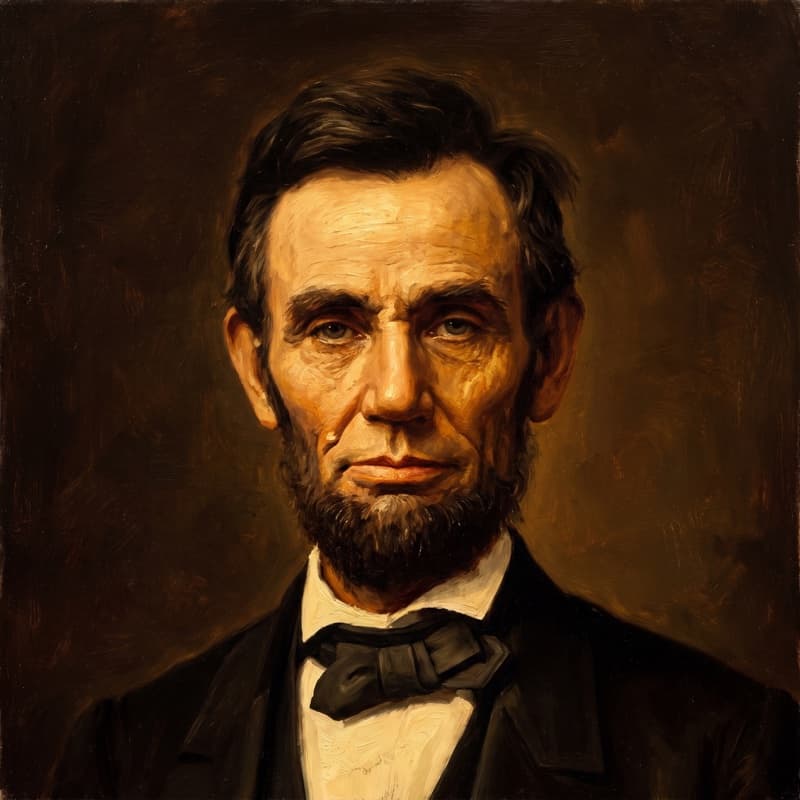
The essential Abraham Lincoln facts: he was the 16th president of the United States (March 4, 1861 – April 15, 1865); he was born February 12, 1809, in a one-room Kentucky log cabin; he was a Republican (the first Republican president), never a Democrat; he and Mary Todd had four sons; he issued the Emancipation Proclamation, delivered the Gettysburg Address, and pushed the Thirteenth Amendment through Congress; and he was assassinated by John Wilkes Booth at Ford's Theatre. All verified. This page gives you the facts worth keeping — and flags the popular "facts" that don't survive checking, because a facts page that can't tell you what's false is only doing half the job.
The core facts, with why they matter
Born February 12, 1809, in a one-room log cabin on Sinking Spring Farm, Kentucky. The cabin matters not as folklore but as a baseline: the distance between that room and the presidency is the whole argument for the self-made version of American life Lincoln came to embody.
He was a Whig, then the first Republican president. He served one term in the U.S. House from Illinois as a Whig (30th Congress, 1847–1849) before reaching the White House as a Republican. If you came here asking "was Lincoln a Republican or a Democrat?" — Republican, definitively; the National Archives lists him as Abraham Lincoln [R] in the 1860 results.
He married Mary Todd on November 4, 1842, and they had four sons. Robert Todd, Edward Baker, William Wallace, and Thomas "Tad." Only Robert lived past young adulthood — a private ledger of grief running under the public life.
He won two presidential elections. 1860, with 180 electoral votes; and 1864, defeating George B. McClellan with 212 — a free election held in the middle of a civil war, a fact worth pausing on.
The Emancipation Proclamation took effect January 1, 1863. It declared enslaved people in rebelling Confederate areas free and opened Union military service to Black men. It did not end slavery everywhere — that took the Thirteenth Amendment, which Congress passed on January 31, 1865, at Lincoln's urging.
He delivered the Gettysburg Address on November 19, 1863. Roughly 272 words at the dedication of the national cemetery at Gettysburg, including the resolve "that the nation, shall have a new birth of freedom."
He was assassinated at the end of the war. John Wilkes Booth — a famous actor and Confederate sympathizer — shot him at Ford's Theatre on April 14, 1865, during the comedy Our American Cousin; Lincoln died at the Petersen House across the street at 7:22 a.m. on April 15.
From a conversation with our Lincoln
An excerpt from our AI Lincoln persona — a stylized recreation, honestly labeled; not a historical quotation.
Caller: What's one thing about you that people get wrong?
Lincoln: That I was born wise, mostly. Folks look at the finished house and forget the years of green lumber. What schooling I had wouldn't fill a season; the rest I begged, borrowed, and read by firelight, and I was wrong as often as any man while I learned it. If there is a fact about me worth keeping, let it be that one — not because it flatters me, but because it is the only fact of mine a body can use.
Popular "facts" that need correcting
"Lincoln was buried 17 times." Shorthand, not fact. The number tallies coffin moves, inspections, hidden storage after an 1876 attempt to steal his body, and the later rebuilding of his tomb — not 17 funerals.
"The Emancipation Proclamation freed all the slaves." It applied to areas in rebellion. Permanent, nationwide abolition came through the Thirteenth Amendment, ratified December 6, 1865.
"Lincoln was Walt Disney's favorite president." The careful version: Disney's own D23 history says Walt had long admired Lincoln, and his Lincoln figure for Great Moments with Mr. Lincoln preceded the whole Hall of Presidents concept. Documented admiration, yes; a private ranking, no.
"Lincoln said: 'You can fool all the people some of the time…'" No solid evidence he did — along with at least six other famous "Lincoln quotes." The full debunk list lives on our quotes page.
Five things Abraham Lincoln did (the honest short list)
- Won the 1860 presidential election.
- Preserved the Union through the Civil War.
- Issued the Emancipation Proclamation.
- Delivered the Gettysburg Address.
- Pressed the Thirteenth Amendment through Congress — passed January 31, 1865, abolishing slavery on ratification.
The fact pages can't hold him
Facts are the skeleton; the voice is the man. Our Lincoln — an AI recreation, built from the sourced record and labeled as what it is — can tell you about the rail-splitting, flatboats, and New Salem years before national fame, about Mary Todd and the losses inside the family, and about the moral arithmetic that led from anti-slavery politics to wartime emancipation. Ask him how a self-taught lawyer's education actually worked. He's ready when you are.
More in this cluster: Lincoln hub · his death · verified quotes · biography.