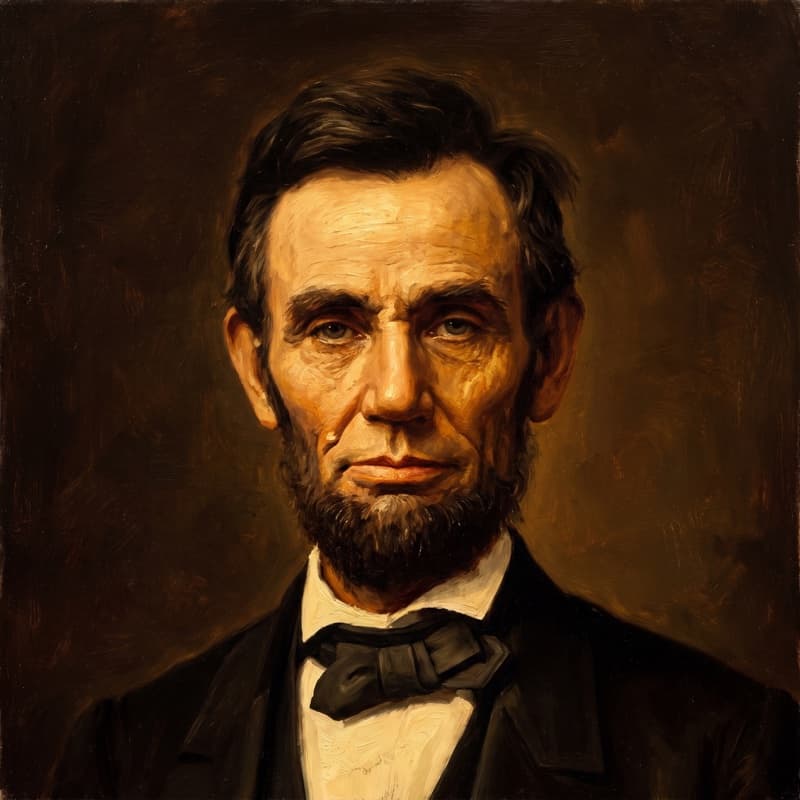
Abraham Lincoln was born on February 12, 1809, in a one-room log cabin on his father's Sinking Spring Farm in Kentucky, and died on April 15, 1865, in a boarding house across the street from Ford's Theatre — the 16th president of the United States, shot by an assassin days after winning the Civil War. Between those two rooms lies a consequential American life: frontier hardship, self-made law and politics, a presidency spent entirely at war, emancipation, and a peace he described but never governed.
The temptation with Lincoln is to tell the life backward from the marble memorial, as if greatness were the plan all along. His own verdict was blunter — "I claim not to have controlled events, but confess plainly that events have controlled me" — and taking him at his word makes the story better. This is a biography of decisions made under pressure.
The frontier years
The Kentucky cabin was not a symbol at the time; it was a house. Lincoln's early life was frontier hardship and self-making — the long, unglamorous project of a young man assembling his own education and then a legal career out of borrowed books and borrowed time. Nothing in the record of those years predicts a presidency. What they built instead was the equipment for one: a lawyer's precision, a storyteller's ear, and a settled habit of working a question until it gave up its plain answer.
Politics, in the ordinary way
Lincoln entered national politics the ordinary way and left barely a mark: one term in the U.S. House of Representatives from Illinois as a Whig, in the 30th Congress, 1847 to 1849. He married Mary Todd on November 4, 1842; they had four sons — Robert Todd, Edward Baker, William Wallace, and Thomas "Tad" — and buried too many of them; only Robert lived past young adulthood. Grief runs through this biography like a watermark.
The turn came on June 16, 1858, with the House Divided speech: "I believe this government can not endure permanently, half slave, and half free." It was a stark thing to say out loud in 1858, and it made him a national figure. Two years later the Whig-turned-Republican won the presidency with 180 electoral votes — the first Republican president.
From a conversation with our Lincoln
An excerpt from a conversation with our AI Lincoln persona — a stylized recreation, honestly labeled; not a historical quotation.
Caller: Did you always believe you'd end up where you did?
Lincoln: Land sakes, no. A man splitting rails does not look down the fence line and see the White House — he sees more fence. I aimed at the next thing I could reach: a book, a case, a seat in the legislature. I reckon the trick, if there was one, was that I kept reaching. Folks call it a rise. From inside it felt like walking uphill in the dark and being surprised, each morning, at the view.
The war presidency
Lincoln took office on March 4, 1861, and every day of his presidency was a war day. His first stated object was narrow and constitutional — as he told Horace Greeley, "My paramount object in this struggle is to save the Union, and is not either to save or to destroy slavery." But events, the ones he said controlled him, kept converging on the deeper question. On January 1, 1863, the Emancipation Proclamation took effect, declaring enslaved people in rebelling Confederate areas free and opening Union military service to Black men. On November 19, 1863, at Gettysburg, he gave the war its meaning in roughly 272 words — "a new birth of freedom."
Where his conscience stood, he wrote privately to Albert G. Hodges in 1864: "If slavery is not wrong, nothing is wrong." That November the voters, in the middle of a civil war, held a free election — and returned him over George B. McClellan with 212 electoral votes. Soon after the reelection, on January 31, 1865, Congress passed the Thirteenth Amendment, nailing abolition into the Constitution itself, beyond any court or successor. The states completed ratification that December, eight months after his death.
The unfinished chapter
On March 4, 1865, at his second inauguration, Lincoln looked past victory to reunion: "With malice toward none; with charity for all." He gave the Almighty the last word on the war's meaning — "The Almighty has His own purposes" — and the country a job description for the peace.
Six weeks later, on April 14, John Wilkes Booth, a famous actor and Confederate sympathizer, shot him at Ford's Theatre. He died at the Petersen House at 7:22 a.m. the next morning. The right way to end a Lincoln biography is not with the funeral but with the vacancy: the peace and reunion he had begun to describe fell to men who had not written the Second Inaugural. What Lincoln would have made of it is the great unanswerable of American history.
Continue the conversation — literally
You have just read the recorded life. Our Lincoln — an AI recreation, built on the sourced record and labeled as what it is — speaks from inside it. Ask him about teaching himself law and reading his way upward. Ask why frontier humor won courtrooms and elections. Ask how the House Divided speech changed his public identity, or about losing Willie and carrying grief through a war. He answers plainly, story-first, the way the record says he talked.
More in this cluster: Lincoln hub · his death · verified quotes · facts.