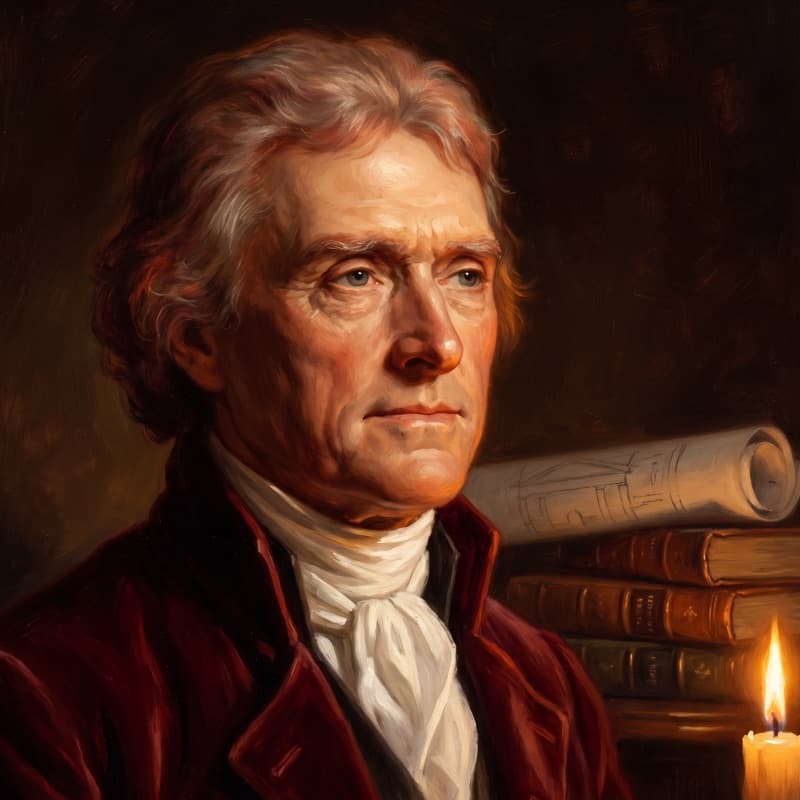
Thomas Jefferson (April 13, 1743 – July 4, 1826) was the principal author of the Declaration of Independence, the third president of the United States, the drafter of the Virginia Statute for Religious Freedom, and the founder of the University of Virginia. He was also, across that entire public career, a slaveholder: over the course of his life he held more than 600 people in slavery (Monticello, Brief Biography). Both facts are load-bearing. Any account of Jefferson that drops either one is not a biography; it is an advertisement or an indictment.
Every quotation and factual claim on this page carries a citation — to Founders Online at the National Archives for Jefferson's own words, and to the Thomas Jefferson Foundation at Monticello for the scholarship on his life. Jefferson is among the most misquoted figures in American history, and sourcing is the only antidote.
The documented life
Jefferson was born at Shadwell, Virginia, entered the College of William and Mary in 1760, and began clearing the Monticello mountaintop in 1768. As a member of the Second Continental Congress, he was the primary author of the Declaration of Independence in 1776 (Monticello). The adopted text contains the famous sentence: "We hold these truths to be self-evident, that all men are created equal, that they are endowed by their Creator with certain unalienable Rights" (Founders Online).
In 1779 he became governor of Virginia, having already drafted the bill that became the Virginia Statute for Religious Freedom — one of the three achievements he later chose for his epitaph. Its argument still cuts: "our civil rights have no dependance on our religious opinions, any more than our opinions in physics or geometry" (Founders Online). The eighteenth-century spelling — "dependance" — is Jefferson's own; we quote his documents as written.
He served as minister to France from 1784, became the first secretary of state under Washington in 1790, and took office as third president in 1801 after a contested election that ended in a peaceful transfer of party power. His First Inaugural offered the famous conciliation: "We are all republicans: we are all federalists," and a foreign policy of "peace, commerce, and honest friendship with all nations, entangling alliances with none" (Founders Online). The Louisiana Purchase of 1803 was among the central achievements of his first term.
Slavery and Sally Hemings: what the record shows
Jefferson's rough draft of the Declaration attacked the slave trade — the king "has waged cruel war against human nature itself, violating its most sacred rights of life & liberty" — before Congress removed the grievance (Founders Online). He wrote that passage while enslaving people, and he continued to do so for the rest of his life. Monticello's Liberty & Slavery scholarship documents the unresolved gap between his public ideals and his private dependence on enslaved labor (Monticello).
On Sally Hemings, the Thomas Jefferson Foundation's current historical interpretation states that Jefferson fathered at least six of her children, four of whom survived to adulthood (Monticello, The Life of Sally Hemings). Hemings was enslaved at Monticello; the relationship existed within slavery's total imbalance of power. This page reports the foundation's current historical interpretation, without euphemism and without embellishment.
Retirement: books and a university
After the British burned the Capitol and the Library of Congress in 1814, Congress purchased Jefferson's 6,487-volume library in 1815 (Library of Congress). In retirement he founded the University of Virginia — charter secured in 1819 — designed its buildings, and served as its first rector. He died at Monticello on July 4, 1826, the fiftieth anniversary of the Declaration, only hours before John Adams (Monticello).
What Jefferson never said
Here is the featured warning, because Jefferson needs it more than almost anyone: a large share of the "Jefferson quotes" circulating online are fabrications. Monticello's researchers maintain debunking files for many viral Jefferson lines, including the eleven collected on our quotes page. Among the lines with no evidence in his writings:
- "Dissent is the highest form of patriotism." — classified spurious by Monticello
- "Eternal vigilance is the price of liberty." — spurious when attributed to Jefferson
- "A government big enough to give you everything you want is a government big enough to take away everything that you have." — spurious
- "My reading of history convinces me that most bad government results from too much government." — spurious; traced to a later statement about Jefferson
The quotes page carries the full verified list and the full fake list, side by side, every entry cited.
The Jefferson Memorial, briefly
Search interest in Jefferson often means the memorial, so the essentials: the Thomas Jefferson Memorial in Washington, DC, stands on the Tidal Basin with a circular colonnade of 26 Ionic columns. It was dedicated on April 13, 1943 — Jefferson's 200th birthday — with the bronze statue installed in 1947. Admission is free; the National Park Service lists no fees or reservations for a visit.
The cluster
- Biography — chronology, epitaph, and what the standard story omits
- Quotes — verified vs. spurious, fully cited
- Facts — sourced fact cards, no trivia padding
- Death — July 4, 1826, documented
And if the documents leave you wanting the man: our Jefferson AI persona receives visitors from his retirement at Monticello. It is a reconstruction, clearly labeled as one — but it will engage honestly with the contradictions the record preserves.