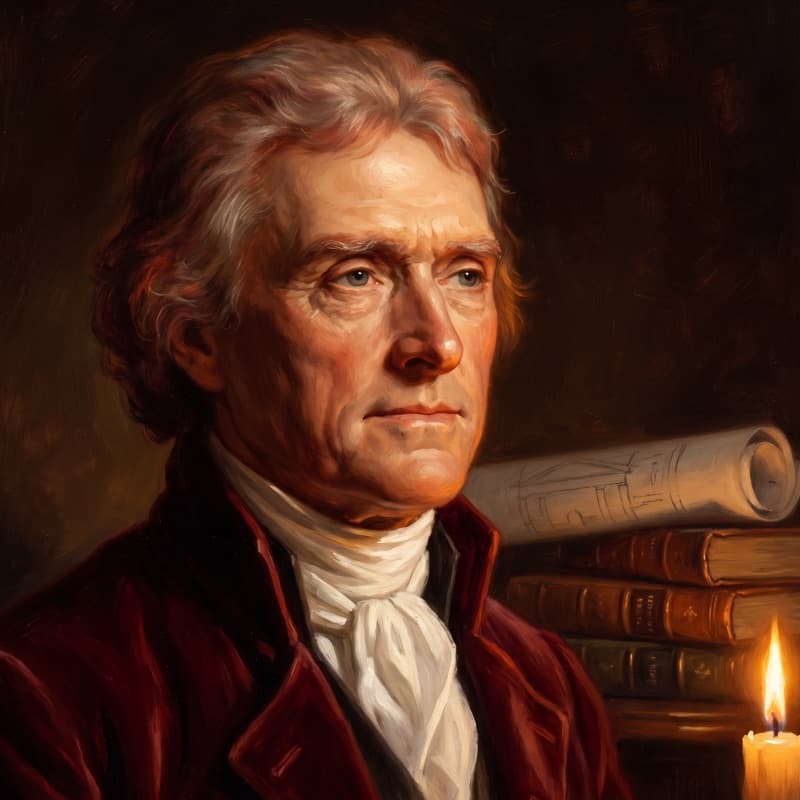
Thomas Jefferson was born on April 13, 1743, at Shadwell, Virginia, and died at Monticello on July 4, 1826 (Monticello, Brief Biography). Between those dates he was the primary author of the Declaration of Independence, drafter of the Virginia Statute for Religious Freedom, minister to France, first secretary of state, third president of the United States, and founder of the University of Virginia. Across that same span he held more than 600 people in slavery. This biography is built on the two institutions that know his record best — the Thomas Jefferson Foundation at Monticello and the National Archives' Founders Online — and it reports what they report, including the parts a monument would omit.
Chronology, sourced
1743–1776. Born at Shadwell; entered the College of William and Mary in 1760; began clearing the Monticello mountaintop in 1768. In 1776, as a member of the Second Continental Congress, he drafted the Declaration of Independence (Monticello). The adopted text's core claim — "We hold these truths to be self-evident, that all men are created equal, that they are endowed by their Creator with certain unalienable Rights" — is preserved at Founders Online. His rough draft also charged the king with waging "cruel war against human nature itself" through the slave trade; Congress removed that grievance (Founders Online).
1779–1789. Jefferson became governor of Virginia in 1779, having already drafted the bill that became the Virginia Statute for Religious Freedom — one of the three achievements he later chose for his epitaph. Its text argues that "our civil rights have no dependance on our religious opinions, any more than our opinions in physics or geometry" (Founders Online). In 1784 he returned to public service in France, first as a trade commissioner, then as minister.
1790–1809. He became the first secretary of state under George Washington in 1790. In 1801 he took office as third president after a contested election that ended in a peaceful transfer of party power (Monticello). The Louisiana Purchase of 1803 was among the central achievements of his first term, and his administration backed the Lewis and Clark expedition. His First Inaugural stated the creed: "peace, commerce, and honest friendship with all nations, entangling alliances with none" (Founders Online).
1809–1826. In retirement he founded the University of Virginia — charter secured in 1819 — designed its buildings, and served as its first rector. After the British burned the Capitol and the Library of Congress in 1814, Congress purchased his 6,487-volume library in 1815 (Library of Congress). He died at Monticello on July 4, 1826 — the Declaration's fiftieth anniversary — only hours before John Adams.
Slavery: the documented contradiction
The record here is not ambiguous, and Monticello — the foundation that operates Jefferson's own plantation — states it without hedging. Jefferson championed liberty while holding more than 600 people in slavery over the course of his life (Monticello). He condemned the slave trade in his draft of the Declaration and, per Monticello's scholarship, called slavery an abominable crime — yet he remained a lifelong slaveholder and never reconciled his public ideals with his private dependence on enslaved labor (Monticello, Liberty & Slavery).
Sally Hemings: the scholarly consensus
Monticello's current historical interpretation states that Jefferson fathered at least six of Sally Hemings's children, four of whom survived to adulthood (Monticello, The Life of Sally Hemings). Hemings was enslaved in Jefferson's household. The relationship existed entirely within slavery and within an extreme imbalance of power; the exact private dynamic is unrecoverable, and responsible history does not fill that gap with either romance or euphemism. We present the foundation's conclusion as what it is: Monticello's current historical interpretation, integrated into the biography where it belongs.
The epitaph test
Jefferson chose three achievements to be remembered by — the Declaration, the Virginia Statute for Religious Freedom, and the University of Virginia — and omitted the presidency. The choice is revealing twice over. It shows what he valued: documents and institutions that enlarge the mind, over offices that merely wield power. And it shows the limit of self-authorship: no epitaph he could write would settle how history weighs the author of "all men are created equal" against the owner of Monticello's labor force. Both facts survive on the same stone-cold documentary record, which is why this page cites everything.
Where next
- Quotes — his verified words, and eleven famous fakes Monticello has debunked
- Facts — the sourced fact file, achievements to memorial
- Death — July 4, 1826, documented without mythology
For the texture the documents can't give you, our Jefferson AI persona — clearly labeled as a reconstruction — answers questions from his Monticello retirement, including the uncomfortable ones the real man spent a lifetime not answering.