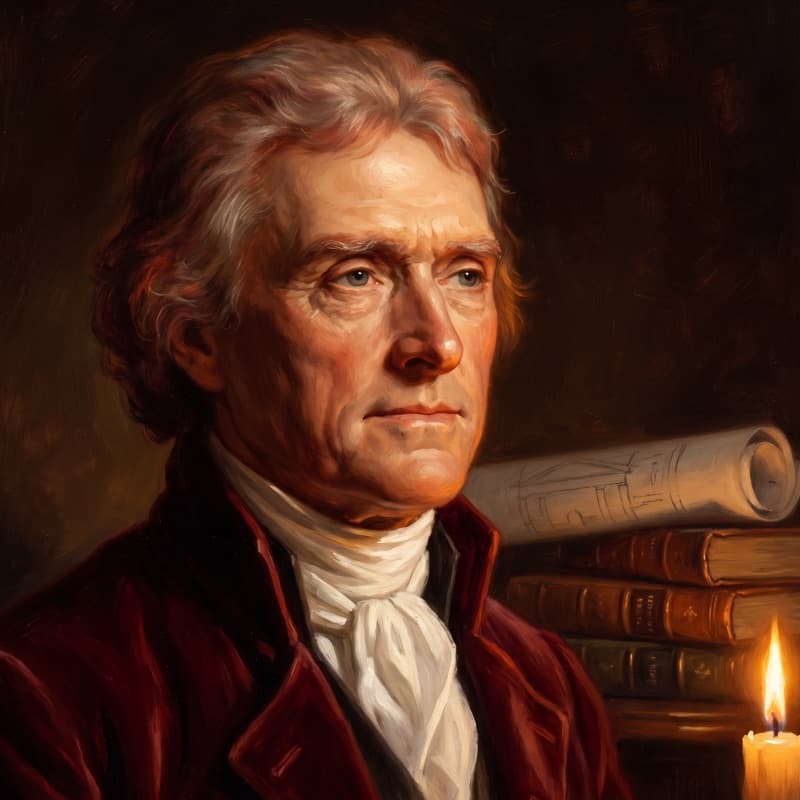
Thomas Jefferson died at Monticello on July 4, 1826, at the age of 83 — the fiftieth anniversary of the Declaration of Independence — only hours before John Adams died (Monticello, Brief Biography). Those are the documented facts, and this page stays inside them: Jefferson's death has accumulated enough legend that the responsible move is to cite what the record supports and label what it doesn't.
The documented final years
The Thomas Jefferson Foundation's account of his retirement is specific: after two presidential terms, Jefferson retired to Monticello in 1809 and spent his last years rebuilding his library, planning the University of Virginia, and struggling with debt (Monticello).
Each element is independently documented. The library: after the British burned the Capitol and the Library of Congress in 1814, Congress purchased Jefferson's 6,487 volumes in 1815 (Library of Congress), and the collection he then rebuilt occupied him to the end. The university: he secured its charter in 1819, designed its buildings, and served as its first rector (Monticello). The debt: it shadowed Monticello through Jefferson's last years.
One fact deserves its own sentence, because sourced history requires it: Monticello remained a slave plantation to the end of Jefferson's life. He held more than 600 people in slavery over his lifetime and never reconciled his ideals with that practice (Monticello, Liberty & Slavery). That fact belongs in any account of his death.
July 4, 1826: the coincidence, verified
The date is central to Jefferson's death story, so let the sourcing be explicit. Monticello's biography states that Jefferson died on July 4, 1826, the fiftieth anniversary of the Declaration of Independence, only hours before John Adams (Monticello). Second and third presidents — both gone on the jubilee of the document that joined their names.
No mysticism is required, and none is offered here. The coincidence is real, contemporaries were staggered by it, and it has carried mythological freight ever since. We report the date and decline the embroidery — including the various "last words" traditions, which circulate in forms the primary record supports unevenly. Where we cannot cite, we do not quote.
The epitaph: his own final document
Jefferson approached even death as a drafting problem. He chose three achievements to be remembered by — author of the Declaration of Independence, of the Virginia Statute for Religious Freedom, and father of the University of Virginia — and pointedly omitted the presidency. The statute was the 1779 bill declaring that "our civil rights have no dependance on our religious opinions" (Founders Online, National Archives); that it outranked the presidency in his own accounting tells you how Jefferson weighed words against power.
The epitaph is also the last instance of a lifelong pattern: Jefferson controlling the record. It names what he built and is silent on what he practiced. Both the monument and the silence are historical evidence, and this site presents them together — the same way we handle the record of Sally Hemings, whose children Monticello's current interpretation concludes Jefferson fathered, at least six of them, four surviving to adulthood (Monticello).
Common questions, answered from sources
When did Thomas Jefferson die? July 4, 1826, at Monticello (Monticello).
How old was he? 83 — born April 13, 1743; died July 4, 1826 (Monticello).
Did Jefferson and Adams really die on the same day? Yes. Jefferson died only hours before Adams, on the Declaration's fiftieth anniversary (Monticello).
What happened to President Jefferson after office? He retired to Monticello in 1809, rebuilt his library, founded a university, struggled with debt, and died at home seventeen years later (Monticello).
The rest of the record is on the biography, quotes, and facts pages. For a different kind of encounter, our Jefferson AI persona — clearly labeled as a reconstruction — converses from 1816, ten years before this page's subject, with all his projects still open on the desk.