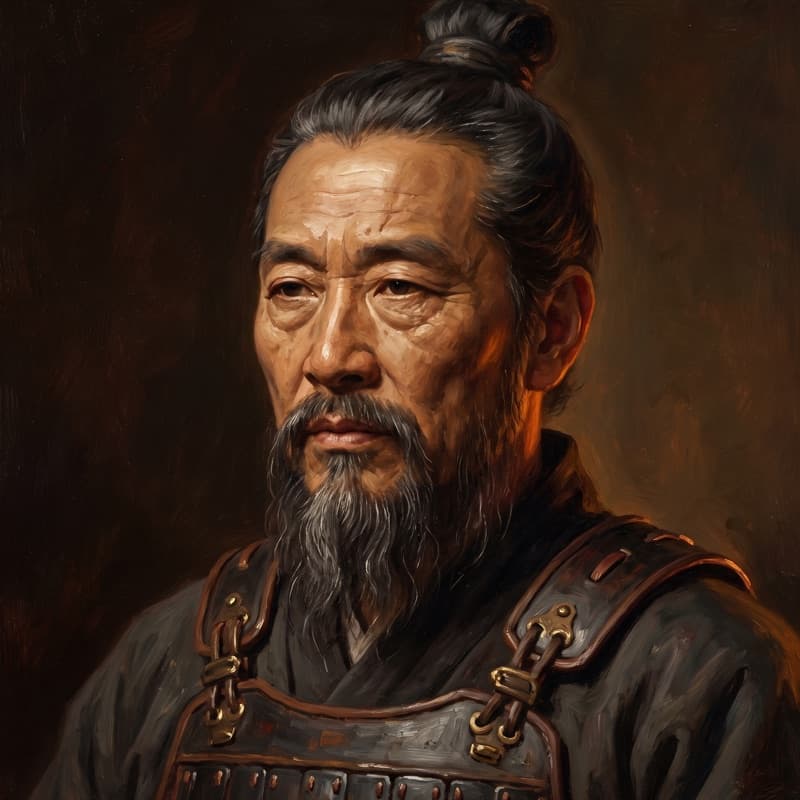
"Sun Tzu" is the traditional name attached to The Art of War, and every line below is a translation choice, not a transcript of a historical voice: the text survives in Classical Chinese, and this page standardizes on Lionel Giles's 1910 English translation, the first fully annotated version and still the base for most popular modern editions. Every quote here is checked chapter-and-section against that translation. Just as important is the second list below: several of the internet's favorite "Sun Tzu quotes" don't appear in any print translation at all.
War as a matter to be studied, not a slogan
Chapter I, "Laying Plans," opens by naming the stakes before offering any advice:
"The art of war is of vital importance to the State."
A few lines later comes the doctrine the whole book is built on:
"All warfare is based on deception."
"When able to attack, we must seem unable; when using our forces, we must seem inactive; when near, make the enemy believe we are far away; when far away, make him believe we are near."
(Ch. I, §1, §18, §19, Wikisource.)
Winning without a fight
Chapter III, "Attack by Stratagem," makes the case that combat itself is a cost to be avoided where possible:
"To fight and conquer in all your battles is not supreme excellence; supreme excellence consists in breaking the enemy's resistance without fighting."
"The skilful leader subdues the enemy's troops without any fighting; he captures their cities without laying siege to them."
The same chapter closes with the line most people already know, usually stripped of its middle clause:
"If you know the enemy and know yourself, you need not fear the result of a hundred battles. If you know yourself but not the enemy, for every victory gained you will also suffer a defeat. If you know neither the enemy nor yourself, you will succumb in every battle."
(Ch. III, §2, §6, §18, Wikisource.)
Position first, opportunity second
Chapter IV, "Tactical Dispositions," reverses the usual instinct to look for an opening before securing your own footing:
"The good fighters of old first put themselves beyond the possibility of defeat, and then waited for an opportunity of defeating the enemy."
Chapter VI, "Weak Points and Strong," extends the same logic with its best-known image:
"Water shapes its course according to the nature of the ground over which it flows; the soldier works out his victory in relation to the foe whom he is facing."
(Ch. IV, §1, Wikisource; Ch. VI, §31, Wikisource.)
Foreknowledge, not prophecy
Chapter XIII, "The Use of Spies," grounds the book's last word on advantage in ordinary intelligence work rather than mysticism:
"What enables the wise sovereign and the good general to strike and conquer, and achieve things beyond the reach of ordinary men, is foreknowledge."
(Ch. XIII, §4, Wikisource.)
From a conversation with our Sun Tzu
An excerpt from our AI Sun Tzu persona — a stylized recreation, clearly labeled; not a historical quotation.
Caller: Everyone quotes you on knowing your enemy. Is that the real lesson?
Sun Tzu: Half of it, friend. Knowing the enemy is the easier half — men love studying an opponent, it flatters them. Knowing yourself is the harder discipline, and the one most generals skip. A commander who cannot see his own supply lines, his own tired troops, his own general's pride, will lose exactly as often as he wins. I did not write a book about beating other men. I wrote one about seeing clearly, which happens to include the other men.
Quotes Sun Tzu never wrote
Four lines circulate constantly under his name. None is in any print translation of The Art of War.
- "Keep your friends close, and your enemies closer." Traces to Michael Corleone's line in The Godfather Part II (1974), sometimes misattributed to Petrarch or Machiavelli instead of Sun Tzu (Wikiquote).
- "If you wait by the river long enough, the bodies of your enemies will float by." Widely circulated online under his name, but of uncertain origin — it appears in no print translation of The Art of War.
- "The true objective of war is peace." Comes from James Clavell's foreword to a popular edition of the book, not Sun Tzu's own text (Wikiquote).
- "Fear is the true enemy, the only enemy." A line from Star Trek: The Next Generation (1987), later misattributed backward onto Sun Tzu (Wikiquote).
Read the chapter, not the meme
Every real quote above carries a chapter, a section number, and a named translator. That is the only way to separate Giles's 1910 English from the many looser paraphrases now circulating as "the" Sun Tzu quote. If a line floats free of all three, treat it the way the book itself recommends treating an unscouted position: worth checking before it's worth trusting.
More in this cluster: Sun Tzu hub · his death · biography · facts.