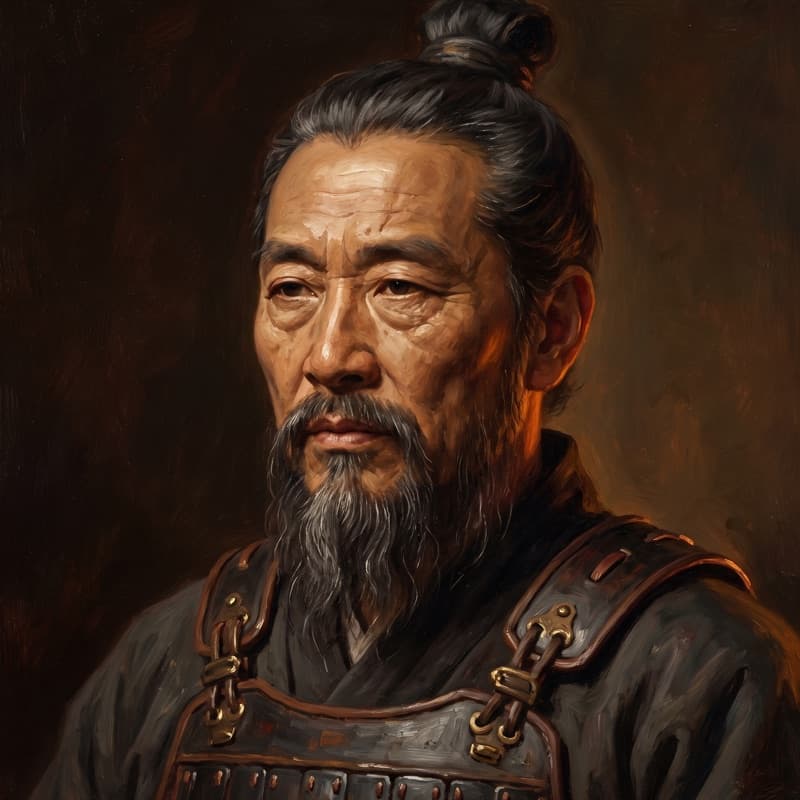
The honest answer is the interesting one: no primary source narrates how, when, or where Sun Tzu died. Later tradition assigns a death date of roughly 496 BC, but that number rests on the same disputed biographical chain as his birth date — not on any independent account. If a page tells you Sun Tzu died a specific death in a specific place, it is repeating legend as settled fact.
The source that should have a death scene — and doesn't
Sima Qian's Records of the Grand Historian (the Shiji, completed around 97 BC) is the primary ancient source for Sun Tzu's life, and it is where the famous stories come from — presenting thirteen chapters to King Helü of Wu, drilling the palace concubines into disciplined ranks, executing the two company commanders who laughed off his orders. Sima Qian gives many historical figures of the period a death narrative. He does not give one to Sun Tzu. The traditional biography simply stops once the famous episodes are told, and later retellings quietly fill that silence with an assumed date rather than admitting the gap.
No tomb, unlike the text itself
Compare this to what did survive: in 1972, construction workers uncovered a cache of Han-dynasty bamboo slips at Yinqueshan, near Linyi in Shandong province, in a tomb sealed sometime between 134 and 118 BC. That tomb held bamboo-slip copies of The Art of War — a genuine, dated, physical trace of the text's early transmission. No comparable site anywhere is identified as Sun Tzu's own burial place. The one tomb connected to this history holds the book, not the man.
Why there's nothing to cross-check against
Part of the reason the gap is so clean is that the Zuo Zhuan — the chronicle that records most other notable figures of the Spring and Autumn period — never mentions Sun Wu at all. Song-dynasty scholars first raised this as a formal problem with his historicity in the 12th century, and it cuts both ways: no contemporary chronicle confirms his life, and none confirms his death either. Absence of evidence is not usually a satisfying answer, but here it is the most defensible one available.
From a conversation with our Sun Tzu
An excerpt from a conversation with our AI Sun Tzu persona — a stylized recreation built from the traditional biography and the text attributed to him, honestly labeled, not a historical recording. Our Sun Tzu has no more knowledge of his own death than the record does.
Caller: How did you die? What actually happened at the end?
Sun Tzu: You ask a general to report ground he never scouted. The chroniclers who might have told you were silent — not evasive, simply silent, which is its own kind of information. A commander who cannot confirm the enemy's position does not invent one; he says plainly what he does not know and plans around the gap. Treat my ending the same way. What outlasted me is the accounting itself — assess before you commit, know the terrain, know yourself. That much I can vouch for. The rest belongs to men who came centuries after and needed a tidier story than the sources gave them.
Sun Tzu is not Sun Bin
One caution worth stating plainly: Sun Tzu is a distinct figure from Sun Bin, a later Warring States-era strategist whose own record in Sima Qian is comparatively more detailed. The two were historically conflated until the Yinqueshan discovery helped separate Sun Bin's text from The Art of War. A source that blends Sun Bin's better-documented life into Sun Tzu's is making exactly the conflation this page is warning against.
The plainest way to say it
Sun Tzu's death is a blank space in the record, not a mystery with a hidden solution. The text he is credited with survived in far better condition than any account of his final days — a fitting, if unintended, irony for a strategist whose whole method was refusing to act on information he didn't actually have.
More in this cluster: Sun Tzu hub · his biography · verified quotes · fact file.