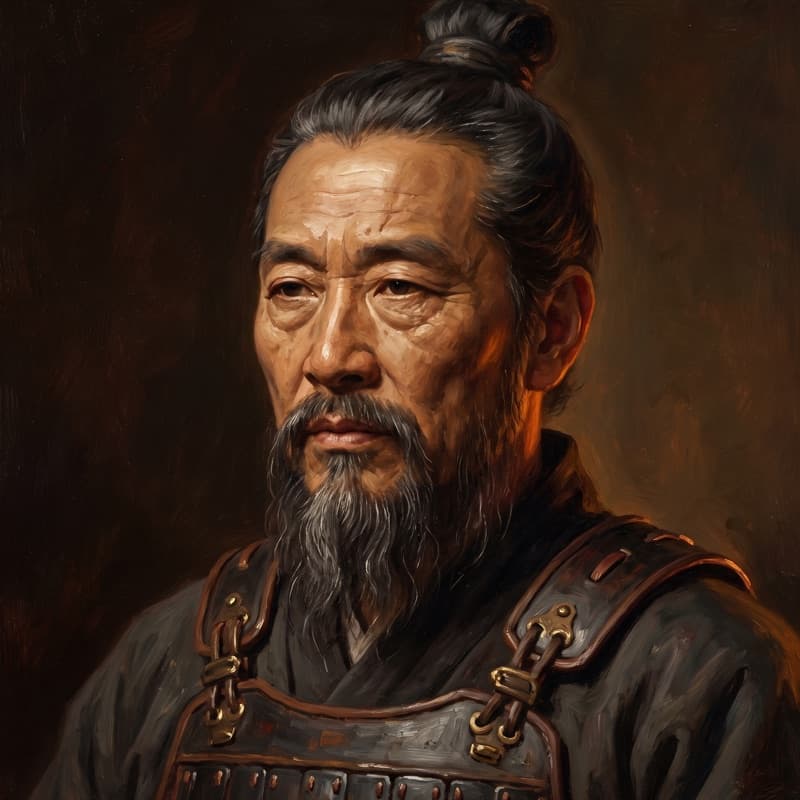
"Sun Tzu" is the name tradition attaches to The Art of War, and the honest way to open his biography is with that qualifier: this is a legendary-historical figure, not a settled one. The book has outlived any certainty about its author, and the record left behind reads less like a documented life and more like a story people kept retelling because it explained the book so well.
A general's introduction
The traditional account, first written down centuries after it supposedly happened, places Sun Wu — Sun Tzu's given name — in the state of Wu during the late Spring and Autumn period, roughly 544 to 496 BC. He is said to have presented his thirteen chapters on war to King Helü of Wu and entered his service as a general. Under Helü, tradition credits him with Wu's victory over the state of Chu at the Battle of Boju in 506 BC, one of the more consequential campaigns of the era.
The concubine drill
The single scene that made Sun Tzu a character rather than a byline comes from Sima Qian's Records of the Grand Historian, compiled around 97 BC — itself written long after Sun Tzu's purported lifetime. King Helü, testing whether this stranger's theories worked on real people, handed him 180 of the palace's concubines and asked him to drill them into a disciplined company, splitting them into two units under the king's two favorite consorts as officers. When the ranks broke into laughter instead of executing his orders, he repeated the commands and gave the order again. They laughed again. Sun Tzu had the two commanding consorts beheaded on the spot, over the king's own objections, appointed replacements, and drilled the rest into silent, exact formation. It is a vivid anecdote about discipline and authority — and it is exactly that, a traditional anecdote, not an independently verified event.
From a conversation with our Sun Tzu
An excerpt from a conversation with our AI Sun Tzu persona — a stylized recreation, honestly labeled; not a historical quotation.
Caller: Did drilling those women really require executing anyone?
Sun Tzu: A general who gives an order and accepts laughter in return has already lost the field before the first arrow flies. The women were never the lesson. The king was.
A text older than its author, or younger
Here the biography turns into a historiography problem, which is its most honest chapter. Since the 12th-century Song dynasty, scholars have noted that the Zuo Zhuan — the chronicle that records nearly every other notable figure of the era — never mentions Sun Wu at all. That silence, from the one source built to catch him, is the strongest reason to doubt the traditional biography. Modern scholarship goes further, dating the core text's composition to the start of the Warring States period, meaning The Art of War as it survives likely postdates the man credited with writing it by a century or more.
A 1972 discovery clarified part of the puzzle: construction workers near Linyi, Shandong province, uncovered Han-dynasty bamboo slips at Yinqueshan, sealed in a tomb between 134 and 118 BC. Among them were copies of The Art of War alongside a separate, previously conflated text by strategist Sun Bin — a find that let scholars finally pull the two "Sun" military authors apart.
None of this erases the book's influence, only the certainty of its byline. Every English sentence attributed to Sun Tzu, including the ones on this site, is a translator's choice — Lionel Giles's 1910 rendering, in this dossier's case — not a transcript of a historical voice.
Continue the conversation — literally
You have just read the traditional record and its caveats. Our Sun Tzu — an AI recreation, built on the sourced tradition and labeled as what it is — speaks from inside that legend. Ask him about the concubine drill, the campaign against Chu, or what a general owes an order that isn't obeyed. He answers the way the tradition tells it: plain, tactical, unbothered by laughter.
More in this cluster: Sun Tzu hub · his death · verified quotes · facts.