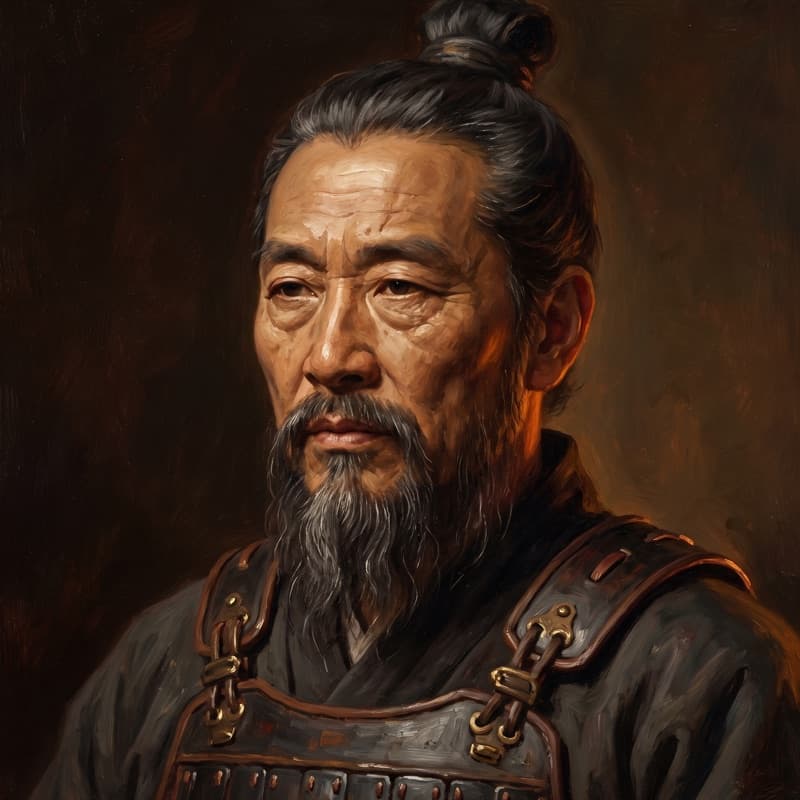
The essential Sun Tzu facts, stated carefully: "Sun Tzu" is the traditional name attached to The Art of War, a Chinese military treatise in thirteen chapters. Tradition, via Sima Qian's Records of the Grand Historian (c. 97 BC), places his life around 544–496 BC and credits him with helping Wu defeat Chu at Boju in 506 BC. Scholars have doubted a matching historical author since the 12th century, chiefly because the Zuo Zhuan — which names most other figures of that era — never mentions him. This page keeps both halves visible: a facts page about a figure this contested only does half the job if it can't say what's disputed too.
The core facts, with why they matter
Tradition dates him to 544–496 BC, late in the Spring and Autumn period, via Sima Qian's Shiji (c. 97 BC) — a source written centuries after his purported lifetime, which is exactly why every date here needs an asterisk.
Historicity has been doubted since the 12th century. Song-dynasty scholars noticed the Zuo Zhuan never names Sun Wu, though it records nearly every other notable Spring-and-Autumn figure. Wikipedia
Tradition credits him, serving under King Helü, with Wu's victory over Chu at Boju in 506 BC — the signature achievement attached to his name, resting on Sima Qian's later account, not a contemporary chronicle. Wikipedia
The famous concubine-drill story is a traditional anecdote, not a verified event. Sima Qian has Sun Tzu drilling King Helü's palace concubines into ranks, then executing two commanders who laughed off his orders — the most vivid scene in the biography, and the clearest reminder that "traditional" isn't "documented."
The Art of War runs thirteen chapters, from "Laying Plans" through "The Use of Spies," and is among the oldest, most widely read military treatises in the world. Wikipedia, The Art of War
Most modern scholars date the core text to the early Warring States period — at least a century after Sun Tzu's traditional lifetime — meaning the book likely postdates the man it's named for. Wikipedia, The Art of War
A 1972 discovery helped separate Sun Tzu from a strategist he'd long been confused with. Han-dynasty bamboo slips found at Yinqueshan, Shandong, included both The Art of War and a separate text by Sun Bin, letting scholars untangle the two "Sun" military writers. Wikipedia, The Art of War
Every English quote on this site is Lionel Giles's 1910 wording — the first fully annotated English translation, and the base text most modern editions still draw from. Project Gutenberg
From a conversation with our Sun Tzu
An excerpt from our AI Sun Tzu persona — a stylized recreation, honestly labeled; not a historical quotation.
Caller: Did you really say all the lines people quote you on?
Sun Tzu: A name does not write every line laid beneath it. What survives passed through a historian's brush, then a translator's pen. Ask which counsel still holds against the ground in front of you — that is the only test worth making.
Popular "facts" that need correcting
"Keep your friends close, and your enemies closer." Not in any print translation — it traces to Michael Corleone's line in The Godfather Part II (1974). Wikiquote
"The true objective of war is peace." From James Clavell's foreword to a popular edition, not Sun Tzu's own text.
The full debunk list, including a widely circulated river line of uncertain origin, lives on our quotes page.
Five things Sun Tzu is credited with
- Writing, in tradition, The Art of War's thirteen chapters.
- Advising King Helü of Wu, per Sima Qian.
- Wu's victory over Chu at Boju, 506 BC — by tradition.
- Framing warfare around deception and foreknowledge over brute force.
- Surviving into the 1972 Yinqueshan find, separating his text from Sun Bin's.
The fact pages can't hold him
With Sun Tzu, even the skeleton has gaps historians still argue about. Our Sun Tzu — an AI recreation, labeled as what it is — can walk you through the concubine-drill legend as legend, or what "know yourself and know the enemy" meant in its original context.
More in this cluster: Sun Tzu hub · his death · verified quotes · biography.