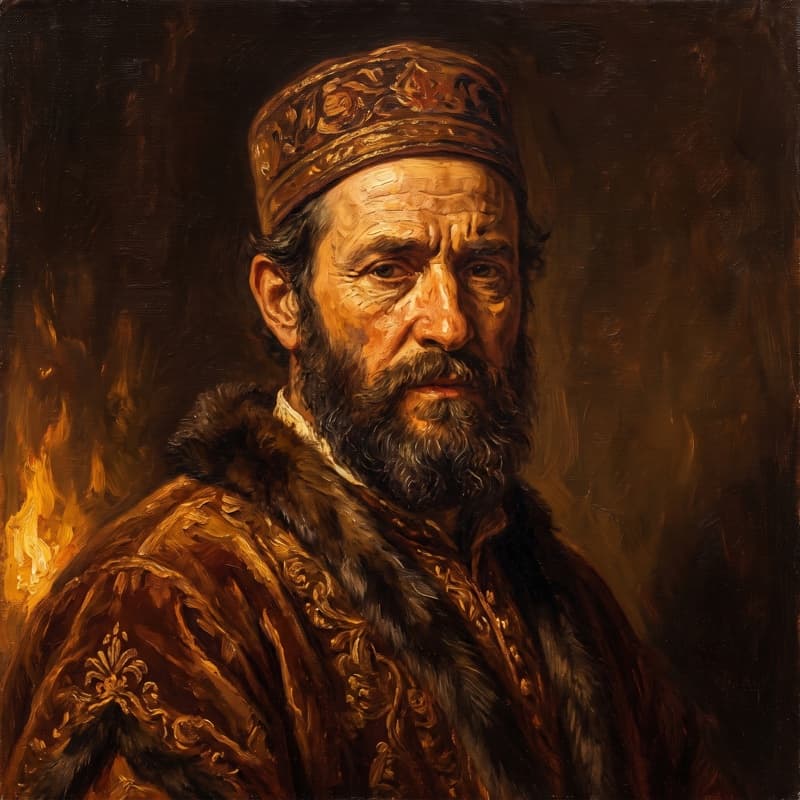
Marco Polo is conventionally dated 1254 to 1324, a Venetian merchant whose account of nearly a quarter-century in Asia became one of medieval Europe's most influential — and most disbelieved — books. He did not sit down and write it himself. While a prisoner of war in Genoa in 1298, he dictated it to a fellow inmate, the romance-writer Rustichello of Pisa, and the resulting book has been read, copied, mocked, and argued over ever since.
That's the summary. The argument underneath it is more interesting than the summary.
A merchant's son who met his father at fifteen
Polo was born in Venice to a family already in the business of very long trips. His father, Niccolò, and his uncle, Maffeo, were Venetian merchants trading beyond the Black Sea before Marco was born, and by the time they returned — having reached the court of Kublai Khan himself — young Marco had grown up largely without a father in the house; his mother had died in his childhood. In 1271, at seventeen, he set out with them on the return journey east, this time to stay in the story rather than hear it secondhand.
The overland route took roughly three and a half years, and the book's own prologue frames it as a passage through Persia, the high, thin-aired plain of the Pamir — "so lofty and cold," the text says, "that you do not even see any birds flying," where fire itself "does not burn so brightly... nor cook food so effectually" — and the Desert of Lop, the Gobi's edge, where stragglers were said to hear spirit voices calling them by name off the track. By around 1275 the party had reached the court of the Great Khan.
Seventeen years in the service of "the greatest Lord that is now in the world"
The book's introduction to Kublai Khan does not undersell him: he is called "the most potent man, as regards forces and lands and treasure, that existeth in the world, or ever hath existed from the time of our First Father Adam until this day." Whatever the hyperbole, Polo's account describes roughly seventeen years serving the Khan, most plausibly as an envoy and gatherer of reports — the traveler who came back from errands not with dry business but with particulars: customs, prices, marvels, the things a curious emperor actually wants to know.
Exactly how far his role extended is where the story gets contested. The narrative includes a claim that Polo served as a governor in the city of Yangzhou; historian Morris Rossabi's assessment for Columbia University's Asia for Educators notes this office is not corroborated by any contemporary source, and that the book also overstates Polo's role in the Mongol siege of Xiangyang, which had already ended before he arrived in the region. None of that unravels the larger claim that he reached the Mongol court — Rossabi's broader argument is that omissions skeptics point to (no mention of tea, chopsticks, or the Great Wall as it's known today, much of which postdates Polo) don't disprove the trip, given how well other details of Yuan-dynasty administration line up with independent sources. The responsible position, a century of scholarship later, is neither "entirely true" nor "entirely invented": the journey stands: the paperwork of individual claims inside it doesn't all stand equally.
The marvels that got him laughed at
Three things in the book did more than anything else to earn Polo his lifelong nickname. First, money made of paper: the text describes the Great Khan's mint turning mulberry-bark pulp into notes stamped with the royal seal, refused by no one "on pain of death" and yet — the book insists — spent gladly, because it worked. Polo's own verdict, rendered as a challenge to the reader: the Khan "hath the Secret of Alchemy in perfection." Second, stones that burn: "a kind of black stones existing in beds in the mountains, which they dig out and burn like firewood... you will find them still alight in the morning" — coal, described to a European audience that mostly heated with wood. Third, scale: the book describes the city of Kinsay (Hangzhou) as "an hundred miles of compass," with "twelve thousand bridges of stone, for the most part so lofty that a great fleet could pass beneath them" — a claim Polo says he later confirmed by seeing the city himself, after first hearing the figures from a captured queen's own written surrender account.
Venetians did not believe any of it, and their skepticism curdled into a nickname: "Il Milione," Marco of the millions, for his habit of measuring the Khan's realm — and everything in it — in numbers that sounded invented. The book survived the mockery. The nickname stuck to the man; the book outlasted both.
Home, capture, and a Genoese cell
The Polos left China around 1291 or 1292, escorting a Mongol princess by sea to Persia, carrying golden tablets of safe passage and commanding a fleet the book puts at thirteen ships. They reached Venice in 1295, twenty-four years after leaving. Within a few years Polo was taken prisoner during a naval conflict between Venice and Genoa — sources differ on whether it was 1296 or 1298 — and it was in that Genoese prison, by the book's own account, that he dictated his travels to Rustichello in 1298.
He was freed in August 1299, married Donata Badoèr in 1300, and raised three daughters — Fantina, Bellela, and Moreta — as, by every account, an ordinary and reasonably prosperous Venetian merchant. He died in Venice on 8 January 1324, at about seventy, and was buried near the Church of San Lorenzo.
A story attached itself to his deathbed: that friends urged the dying Polo to retract the book's "great and strange things," and that he answered he had "not told one-half of what he had really seen." It's a good line, and it travels widely in secondary accounts of his life — but it comes down through a chronicle written after the fact, not from the book itself or any statement in Polo's own hand. Treat it as legend attached to a real man, not a verified quotation.
Talk to him yourself
Our AI Marco Polo answers from that Genoese cell in 1298 — mid-dictation, mid-marvel, entirely convinced you're the best audience he's had all week. Ask him to defend the paper money, describe the singing sands of the Gobi, or explain exactly how a city can have twelve thousand bridges. He deals only in particulars, and he's got twenty-six years of them.