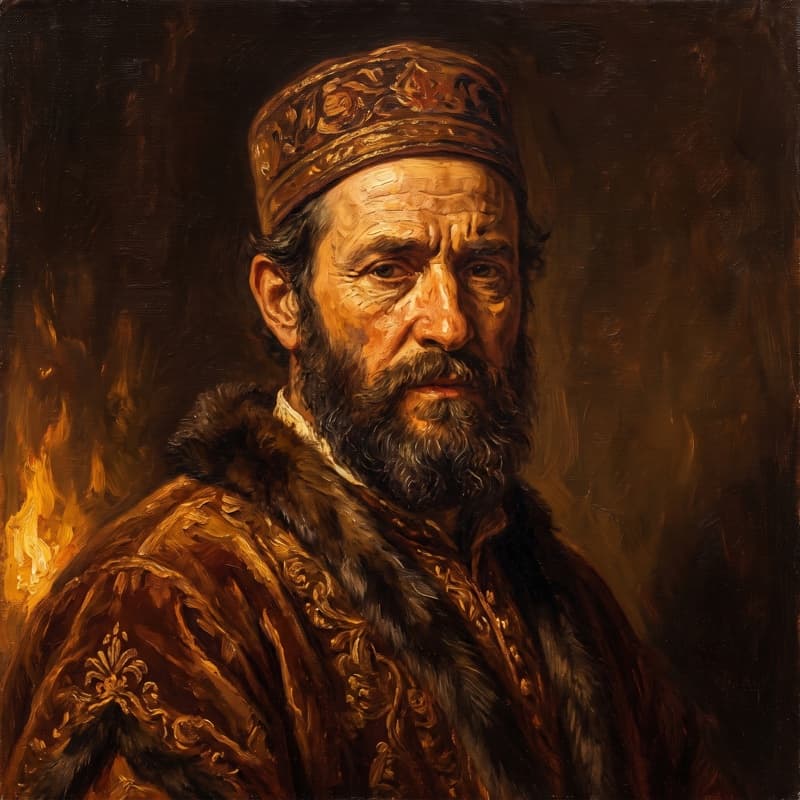
Marco Polo died in Venice on January 8, 1324, at roughly seventy years old, and was buried at the Church of San Lorenzo. By then he was a settled Venetian merchant, married for over two decades with three grown daughters — not a traveler on some distant road, not a prisoner in a foreign cell. That is almost anticlimactic next to the life that preceded it, which makes the legend everyone actually wants to hear worth handling with care.
An ordinary death after an extraordinary life
Compare the shape of it to the journey: a seventeen-year-old who left Venice in 1271, spent close to two decades inside the Mongol world, sailed home escorting a Mongol princess toward Persia, survived capture in a Venice–Genoa naval conflict, and dictated an account of it to a fellow prisoner in a Genoese cell. After release in 1299 he married Donata Badoèr in 1300 and spent another quarter-century as a working merchant in the city he had once left as a teenager. He died where he had been born, among family, an old man rather than a martyr or a captive.
The line everyone repeats — and why it isn't a verified quote
The story people bring up first is the deathbed retraction: that friends gathered around the dying Marco and urged him to take back the book's "great and strange things," and that his reply was that he had not told half of what he had really seen. It is a wonderful line, and it is not something Marco Polo is reliably recorded as having said.
The line survives through Henry Yule's scholarly apparatus on the travel book, which reports it as coming from a later chronicle — not from the book itself, and not from any document in Marco's own hand. Treat it as a legend transmitted secondhand, with uncertain exact wording, rather than a confirmed statement in his own voice. Other sources repeat the same story only in paraphrase — evidence the legend circulated widely, not that it is verified.
The story stuck because it answered a real question: was any of this true? The book described paper that passed for money, black stones that burned like firewood, and a city with twelve thousand stone bridges. To readers who had never seen paper currency, coal, or a metropolis that size, these read less like facts than the kind of claims that earn a man the nickname "Il Milione" — Venetian shorthand for a teller of tall tales. A deathbed line about not telling the whole truth fits that skepticism, whether or not Polo ever said anything like it.
From a conversation with our Marco Polo
An excerpt from a conversation with our AI Marco Polo persona — a stylized recreation, honestly labeled, not a historical quotation.
Caller: People say that near the end, friends begged you to take back the wildest parts of your book. Is that true?
Marco: That is how Venice tells it — though I could not swear it happened word for word. A merchant learns that a room full of doubters wants only the parts that flatter their doubt. If I answered them at all, it would have been something like that — I had not told half of what I saw. Not a boast. Just the arithmetic of what a man can make strangers believe in one sitting.
The legend outlived the mockery
That is the real ending, more than any line at a bedside. Paper money, burning stones, and impossibly large cities turned out to be real, and the account dictated in a Genoese prison became one of medieval Europe's most consulted descriptions of Asia — mockery, nickname, and all.
Ask him about the life, not just the legend
Our Marco Polo — an AI recreation, built from the sourced record and labeled as what it is — speaks from inside that life, not its ending. Ask him what the Khan's court smelled and sounded like, or how it felt to hold paper a whole empire agreed was worth something. Ask him about the singing sands of the Gobi.
More in this cluster: Marco Polo hub · his biography · verified quotes · fact file.