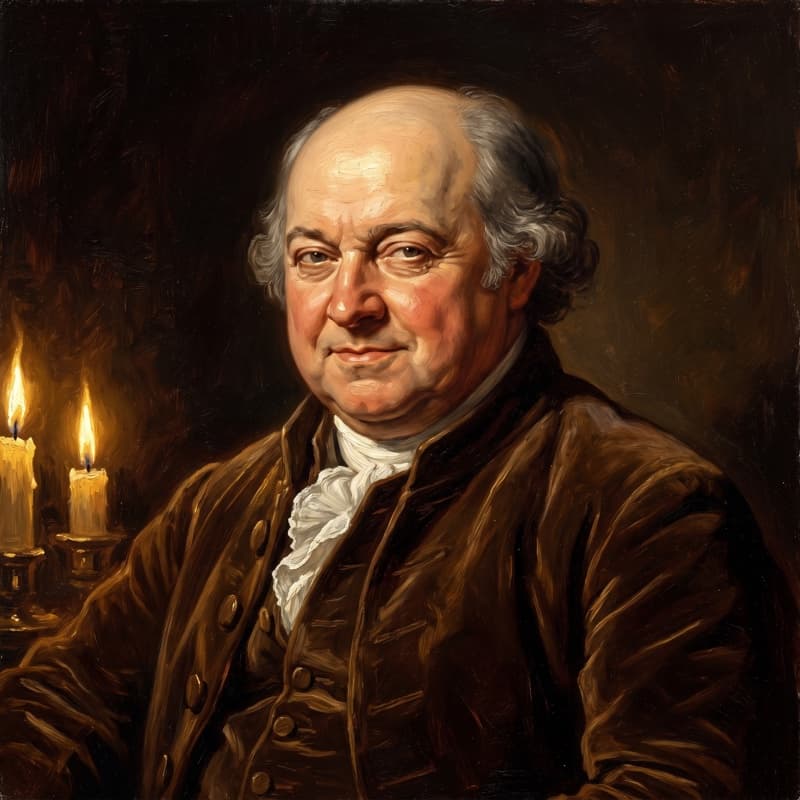
John Adams's most reliably documented quotes read like a lawyer's brief, because most of them were written by one: "Facts are stubborn things," from his 1770 defense of the British soldiers; "a government of laws and not of men," from the Massachusetts Constitution he drafted; "Independence forever," his last public words, offered as a toast four days before he died. What connects them is Adams's habit of arguing even in his tenderest letters. Below are nine lines confirmed against primary Adams texts, grouped by period from his early legal career to his last words — plus the one popular "Adams quote" that has no real source behind it.
1770: The defense no one else would take
Defending the British soldiers charged after the Boston Massacre was the most unpopular case in Boston, and Adams built his closing argument on a single, blunt claim:
"Facts are stubborn things; and whatever may be our wishes, our inclinations, or the dictates of our passions, they cannot alter the state of facts and evidence."
The jury acquitted most of the defendants. Adams later called the case one of the best pieces of service he ever rendered his country — evidence over passion, argued at real professional risk.
1765: Knowledge as a right, government as a trust
A decade before independence, in A Dissertation on the Canon and Feudal Law, the young lawyer laid out the theory he'd spend his life defending:
"Liberty cannot be preserved without a general knowledge among the people."
"Rulers are no more than attorneys, agents, and trustees, for the people."
Both lines reduce government to a job, not a birthright — a claim the essay makes well before 1776 made it fashionable.
Letters home: the private cost of a public cause
Writing to Abigail in 1777, with the war going badly, Adams turned his mind to the price later generations wouldn't see:
"Posterity! You will never know, how much it cost the present Generation, to preserve your Freedom!"
Three years later, from Paris, he explained the sacrifice in more personal terms — one generation's grim work for the next generation's freedom to do something gentler:
"I must study Politicks and War that my sons may have liberty to study Painting and Poetry Mathematicks and Philosophy."
1776: The wrong date, the right instinct
On July 3, 1776 — the day after Congress voted for independence, and a day before the Declaration's famous date — Adams wrote Abigail convinced history had already turned:
"The Second Day of July 1776, will be the most memorable Epocha, in the History of America."
He picked the wrong day. The instinct that the vote deserved "Pomp and Parade... Bonfires and Illuminations" for generations to come was exactly right, just two days early.
1780: A government of laws
Adams's most durable line of authorship isn't a letter or a speech — it's a clause. Drafting the Massachusetts Constitution, he built in a separation-of-powers guarantee that closes with the phrase now cited across American law:
"...to the end it may be a government of laws and not of men."
The constitution he wrote is still in force, amended but intact, nearly two and a half centuries later.
1818: Revolution as a change of mind
Late in life, explaining to Hezekiah Niles what the Revolution actually was, Adams located it somewhere other than the battlefield:
"The Revolution was effected before the War commenced. The Revolution was in the minds and hearts of the people."
From a conversation with our Adams
An excerpt from our AI Adams persona — a stylized recreation, clearly labeled; not a historical quotation.
Caller: You spent your whole career arguing cases. Did independence ever feel like just another brief?
Adams: Every case I ever won, I won on the facts, and independence was no different — I simply had fifty years to prepare the closing argument instead of a fortnight. The soldiers' trial taught me a man's passions will lie to him gladly if he lets them; a nation's are worse. So I wrote what I believed and let the evidence do the persuading. It is slower than eloquence. It also holds up better in the next century, which is the only jury that matters.
1826: The last public word
Four days before he died, a Quincy committee visited the dying Adams to ask for a Fourth of July toast. He gave them one line, then declined to improve on it:
"I will give you, 'Independence Forever!'"
Asked if he wanted to add anything, he said only, "not a word." He died that July 4 — the Declaration's fiftieth anniversary — hours after Thomas Jefferson.
A quote Adams never said
Widely shared online, never found in his papers:
- "There are two ways to conquer and enslave a nation. One is by sword. The other is by debt." No evidence Adams wrote or said this. Sara Martin, editor-in-chief of the Adams Papers, told fact-checkers the project has found "no direct evidence that Adams ever wrote it"; the line's earliest known print appearance is 2002 — more than 175 years after his death (Check Your Fact).
Adams's actual reported dying words — "Thomas Jefferson survives," spoken not knowing Jefferson had died hours earlier that same day — are real in substance but not secured word-for-word across every contemporary account (American Battlefield Trust); treat that one as remembered, not transcribed.
Argue with the source, not the wall art
Our Adams — an AI recreation, honestly labeled — argues the way the record shows he argued: by evidence, by letter, occasionally by grievance. Ask him why he defended soldiers his neighbors wanted hanged, or what he actually meant by a government of laws. He'll give you a closing argument, not a fortune cookie.
More in this cluster: Adams hub · his death · biography · facts.