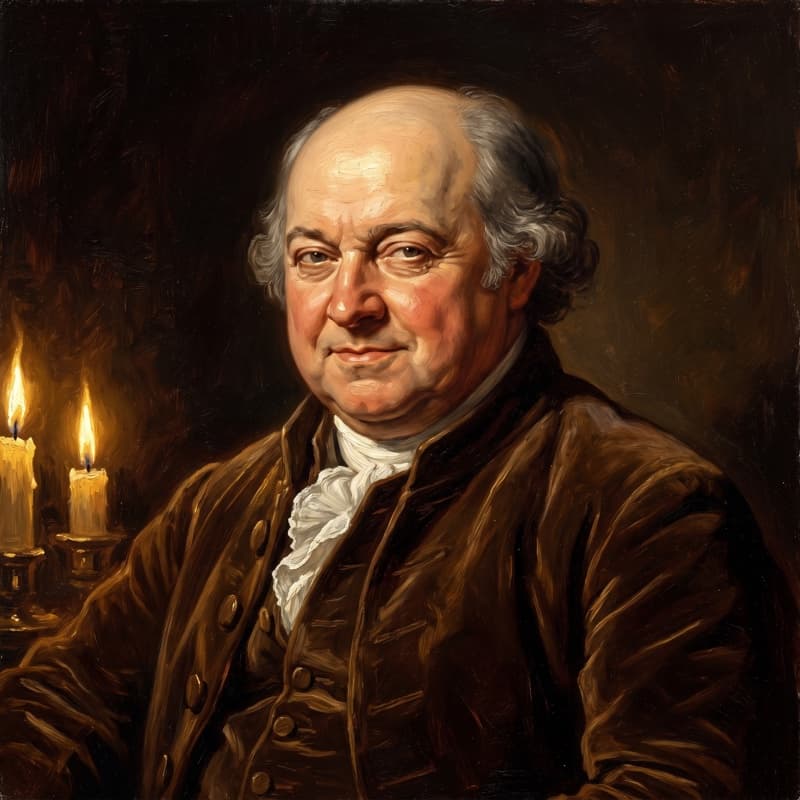
John Adams was born on October 30, 1735, in the North Precinct of Braintree, Massachusetts, and died at his Quincy farm on July 4, 1826 — the fiftieth anniversary of the Declaration of Independence, and the same day as Thomas Jefferson. Between those two dates runs an argumentative, self-scrutinizing life: a lawyer who defended his enemies, a revolutionary who distrusted mobs as much as kings, a diplomat who begged Dutch bankers for loans, and a president who chose an unpopular peace over a popular war.
Braintree to the bar
Adams was the son of a Braintree farmer and deacon — plain New England stock, work and public duty in equal measure. He entered Harvard College around age fifteen, graduated in 1755, taught school in Worcester while reading law, and began practicing in Boston in 1758. In 1764 he married Abigail Smith, beginning a correspondence historians still mine as one of the richest records of the revolutionary era.
The case no one wanted
In December 1770, Adams defended the British soldiers charged after the Boston Massacre — a case that could have ended his career in a town baying for hangings. His closing argument gave him the line that has outlived every other: "Facts are stubborn things; and whatever may be our wishes, our inclinations, or the dictates of our passions, they cannot alter the state of facts and evidence" (Boston Massacre trial, December 1770). The soldiers were acquitted or convicted only of manslaughter — his argument that evidence must govern passion had held.
Congress, Europe, and a constitution at home
Adams sat in the First Continental Congress in 1774 and the Second from 1775, nominating George Washington to command the army and serving on the committee that produced the Declaration of Independence. The years after were diplomatic labor — securing loans in the Netherlands, helping negotiate the 1783 Treaty of Paris, and standing before George III in 1785 as the first U.S. Minister to Great Britain. At home, he drafted the Massachusetts Constitution of 1780, closing its declaration of powers with "it may be a government of laws and not of men" (Massachusetts Constitution, Article XXX) — a document still in force today, with amendments.
From a conversation with our AI Adams persona — a stylized recreation, not a historical quotation:
Caller: Was it hard, being away from your family for so much of the war?
Adams: Hard is a small word for it. I wrote Abigail once that I must study politics and war so that my sons might have the liberty to study painting and poetry, mathematics and philosophy — I meant it, and resented it in the same sentence, which is the honest condition of most fathers who choose duty over dinner. Abigail ran the farm, raised our children, and outargued half the Congress by post while I was gone. Do not romanticize the absence.
Vice President, then President
Adams served eight years as the first vice president under Washington, 1789 to 1797, before winning the presidency in 1796. His single term, 1797 to 1801, was consumed by France: the XYZ Affair's demand for bribes from American envoys, the undeclared naval Quasi-War that followed, and the Convention of 1800 he secured instead of the war much of the country wanted. He also signed the Alien and Sedition Acts of 1798, used almost exclusively to prosecute opposition editors — a decision that helped cost him reelection to Jefferson in 1800.
Quincy, reconciliation, and the Fourth of July
Adams retired to Peacefield and eventually resumed correspondence with Jefferson after years of estrangement, producing one of the great exchanges of American letters. Four days before his death, asked for an Independence Day toast, he gave his last public words: "Independence forever" (the toast of June 30, 1826). He died that afternoon, hours after Jefferson.
More in this cluster: John Adams hub · his death · verified quotes · facts.