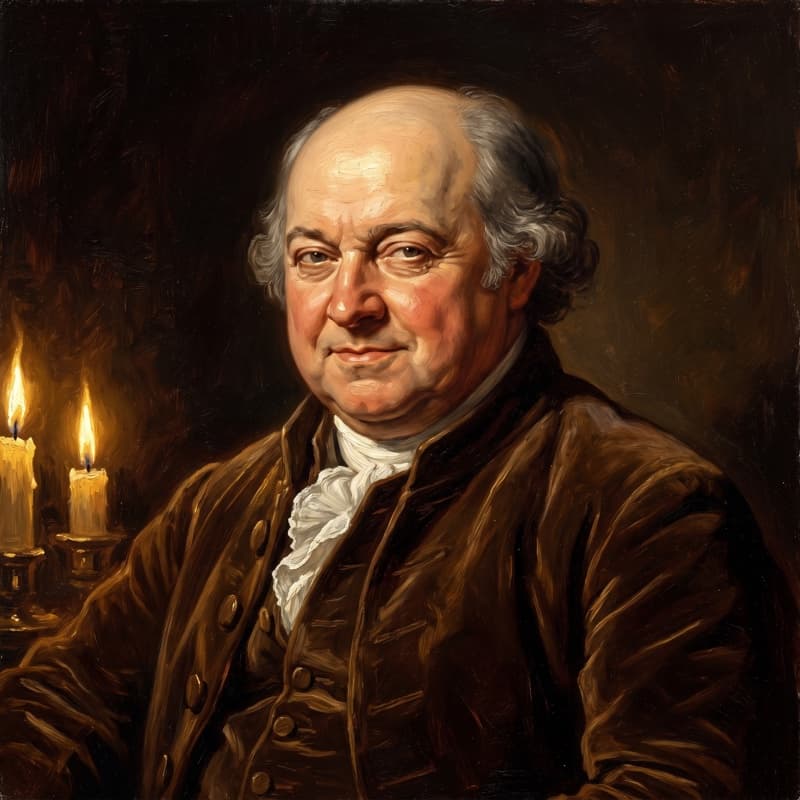
John Adams died at his farm, Peacefield, in Quincy, Massachusetts, on July 4, 1826, at ninety — the fiftieth anniversary, to the day, of the Declaration of Independence he had helped draft as a member of Congress's committee. He died the same day as Thomas Jefferson, his old ally turned rival turned correspondent, who died at Monticello hours earlier. Two of the Declaration's own architects, gone on its golden jubilee — a real, documented coincidence, not embellished after the fact (Miller Center; American Battlefield Trust).
The toast that turned out to be his last words
Four days before he died, on June 30, 1826, the Reverend George Whitney rode out to Peacefield on behalf of Quincy's Fourth of July committee, looking for a toast the ailing ninety-year-old could contribute. Adams gave him two words: "Independence forever." Asked if he wanted to add anything, he answered, "Not a word." The exchange, later printed in The Works of John Adams, edited by Charles Francis Adams, stands as Adams's last recorded public statement (The American Mind) — spoken days before his death, on the very anniversary he had spent fifty years anticipating.
Did he really say "Thomas Jefferson survives"?
Popular tradition holds that Adams's literal last words, spoken as he lay dying on July 4, referenced Jefferson — usually rendered as "Thomas Jefferson survives." The substance checks out: accounts of his final hours describe him speaking of Jefferson, not knowing his old friend had already died that same day. But the tidy, quotable phrasing that circulates today isn't pinned down by a single contemporary transcript the way the June 30 toast is. Treat the sentiment as real and the polished wording as tradition rather than a verified quotation.
A prophecy fifty years early
The July 4 date carries extra weight because of something Adams wrote half a century earlier. The day after Congress voted for independence, on July 3, 1776, he told Abigail that "the Second Day of July 1776, will be the most memorable Epocha, in the History of America" and predicted it would be "celebrated, by succeeding Generations... with Pomp and Parade... Bonfires and Illuminations from one End of this Continent to the other" (Massachusetts Historical Society). He guessed the wrong date — the country celebrates July 4, when the Declaration was adopted, not July 2, when Congress voted for independence — but he was right it would become a day fixed in national memory. Fifty years later, that day fixed itself around him too (National Archives).
From a conversation with our Adams
An excerpt from a conversation with our AI John Adams persona — a stylized recreation built from the historical record, honestly labeled, not a historical quotation.
Caller: Fifty years later, on the same day — did you plan that?
Adams: Plan it! Sir, I could scarcely plan my breakfast in my last years, let alone my exit. I take it as the sort of thing a man notices and does not explain. I spent a great deal of my life insisting the second of July ought to be remembered, and I was wrong about the date and stubborn about the argument — rather the pattern of my whole career. If Providence wished its joke at my expense on the fiftieth anniversary, it kept better company than most of my critics did.
For his life before the ending, see the biography; for the record behind these lines, the quotes page; for the rest, the fact file or the Adams hub. Or ask our Adams persona what he made of a revolution he once called a change "in the minds and hearts of the people."