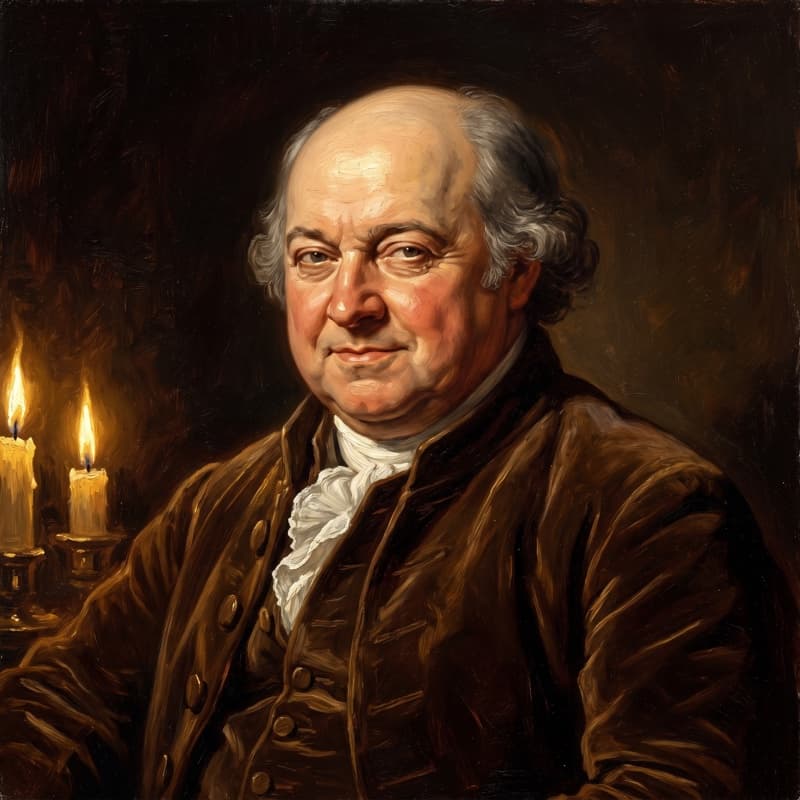
The essential John Adams facts: born October 30, 1735, in Braintree, Massachusetts; defended the British soldiers charged after the Boston Massacre in 1770; married Abigail Smith in 1764, whose son John Quincy Adams became the sixth president; drafted the Massachusetts Constitution of 1780; served as the first vice president (1789–1797) and the second president (1797–1801); died July 4, 1826, the fiftieth anniversary of the Declaration of Independence, hours after Thomas Jefferson. All verified below, along with the popular "facts" that don't survive checking — a facts page that can't say what's false is only doing half the job.
The core facts, with why they matter
Born October 30, 1735, in the North Precinct of Braintree, Massachusetts — the town later renamed Quincy. A deacon's son from a farming family, not the pedigree that usually produces presidents. (Miller Center)
He defended the British soldiers after the Boston Massacre, 1770. Five colonists lay dead on King Street and Boston wanted the soldiers hanged; Adams took their defense anyway, arguing the case had to turn on evidence, not fury: "Facts are stubborn things; and whatever may be our wishes, our inclinations, or the dictates of our passions, they cannot alter the state of facts and evidence." The soldiers were acquitted or convicted only of the lesser charge of manslaughter. (National Park Service)
He married Abigail Smith on October 25, 1764. They had five children, including future president John Quincy Adams; one daughter died in infancy. Their letters are one of the richest personal records of the revolutionary era. (Miller Center)
He drafted the Massachusetts Constitution of 1780. It calls for "a government of laws and not of men" and remains in force today, with amendments — the oldest still-operating constitution he helped write. (Massachusetts Constitution of 1780, Article XXX)
He was the first vice president, then the second president. Adams served under George Washington from 1789 to 1797, then won the presidency himself, serving March 4, 1797, to March 4, 1801. As president he steered the country through the XYZ Affair and the undeclared "Quasi-War" with France without full-scale war, but also signed the Alien and Sedition Acts of 1798, which criminalized "false, scandalous, and malicious" writing against the government. (Miller Center; U.S. Department of State)
He died July 4, 1826 — the same day as Thomas Jefferson. Adams died at his Quincy farm, Peacefield, at age 90, hours after Jefferson died at Monticello — both on the fiftieth anniversary of the Declaration of Independence. (Miller Center)
From a conversation with our Adams
An excerpt from our AI Adams persona — a stylized recreation for readers, not a historical quotation.
Caller: What's a fact about you that people get backwards?
Adams: That I wished to be liked. I did not. I wished to be right, which pays worse in friendship. People remember the soldiers I defended and the peace I made with France as if I calculated the applause — I calculated none of it, and got none for either. If you want a fact worth keeping, let it be that one.
Popular "facts" that need correcting
"Adams became president in 1789." No — 1789 is when he became Washington's vice president. He did not become president until his own inauguration on March 4, 1797. Even some biography sites get this backwards. (Miller Center)
"There are two ways to conquer and enslave a nation: by sword, or by debt." Widely shared as an Adams quote; it isn't one. The editors of the Adams Papers have found no evidence he ever wrote or said it — its earliest traceable appearance in print is around 2002. (Check Your Fact)
"His last words were 'Thomas Jefferson survives.'" The sentiment is real — Adams did speak of Jefferson as he was dying, not knowing Jefferson had died hours earlier — but the exact polished wording isn't secure across contemporary accounts. Treat it as legend built on a true moment, not a verified quotation. His last confirmed public words, four days earlier at a Fourth of July toast, were simply: "Independence forever."
Five things John Adams did (the honest short list)
- Defended the British soldiers charged after the Boston Massacre (1770).
- Served on the committee that prepared the Declaration of Independence (1776).
- Drafted the Massachusetts Constitution, still in force today (1780).
- Served as the first vice president, then the second president (1789–1801).
- Steered the XYZ Affair and Quasi-War with France to a negotiated peace instead of war.
The fact pages can't hold him
Facts are the skeleton; the arguments are the man. Our Adams — an AI recreation, built from the sourced record and labeled as what it is — can walk you through why he took the case nobody wanted, what it took to argue independence past a hesitant Congress, and how he made peace with Jefferson decades after politics broke them apart. Ask him what he'd change about the Sedition Act. He won't dodge it.
More in this cluster: Adams hub · his death · verified quotes · biography.