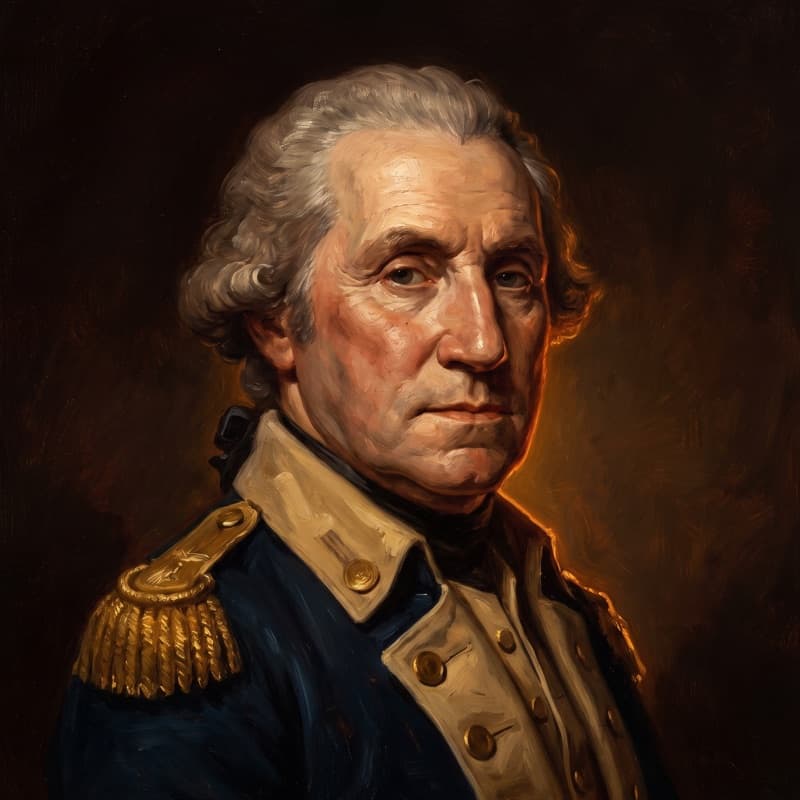
George Washington's most reliably documented lines come from three moments of letting go: the Circular Letter to the States (1783), his resignation of command at Annapolis that same year, and the Farewell Address of 1796. Washington was not a phrasemaker chasing quotability — he wrote (or had written) for the specific job of keeping a fragile republic from tearing itself apart. Read in order, his real words track a life spent handing power back.
1783: Handing back a war
Writing to the states in June 1783, with the army still unpaid and the peace barely settled, Washington named what the new country needed to survive:
"There are four things, which I humbly conceive, are essential to the well being, I may even venture to say, to the existence of the United States as an Independent Power."
He closed the letter with a warning that put the responsibility for the outcome squarely on his readers:
"the fault will be intirely their own"
Six months later, at Annapolis, he gave up command of the army he had led for eight years:
"Having now finished the work assigned to me, I retire from the great theatre of Action; and bidding an Affectionate farewell to this August body under whose orders I have so long acted, I here offer my Commission, and take my leave of all the employments of public life."
Contemporaries treated that resignation, not any battlefield victory, as the act that defined him — a commanding general who simply gave the war back to Congress.
1789 and 1796: The presidency, framed and closed
At his first inauguration, Washington described the new government as an experiment whose outcome rested on the people, not on him:
"the preservation of the sacred fire of liberty and the destiny of the republican model of government are justly considered, perhaps, as deeply, as finally, staked on the experiment entrusted to the hands of the American people."
Seven years later, the Farewell Address — published as a newspaper letter, never delivered as a speech — gave that experiment its owner's manual. On national identity:
"The name of American, which belongs to you, in your national capacity, must always exalt the just pride of Patriotism"
On foreign policy, in the line usually mangled into "no entangling alliances" (that phrase is actually Jefferson's, from 1801):
"It is our true policy to steer clear of permanent alliances with any portion of the foreign world"
On dealing honestly with other nations:
"Observe good faith and justice towards all Nations; cultivate peace and harmony with all."
On education:
"Promote, then, as an object of primary importance, institutions for the general diffusion of knowledge."
And on the civic foundations he thought the republic could not do without:
"Of all the dispositions and habits, which lead to political prosperity, Religion and Morality are indispensable supports."
A maxim he copied, not composed
As a teenager, Washington copied out 110 rules of etiquette in a schoolbook exercise, translated from a 16th-century French Jesuit text. The last one has outlived the rest:
"Labour to keep alive in your Breast that Little Spark of Celestial fire Called Conscience."
It reads like Washington's personal motto, and by the end of his life it may as well have been one — but he transcribed it at about sixteen, decades before anything he actually wrote. Credit it to "the maxims young Washington copied," not to Washington's own pen.
On slavery, in his own words
Washington held enslaved people at Mount Vernon his entire adult life, and late in life he wrote privately that he wanted slavery ended — by law, not by his own unilateral act. In an April 1786 letter to Robert Morris, he said that no one living wished more sincerely than he did to see a plan adopted for the abolition of slavery — but that there was only one proper and effectual way to accomplish it, and that was by legislative authority.
The position does not resolve the contradiction of a slaveholder holding it. It documents that he saw one.
A famous line, reported but not confirmed word-for-word
During the 1783 Newburgh crisis, when unpaid officers were close to mutiny, Washington is remembered for putting on reading glasses in front of the room and saying something close to:
"Gentlemen, you will permit me to put on my spectacles, for I have not only grown gray but almost blind in the service of my country."
It is a well-attested moment — the gesture visibly moved the officers and defused the confrontation — but the exact wording comes down through secondhand retelling, not Washington's own written text of the address. Treat the moment as real and the phrasing as reported.
Quotes Washington never said
- "I cannot tell a lie." The cherry-tree confession is fiction, invented by biographer Mason Locke Weems and first added to the fifth edition (1806) of his Washington biography, six years after the book first appeared in 1800.
- "First in war, first in peace, and first in the hearts of his countrymen." This is Henry "Light-Horse Harry" Lee's eulogy for Washington, delivered to Congress in December 1799 — a line about Washington, not by him.
Hear him argue it himself
Our AI Washington — a stylized recreation, clearly labeled, not a historical record — will walk through why he chose to resign twice rather than hold power once. Ask him about the Circular to the States, the spectacles at Newburgh, or what "permanent alliances" actually meant to a country with no army and no navy. He answers the way the record suggests he thought: plainly, in long sentences built to be read aloud, more interested in precedent than in being quoted.
More in this cluster: George Washington hub · his death · biography · facts.