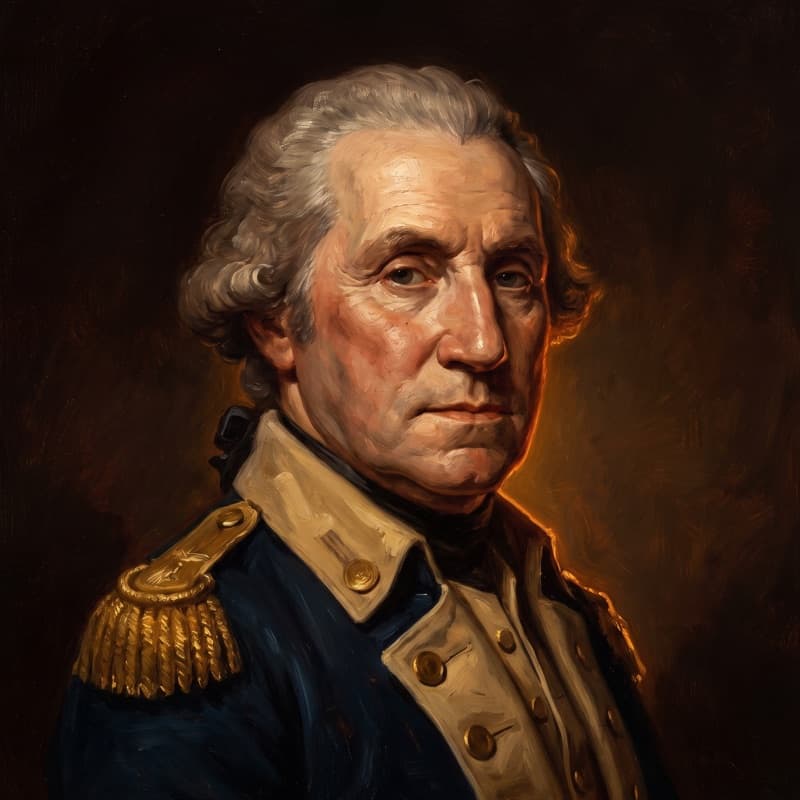
George Washington died at Mount Vernon, Virginia, on the night of December 14, 1799, at the age of 67, two days after a cold he caught while out on his farms in bad weather turned into a severe throat infection (History.com; American Battlefield Trust). It was a fast, ordinary-sounding illness that killed the man who had survived Fort Necessity, Braddock's defeat, and eight years commanding an army that was chronically starved of supplies. No battle did it. A sore throat did.
A wet ride, a hoarse voice
Washington was still riding his own farms daily in retirement, and that routine undid him — he was out inspecting his properties in raw December weather, exposed for hours, and did not treat it as urgent at the time (History.com). Within a day his throat had tightened and his voice had gone hoarse; by the next, he could barely swallow. There was almost no interval between "Washington has a cold" and "Washington is gravely ill."
What medicine could offer in 1799
This is the honest, unglamorous part of the story. Late-eighteenth-century medicine had no antibiotics and no way to open a swelling airway beyond crude, painful measures — and the treatments Washington's doctors reached for, standard for the era, are now generally understood by historians to have done him more harm than good in his final hours. That is less a myth to correct than a hard fact about the limits of 1799 medicine: the conviction that carried Washington through a Revolution could not be out-willed against a closing throat, two centuries before doctors had anything real to offer one.
The line he never said
The best-known Washington quotation isn't one he ever spoke. "I cannot tell a lie," the cherry-tree confession, comes from Mason Locke Weems's biography of Washington — the anecdote first appeared in the book's fifth edition (1806), six years after the first 1800 edition, drawn from a story Weems attributed to an unnamed elderly relative rather than to any eyewitness or document. Historian Henry Cabot Lodge later dismissed it and Weems's other anecdotes as "hopelessly and ridiculously false" (Wikipedia). No specific last words of Washington's own are reliably documented from that final night at Mount Vernon; be skeptical of any version you see presented as a verified quotation.
What is documented is how the country responded once the news reached it. Henry "Light-Horse Harry" Lee delivered a eulogy to Congress that December, and his line — "first in war, first in peace, and first in the hearts of his countrymen" — became the epitaph history remembers, even though it belongs to Lee, not to Washington (American Battlefield Trust).
From a conversation with our Washington
An excerpt from our AI Washington persona — a stylized recreation, clearly labeled, not a historical record. His knowledge, like the man's, ends before that December.
Caller: People still quote your last words. What do you make of that?
Washington: I make very little of it, because I doubt anyone wrote them down accurately, and I was in no state that night to compose for posterity. A man dying of a shut throat is not delivering an address. I would rather be remembered for the two times I put power down than for whatever I may have gasped at the end. Handing back a commission, declining a third term — those I did on purpose, with a clear head, for the country to see. Weigh me by those.
He can't tell you about that night — ask him about everything before it
Our Washington's knowledge ends before his final illness. But the eight years of command, the resignation at Annapolis, the presidency he built from nothing, and the Farewell Address he wrote instead of running again — all of that he can discuss directly. Ask him why he walked away from power twice when almost no one in his position ever had. He has time for it.
More in this cluster: Washington's verified quotes · his biography · fact file · back to the Washington hub.