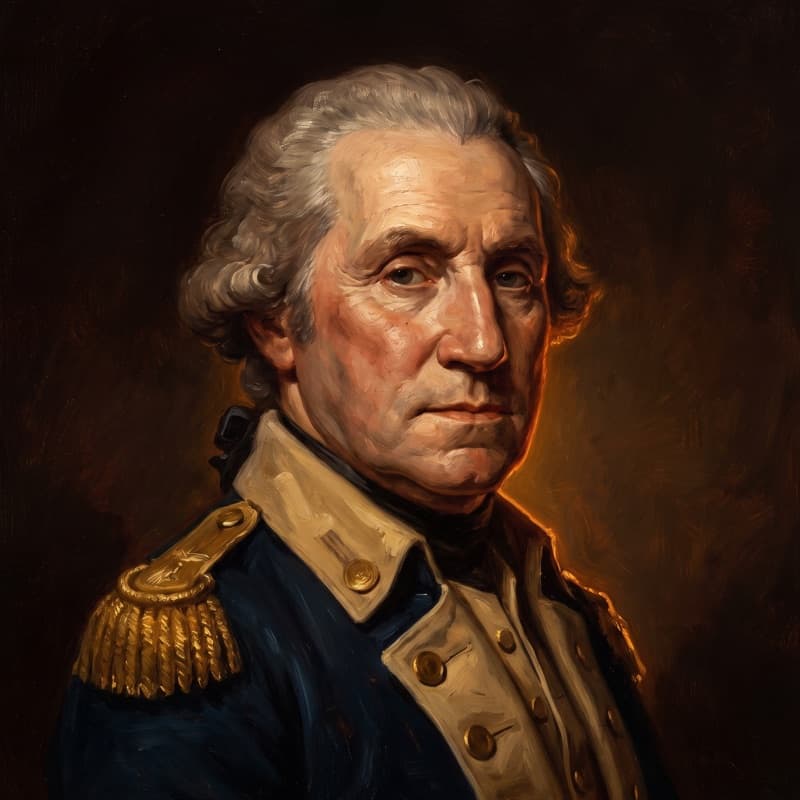
George Washington was born on February 22, 1732, at Popes Creek in Virginia's Northern Neck, and died at Mount Vernon on December 14, 1799, at 67 — a life opening on a colonial tobacco farm and closing eight months after he watched someone else sworn in as president. In between sits a rare founding story: a man handed supreme power twice, over an army and then a nation, who voluntarily set it down both times.
Washington said as much himself. Resigning his commission at Annapolis in December 1783, he told Congress he was ready to "retire from the great theatre of Action" and take "leave of all the employments of public life." He meant it, briefly — the country would not let him stay retired long.
Surveyor before soldier
Washington's father died when he was eleven, so there was no funded trip to England for a gentleman's education. At six his family had moved to Ferry Farm; from there he made himself a surveyor and, by his early twenties, a Virginia militia officer. The French and Indian War taught him command the hard way — Fort Necessity's surrender and Braddock's 1755 defeat were the tuition. He survived both.
Eight years holding an army together
Chosen commander-in-chief by the Second Continental Congress on June 15, 1775, Washington spent the next eight years less as a battlefield genius than as the man who kept a starving, underpaid, often mutinous army from dissolving. At Newburgh in March 1783 he talked down officers threatening to march on Congress over unpaid wages. That June, his Circular Letter to the States named what he believed the nation could not survive without: "there are four things... essential to the well being... of the United States as an Independent Power." That December, he resigned his commission and went home to farm.
From a conversation with our Washington
An excerpt from a conversation with our AI Washington persona — a stylized recreation, honestly labeled, not a historical quotation.
Caller: Weren't you tempted to just keep the command?
Washington: Tempted is a soldier's word for a question a farmer already answered. I had watched what unchecked authority does to men who hold it too long, and did not intend to become the example. Handing it back taught the country something a speech could not: that power here was meant to be lent, not kept.
Building a presidency from nothing
Mount Vernon's quiet ended when he was called to preside over the 1787 Constitutional Convention in Philadelphia, then elected first president under the document it produced. Inaugurated in New York City on April 30, 1789, he spent two terms improvising an office with no precedent — a cabinet, a rhythm of governance, a two-term limit set by walking away, not by law. His Farewell Address, published as a newspaper letter on September 19, 1796, carried the warning he wanted kept: steer clear of "permanent alliances with any portion of the foreign world," and guard against the "spirit of party" he feared would outlast him.
The last chapter at Mount Vernon
The presidency ended March 4, 1797, and he returned to farming — and to the plantation's enslaved workforce, whose labor had sustained his estate even as he wrote privately, in an 1786 letter to Robert Morris, that he wished to see "a plan adopted for the abolition of it" through legislative means. He died at Mount Vernon in December 1799, eight months into Adams's presidency, after a rapidly worsening throat illness. Congress's eulogist, Henry Lee, called him "first in war, first in peace, and first in the hearts of his countrymen" — words about him, not from him, an early sign of the myth-making to come.
Continue the conversation — literally
You have just read the recorded life. Our Washington — an AI recreation, built on the sourced record and labeled as such — speaks from inside it. Ask him about losing at Fort Necessity, resigning twice, or the gap between the Robert Morris letter and Mount Vernon.
More in this cluster: Washington hub · his death · verified quotes · facts.