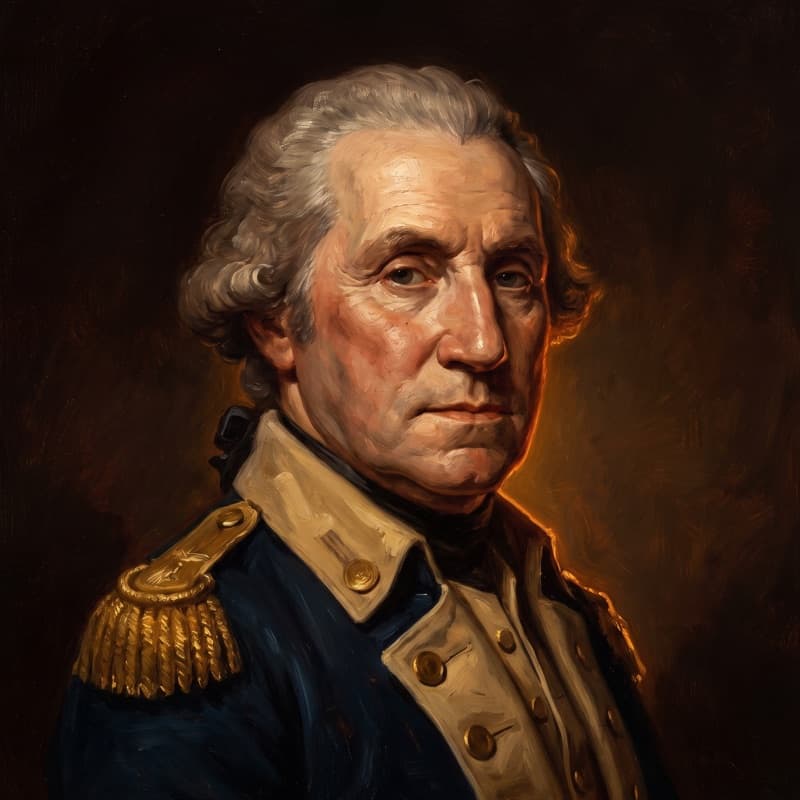
Start with what's documented: George Washington was born February 22, 1732, at Popes Creek in Virginia's Northern Neck; he commanded the Continental Army for eight years with no formal military-academy training; he presided over the 1787 Constitutional Convention; he served as the first U.S. president from 1789 to 1797, then walked away from power on his own terms — twice; and he died at Mount Vernon on December 14, 1799, at age 67. He also enslaved people at Mount Vernon his entire adult life. A facts page that leaves either side out isn't giving you the man. Here's what's verified, and what popular history gets wrong.
The core facts, with why they matter
Born 1732 at Popes Creek, raised at Ferry Farm. At age six his family moved to the Virginia property later preserved as Ferry Farm, where he spent his boyhood — no British schooling, no university, a self-made education in surveying instead (National Park Service; Historic Kenmore and George Washington's Ferry Farm).
He left power twice, voluntarily. On December 23, 1783, at Annapolis, he resigned his commission as commander-in-chief to Congress rather than keep the army under his own command — telling the assembled body he was retiring "from the great theatre of Action" (Wikisource, Resignation as Commander-in-Chief). Then, after two terms as president, he declined a third and left office March 4, 1797, when John Adams was inaugurated (Miller Center). No law required either exit. That's the fact that separates him from most people who have ever held that much power.
The Farewell Address was never spoken. Published as a newspaper letter on September 19, 1796, it warned against the "spirit of party" and permanent foreign alliances — not delivered as a speech, despite how it's often pictured (Miller Center: Key Events; Wikisource).
He presided over the Constitutional Convention but rarely spoke during it. As the 1787 Philadelphia convention's president, his role was steering the room, not dominating debate (Wikipedia).
He held enslaved people at Mount Vernon while privately favoring legislative abolition. In an April 12, 1786 letter to Robert Morris, Washington wrote there was "not a man living who wishes more sincerely" to see slavery abolished — but insisted it could only happen through "Legislative authority," not private action (Teaching American History). He kept enslaving people regardless, for the rest of his life.
He died at 67 of a fast-moving throat illness, not a mythologized cause. A cold caught riding his farms in bad weather worsened rapidly over two days into a severe throat infection that killed him at Mount Vernon (History.com; American Battlefield Trust).
From a conversation with the Calls From The Past George Washington persona — an AI reconstruction, not a historical quotation:
"You ask which fact I'd keep, if only one survived. Not the crossing, not the inauguration. That I handed the sword back. A man who cannot let go of what he's won has not yet proven he deserved to hold it."
Popular "facts" that need correcting
"I cannot tell a lie" — the cherry tree. Invented whole cloth by biographer Mason Locke Weems and first added to the fifth edition (1806) of his Washington biography, six years after the book first appeared in 1800 (National Park Service). Even 19th-century historians called it "hopelessly and ridiculously false" (Wikipedia).
"Washington had wooden teeth." His dentures held no wood — they were built from human teeth, hippopotamus and other animal ivory, and metal, with ivory staining dark from wine and food likely creating the wooden look (Wikipedia).
"First in war, first in peace, and first in the hearts of his countrymen." Widely quoted as if Washington said it about himself — it's actually Henry "Light-Horse Harry" Lee's eulogy for Washington, delivered to Congress in December 1799 (American Battlefield Trust). A tribute from someone else, not a Washington line.
Keep pulling the thread
The full narrative is on the biography page; his final days are on the death page; his verified words — Farewell Address, resignation speech, and more — are on the quotes page. Or skip the summary and ask him directly: our Washington persona, an AI recreation built from the sourced record and always labeled as such, is ready to talk about what it actually took to walk away twice.