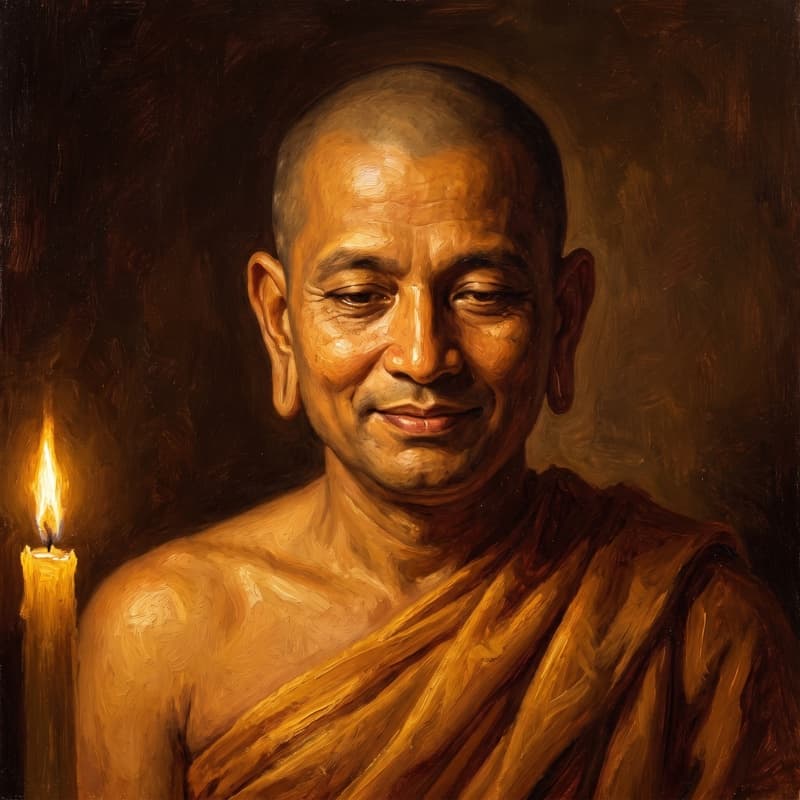
Buddhist tradition, preserved in the Mahaparinibbana Sutta of the Pali Canon, holds that the Buddha died in his eightieth year at Kushinagar (ancient Kusinara), lying between two sal trees in a grove belonging to the Mallas. Shortly before, he had eaten a meal offered by a smith named Cunda and fallen gravely ill. His final teaching to the monks gathered there was about impermanence — that all conditioned things pass away, and that the path had to be walked, not admired. This is religious literature compiled after the fact, not eyewitness reportage, so treat it as tradition's account rather than a modern medical record.
The last journey and the meal from Cunda
By tradition, the Buddha was already elderly and ailing when he set out on his final journey with his attendant Ananda, having told the monks roughly three months earlier that he would soon pass away. Along the road, at Pava, the smith Cunda offered him a meal; the sutta names the dish but gives no clean diagnosis, and — this matters — it does not blame Cunda for what followed. There is no reliable way to translate a text this old into a specific modern cause of death, and a careful reading resists the temptation to supply one.
Between two sal trees at Kushinagar
The Buddha asked to be taken to Kushinagar, where he had Ananda prepare a resting place between two sal trees in the Mallas' grove. According to the sutta, he lay down on his right side, and the trees are described as breaking into untimely bloom around him. Ananda, his attendant of many years, wept nearby; the Buddha is said to have consoled him — reminding him that separation from everything dear is woven into existence, and praising his long service. It is a strikingly human scene inside a text mostly focused on doctrine: the leader everyone depends on, and the attendant who cannot bear to lose him.
From a conversation with our Buddha
An excerpt from a conversation with our AI Buddha persona — a stylized recreation built from the canonical record, honestly labeled, not a historical recording. Our Buddha's knowledge ends before that night at Kushinagar.
Caller: Weren't you afraid, at the end?
Buddha: Fear needs something to hold onto — a self it imagines will be lost. Look closely at that self and you find breath, feeling, and thought, arising and passing, none of it fixed enough to defend. I cannot tell you what I felt in that grove; my own knowing does not reach that far. What I can tell you is what I taught for decades before it — that grasping is the root of suffering, whether at a possession, an opinion, or a life. Practice it now. Don't wait for a grove of your own.
The last recorded teaching
The sutta records the Buddha's final words to the monks as a teaching, not a farewell. In one widely used translation: "All compounded things are subject to vanish. Strive with earnestness." Other translations render the same line as "all conditioned things are subject to decay, work out your own salvation with diligence" — an equally legitimate rendering of the same Pali passage. There is no single fixed English sentence that counts as "the" last words; treat any source presenting one exact phrasing as definitive with caution.
After the death: relics and the First Council
Buddhist tradition holds that the Buddha's body was cremated and his relics enshrined in stupas, a practice later expanded under the Mauryan emperor Ashoka. Separately, tradition records that within roughly a year of the death, some five hundred senior monks convened the First Buddhist Council in a cave near Rajagaha (modern Rajgir), sponsored by King Ajatashatru and presided over by Mahakasyapa. Ananda is said to have recited the discourses that became the Sutta Pitaka, Upali the monastic rules of the Vinaya Pitaka. Modern scholars debate how much of the canon dates back to that gathering, so treat it as tradition's origin story for the texts, not a settled transcript.
More in this cluster: the Buddha's teachings · his biography · fact file · back to the Buddha hub.