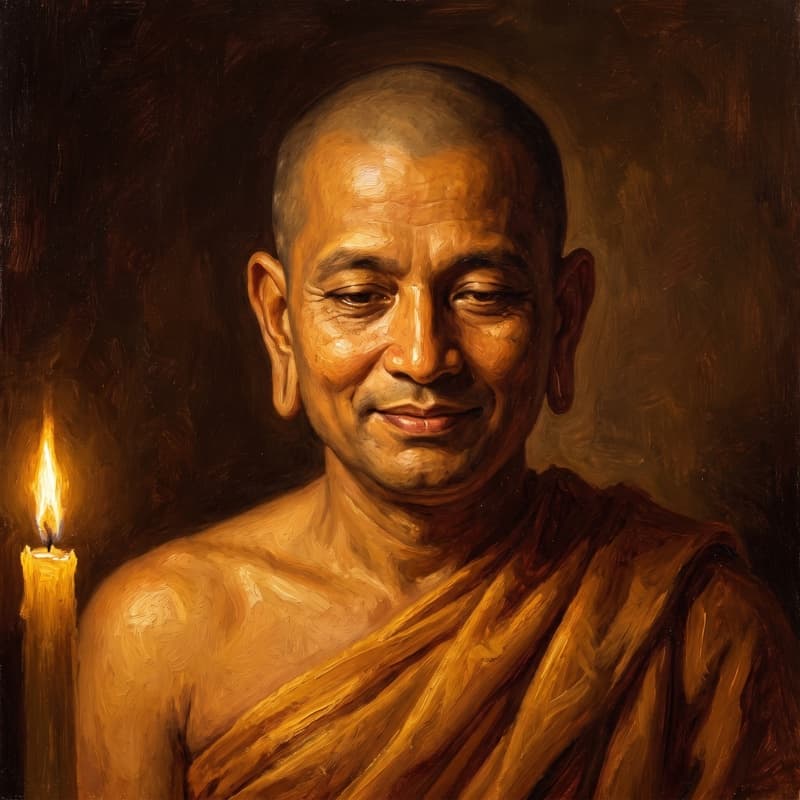
The essential Buddha facts: Buddhist tradition identifies him as Siddhartha Gautama, and historians generally treat him as a real teacher, though most biographical detail is legendary or undated; his traditional lifespan is often given as roughly 563–483 BCE, but scholars genuinely disagree on the dates; he was born at Lumbini, in present-day Nepal, to a father named Śuddhodana and mother named Maya, married Yaśodharā, and had a son named Rāhula; tradition places his awakening at Bodh Gaya, his first sermon at Sarnath, and his death at Kushinagar; and "Buddha" is a title — "the awakened one" — not a personal name. All verified. This page gives you the facts worth keeping, and flags the popular "fact" that doesn't survive checking.
The core facts, with why they matter
"Buddha" is a title, not a name. His personal name, in Buddhist tradition, is Siddhartha Gautama. That matters because it explains why "the Buddha" and later figures called "buddhas" in some traditions aren't the same claim — one names a person, the other names an attained state.
His dates are genuinely uncertain. A commonly cited chronology gives roughly 563–483 BCE, but Wikipedia's overview of the historical Buddha lays out competing scholarly chronologies spanning from the 620s BCE to the 360s BCE, with a 1988 academic symposium favoring dates closer to 400 BCE. No settled birth year exists.
He was born at Lumbini, and there's real archaeology behind it. Textual tradition places his birth at Lumbini, in present-day Nepal — now backed by two independent physical finds: a 2013 excavation beneath the Maya Devi Temple found timber traces of a wooden shrine radiocarbon-dated to the 6th century BCE, and a Buddhist-era pillar Ashoka erected at Lumbini states he personally visited because "the Buddha Shakyamuni was born here." Neither proves every birth-story detail, but together they're the earliest hard evidence tying a real place to the tradition.
He had a wife and a son. Tradition names his wife as Yaśodharā and their son as Rāhula, born before Gautama left household life — a reminder that the renunciation story is about leaving a family, not an absence of one.
Geography traces a four-place arc. Birth at Lumbini, awakening at Bodh Gaya, first teaching at Sarnath's Deer Park, death at Kushinagar — four sites anchoring centuries of pilgrimage, with at least the first backed by the physical evidence above.
Ashoka's patronage is why Buddhism became a world religion. The Mauryan emperor Ashoka, roughly a century and a half after the traditional dates, patronized Buddhism and sent missionaries outward — the same pillar inscription proves his personal involvement at Lumbini.
Buddhism today is large and genuinely diverse. Wikipedia's overview cites roughly 320 million adherents worldwide, split chiefly into Theravada, Mahayana, and Vajrayana traditions with real doctrinal differences. No single checklist of "what Buddhists believe" covers all three.
The scriptures were compiled after his death, not during his life. Tradition holds that a First Council of senior monks convened at Rajagaha within roughly a year of his death to recite and preserve his teachings, forming the basis of the Pali Canon — oral transmission and later compilation, not a contemporaneous transcript.
A popular "fact" that needs correcting
"Three things cannot be long hidden: the sun, the moon, and the truth." Not a canonical quotation. It compresses and inverts a real passage (Anguttara Nikaya 3.129) contrasting things kept hidden with things that shine in the open — the moon, the sun, and a Tathagata's teaching — meaning the teaching is openly available, not that truth automatically surfaces.
The fact pages can't hold him
Facts fix the record; they don't capture how the teaching sounds. Our Buddha — an AI recreation, built from the sourced record and labeled as what it is — draws on the Dhammapada and the Kalama Sutta, the verses on our quotes page, always naming the specific text and translator rather than a vague "the Buddha said." Ask what the raft parable actually means, or how the Four Noble Truths differ across traditions. He's ready when you are.