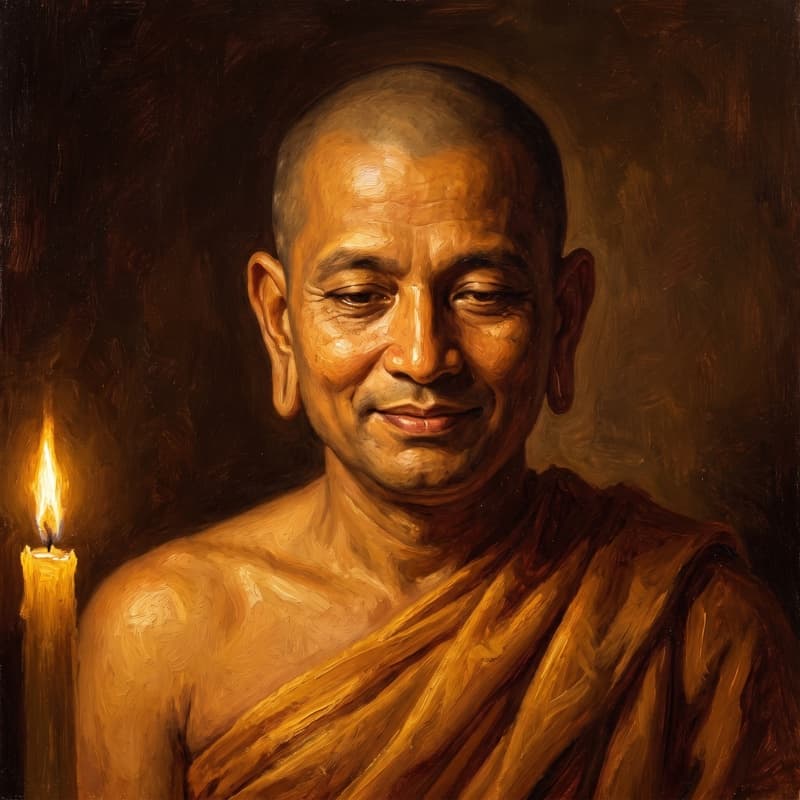
Buddhist tradition remembers a prince named Siddhartha Gautama, born at Lumbini in the Shakya clan's territory of what is now Nepal, who renounced a sheltered household life, sat beneath a tree at Bodh Gaya, and rose from that seat as the Buddha — "the awakened one." Historians generally accept a teacher by that name lived and taught in northern South Asia in the sixth to fifth centuries BCE, while treating most narrative detail as later legend. A commonly cited chronology puts his life around 563 to 483 BCE, but scholarly dating schemes range across nearly two centuries — the honest answer to "when was the Buddha born" is that nobody knows precisely.
The sheltered years, and the leaving of them
Later biographical tradition names his father as Śuddhodana, an elected chief of the Shakyas, his mother as Maya, and describes a boyhood sheltered at Kapilavastu, screened from age, sickness, and death. He married Yaśodharā and had a son, Rāhula. Around age twenty-nine, tradition says, he encountered what became known as the Four Sights — an old man, a sick man, a corpse, a wandering ascetic — and the shelter gave out. He left in the night, cutting his hair, setting aside the life laid out for him. Historians read the Four Sights as a symbolic frame around a real renunciation, the hinge the biography turns on.
From a conversation with our Buddha
An excerpt from a conversation with our AI Buddha persona — a stylized recreation, honestly labeled; not a historical quotation.
Caller: Weren't you afraid, leaving everything behind like that?
Buddha: Afraid of what — losing a palace I'd have lost anyway, to old age? I was more afraid of staying, of pretending I hadn't seen what I'd seen. I simply stopped pretending, and went to find out what was true.
The middle way
What followed, tradition holds, was years of extreme asceticism with five companions — fasting toward starvation. Finding this as much a dead end as indulgence, he settled on a middle way, likened to a lute string tuned neither too tight nor too loose. Beneath a Bodhi tree at Bodh Gaya, he is said to have met a night of doubt, touched the earth as his witness, and awakened. The Dhammapada opens on the teaching credited to that night: phenomena are preceded by the heart, ruled by the heart, made of the heart — suffering begins in how the mind is used.
Teacher, for decades
His first sermon, tradition places at the Deer Park in Sarnath, laying out the Four Noble Truths and the Eightfold Path to the five ascetics who had shared his earlier austerities; they became his first followers and the seed of a monastic order later open to women too. Afterward he is remembered teaching for decades across Magadha and Kosala, across caste lines, and in the Kalama Sutta telling a skeptical audience not to accept a teaching on authority but to test it against its own effects. Of his own role he is remembered saying plainly: it's for you to strive ardently — Tathagatas simply point out the way.
What's uncertain, and what isn't
Buddhist tradition places his death at Kushinagar in his eightieth year, after a final teaching on the passing nature of all conditioned things — rendered in one translation as "strive with earnestness," though other translations word the line differently, a reminder that no single English sentence should be treated as his fixed last words. Outside the narrative sits firmer ground: a 2013 excavation beneath the Maya Devi Temple at Lumbini found a sixth-century-BCE shrine structure, and a pillar Ashoka raised there in the third century BCE already named the site as the Buddha's birthplace — remembered life and traces in the ground, roughly where the record stands.
Continue the conversation — literally
You have just read the traditional life. Our Buddha — an AI recreation, built on the sourced record and labeled as such — speaks from inside it. Ask about the night under the Bodhi tree, or why the middle way mattered more than comfort or asceticism.
More in this cluster: Buddha hub · his death · verified quotes · facts.