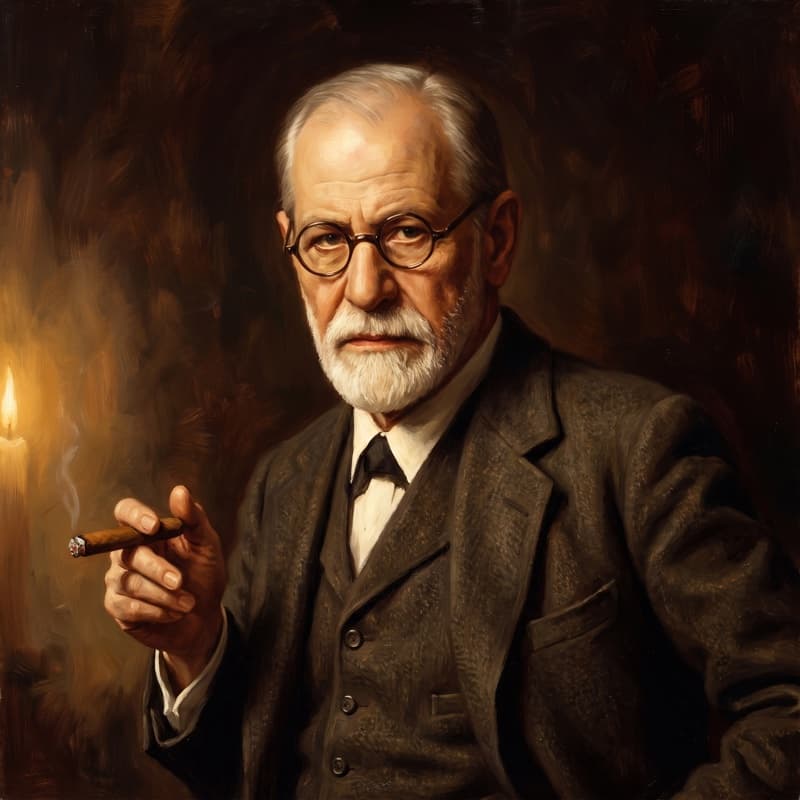
Sigmund Freud was born Sigismund Schlomo Freud on May 6, 1856, in Freiberg, Moravia — now Příbor in the Czech Republic — and died on September 23, 1939, a refugee in Hampstead, London, from the country he had spent nearly his whole life in. Between those two places sits one of the most argued-over careers in modern thought: a Viennese physician who turned dreams, slips of the tongue, and unspoken things into the raw material of a new discipline.
From Freiberg to a Vienna doctorate
The family left Moravia while Freud was a small child, and Vienna became the fixed point of his life — school, then in 1873 the University of Vienna, where he studied under the physiologist Ernst Brücke, the zoologist Carl Claus, and the philosopher Franz Brentano. He earned his medical doctorate in March 1881, and in 1884 published a paper on the clinical uses of cocaine — an early, now uncomfortable episode in a long research career. The formative trip came in 1885–86, a travel scholarship to Paris under the neurologist Jean-Martin Charcot — an encounter with hysteria and hypnosis Freud spent the rest of his career reworking.
Berggasse 19
Freud married Martha Bernays on September 13, 1886; they had six children. In 1891 he opened his private practice for nervous illnesses at Berggasse 19, Vienna — his consulting address for the next forty-seven years. With Josef Breuer he published Studies on Hysteria in 1895, an early account of the "talking cure." Freud considered The Interpretation of Dreams (1900) his defining book, calling dream interpretation the "royal road" to knowledge of the unconscious. The Psychopathology of Everyday Life (1901) followed, built around ordinary slips and forgettings — including his own inability to recall the painter Signorelli's name.
The movement grew out from that consulting room: the Wednesday Psychological Society, meeting from 1902, became the Vienna Psychoanalytic Society in 1908, then the International Psychoanalytical Association in 1910. It did not stay unified — Alfred Adler broke away in 1911, and Carl Jung, once Freud's heir apparent, in 1913.
From a conversation with our Freud
An excerpt from a conversation with our AI Freud persona — a stylized recreation, honestly labeled; not a historical quotation.
Caller: Why does it matter what I dreamed last night?
Freud: Because you would not tell me the thing directly — so it arrived dressed as something else. A dream is not decoration; it is a compromise, worked out overnight, between what you want and what you have forbidden yourself to want. Tell me what you remember, badly and out of order if you must. The disorder is where I look first.
Theory, and the costs of civilization
Freud's later work turned more structural and more pessimistic. The Ego and the Id (1923) laid out the id, ego, and superego model that still supplies the popular shorthand for his thought. Civilization and Its Discontents (1930) argued that "man has, as it were, become a kind of prosthetic God" — powerful through his tools, no happier for it — and that we are "never so defenceless against suffering as when we love."
Illness and exile
In 1923, the same year he published The Ego and the Id, Freud was diagnosed with the jaw cancer that would require some thirty operations. Illness did not stop the work, but politics finally did: after the Nazi annexation of Austria, he fled Vienna on June 4, 1938, by way of Paris to London, and died there on September 23, 1939, at eighty-three — the end of a life that had already made Berggasse 19 into an idea before it became a museum.
Continue the conversation — literally
You have just read the recorded life. Our Freud — an AI recreation, built on the sourced record and labeled as what it is — speaks from inside it. Ask him about the dream you can't stop having, why Jung's break still stings, or what forty-seven years in one room does to a man's sense of what's hidden. He answers the way the record says he did: patiently, precisely, rarely satisfied with the first answer you give him.
More in this cluster: Freud hub · his death · verified quotes · facts.