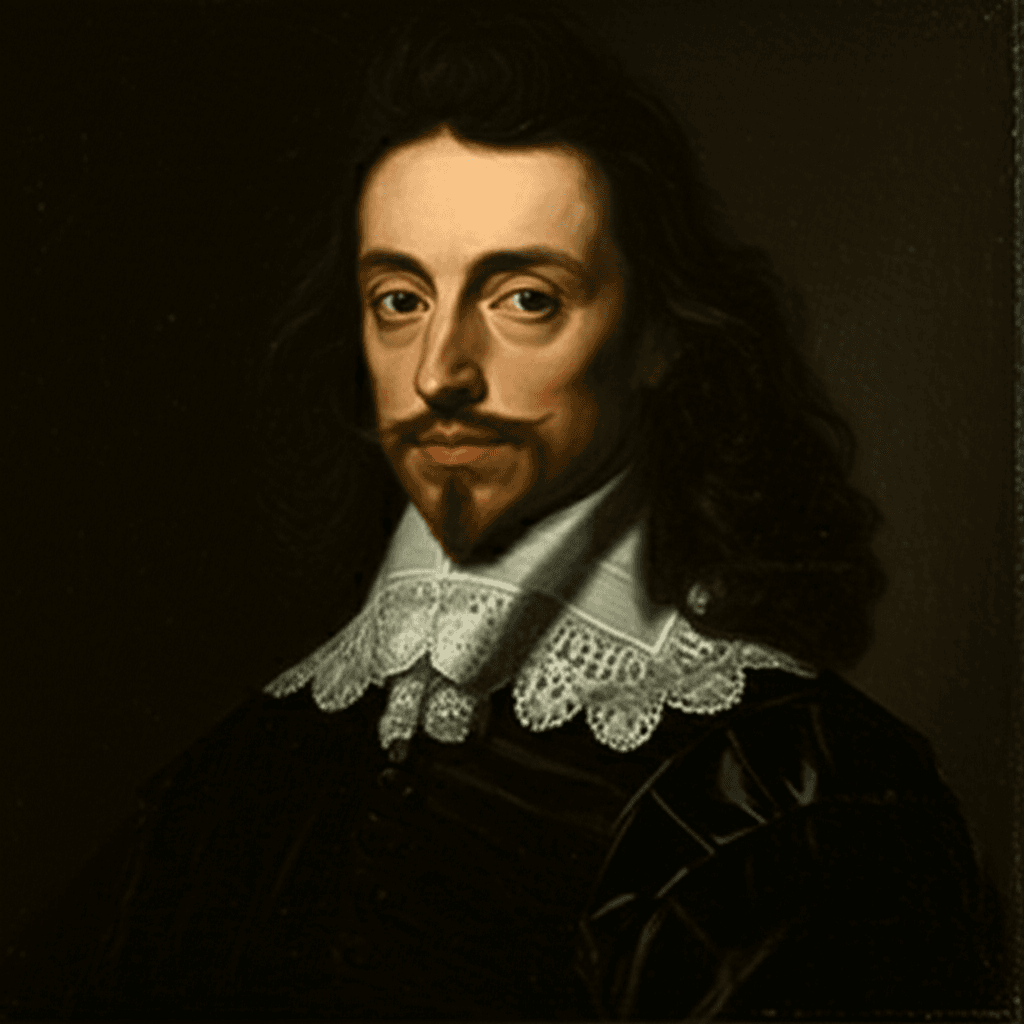
The essential Samuel Pepys facts: born February 23, 1633, above his father's tailor shop in London; kept a shorthand diary from January 1, 1660, to May 31, 1669; served as Clerk of the Acts to the Navy Board and, later, Secretary to the Admiralty; buried Parmesan cheese in his garden during the Great Fire of 1666; served as President of the Royal Society from 1684 to 1686, in office when Newton's Principia went to press; and died at Clapham on May 26, 1703, leaving his library to Magdalene College, Cambridge. All verified against the diary text and Pepys's own college archive. This page gives the facts worth keeping — and flags the popular "facts" that don't survive checking.
The core facts, with why they matter
A tailor's son, educated on a scholarship. Pepys reached Magdalene College, Cambridge, in 1651 only because he won a place there (Magdalene College). The distance between that shop and the Admiralty is the whole shape of his career.
The diary was never meant to be read. Written in Shelton's shorthand from age twenty-seven, it runs to roughly 1.25 million words (Wikipedia); Pepys disguised his most private passages further still, switching into phonetic French or Spanish inside the cipher itself — secrecy that became, by accident, one of the best firsthand records of Restoration London.
He carried the King's order, then buried his cheese. On September 2, 1666, Pepys reported the Great Fire to Charles II at Whitehall and carried back the order that houses be pulled down as firebreaks (Wikisource). Two days later, with the Navy Office threatened, he dug a pit and buried papers, wine, and — his own words — "my Parmazan cheese, as well as my wine and some other things." The joke survives without the context: an administrator saving his records and his supper in the same afternoon.
He saw the plague arrive, and admitted it made him richer. His diary records the first red crosses on doors in Drury Lane on June 7, 1665 (Wikisource); by year's end, with London's death toll past 68,000, he confessed "I have never lived so merrily (besides that I never got so much) as I have done this plague time." He didn't soften that for posterity.
He ran the Navy, then went to the Tower for it. Clerk of the Acts to the Navy Board from 1660, Pepys became Secretary to the Admiralty in 1673 and an MP for Castle Rising, then Harwich (Wikipedia). That prominence twice landed him in the Tower on suspicion of treason — 1679 and briefly 1690 — with no charge ever proven.
He was President of the Royal Society when Newton's Principia was approved. Pepys served as President from December 1684 to November 1686 (Wikipedia, list of presidents); the imprimatur on the Principia Mathematica carries his name from that term.
From a conversation with our Pepys
An excerpt from our AI Pepys persona — a stylized recreation, honestly labeled; not a historical quotation.
Caller: Be honest — was it really the cheese you worried about most while London burned?
Pepys: Honest, you say — that is what this diary was for. I had carried the King's own order that day, and still, when the pit was dug, I thought first of the papers, then the wine, then, yes, the Parmazan. A man does not stop being himself because the city is on fire. I set the cheese down because it was true, not dignified — and it is the undignified things people remember me for.
Popular "facts" that need correcting
"Pepys always ended entries with 'And so to bed.'" A popular composite, not one recurring line — entries end "So home and to bed," "and so to bed," or mid-sentence, not a fixed catchphrase.
"A 2020 viral quote shows Pepys comparing the plague to coronavirus lockdown." Fake — it comes from a parody Twitter account, not the diary; Charles II, not a queen, reigned throughout (Prospect Magazine).
"The diary covers his whole life." It doesn't. Pepys stopped writing in 1669, fearing for his eyesight, and lived another thirty-four years — through the Admiralty secretaryship, two Tower imprisonments, and the Royal Society presidency — almost none of it in his own hand (Magdalene College).
Five things Samuel Pepys did (the honest short list)
- Kept a nearly decade-long shorthand diary of Restoration London, 1660–1669.
- Reported the Great Fire to Charles II and carried back the order to demolish houses as firebreaks.
- Administered the Navy Board, then the Admiralty, through two major wars.
- Served as President of the Royal Society, 1684–1686, during Newton's Principia.
- Left his 3,000-volume library, diary included, to Magdalene College, Cambridge.
The fact pages can't hold him
Facts are the skeleton; the voice is the man. Our Pepys — an AI recreation, built from the sourced record and labeled as what it is — can tell you what the Navy Office smelled like on a bad day, and why a man saving his cheese from the fire still worried more about his ledgers. Ask him what he really thought while the city burned. He's ready when you are.
More in this cluster: Pepys hub · his final years and death · his verified quotes · his full biography.