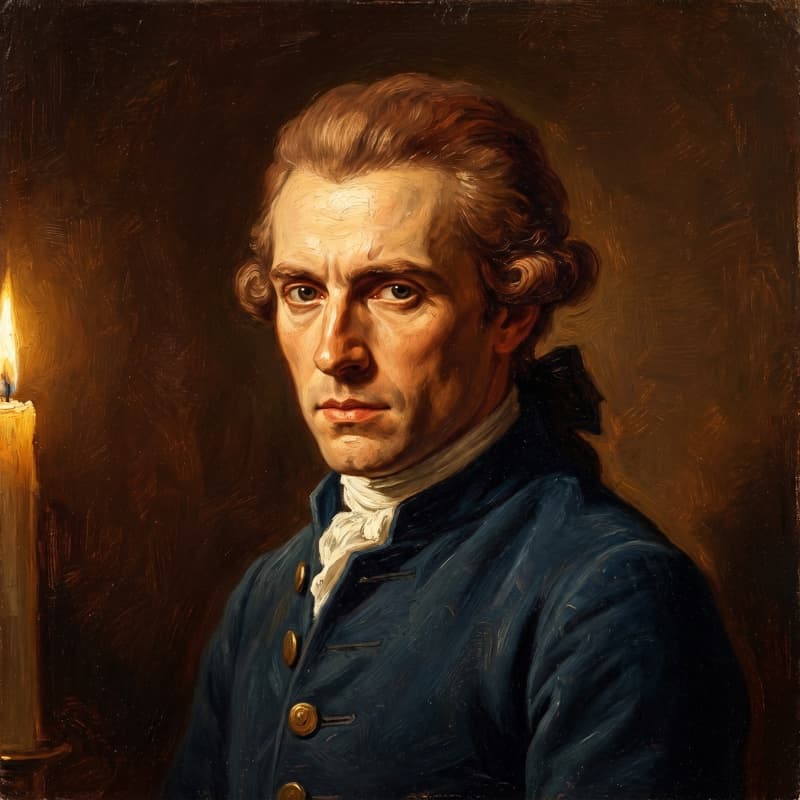
Alexander Hamilton left an enormous paper trail — essays, love letters, a legal opinion, a statement written days before he died — and almost none of it sounds like a poster. His real sentences are long and argumentative, built to win a specific fight. Here are six lines that trace directly to his surviving documents, in the order he wrote them, followed by the ones the internet keeps handing him that he never wrote.
1775: Rights before parchment
As a King's College student, defending the Continental Congress against a Loyalist pamphleteer, Hamilton grounded rights in nature rather than royal charter:
"The sacred rights of mankind are not to be rummaged for, among old parchments, or musty records. They are written, as with a sun beam, in the whole volume of human nature, by the hand of the divinity itself; and can never be erased or obscured by mortal power."
That's from The Farmer Refuted, February 23, 1775 — a student's pamphlet, not yet a Founding Father's.
1788: Energy in the executive, restraint in the courts
Arguing for a single, empowered president rather than a weak committee, he wrote the line most associated with his politics:
"Energy in the Executive is a leading character in the definition of good government."
And on the courts, which he thought the weakest of the three branches by design:
"The judiciary, on the contrary, has no influence over either the sword or the purse; no direction either of the strength or of the wealth of the society; and can take no active resolution whatever."
1791: The bank, defended
As Treasury Secretary, Hamilton put the doctrine of implied powers in writing to defend the Bank of the United States against Jefferson's narrower reading of the Constitution:
"It is unquestionably incident to sovereign power to erect corporations, and consequently to that of the United States, in relation to the objects intrusted to the management of the government."
1804: A letter to Eliza
A week before the duel, he wrote a farewell letter to his wife, to be delivered only if he did not come home, telling her plainly why he could not have avoided the meeting with Burr:
"If it had been possible for me to have avoided the interview, my love for you and my precious children would have been alone a decisive motive."
That's from Hamilton's farewell letter to Elizabeth, dated July 4, 1804.
1804: Before Weehawken
Found among his papers after his death, this statement explains why Hamilton went to the dueling ground intending not to kill Aaron Burr:
"I have resolved if our interview is conducted in the usual manner, and it pleases God to give me the opportunity, to reserve and throw away my first fire, and I have thoughts even of reserving my second fire—and thus giving a double opportunity to Col. Burr to pause and to reflect."
From a conversation with our Hamilton
What follows is an excerpt from a conversation with our AI Hamilton persona — a stylized recreation for readers, not a historical quotation.
Caller: Which of these lines would you actually want people to remember?
Hamilton: None of them, taken alone — quotation amputates an argument at the knee. If pressed, the one to Eliza, the farewell letter. A statesman's sentences are built to persuade a room; that one was built for nobody but her.
Quotes he never wrote
Four of the internet's favorite Hamilton lines — "I'm not throwing away my shot," "History has its eyes on you," "Talk less. Smile more," and "Immigrants: We get the job done" — are Lin-Manuel Miranda's, credited to him as book, music, and lyrics for the musical, not Hamilton's own words. A fifth, "those who stand for nothing fall for anything," is a modern proverb of unknown authorship that Quote Investigator traces no earlier than the 1940s — the Hamilton attribution appears to be a mix-up with a twentieth-century British broadcaster who happened to share his name.
Keep reading
For the fuller record behind these lines: his biography, the facts, sourced, and how he died. Or ask our Hamilton directly — he argues in numbered points and has opinions about the musical.