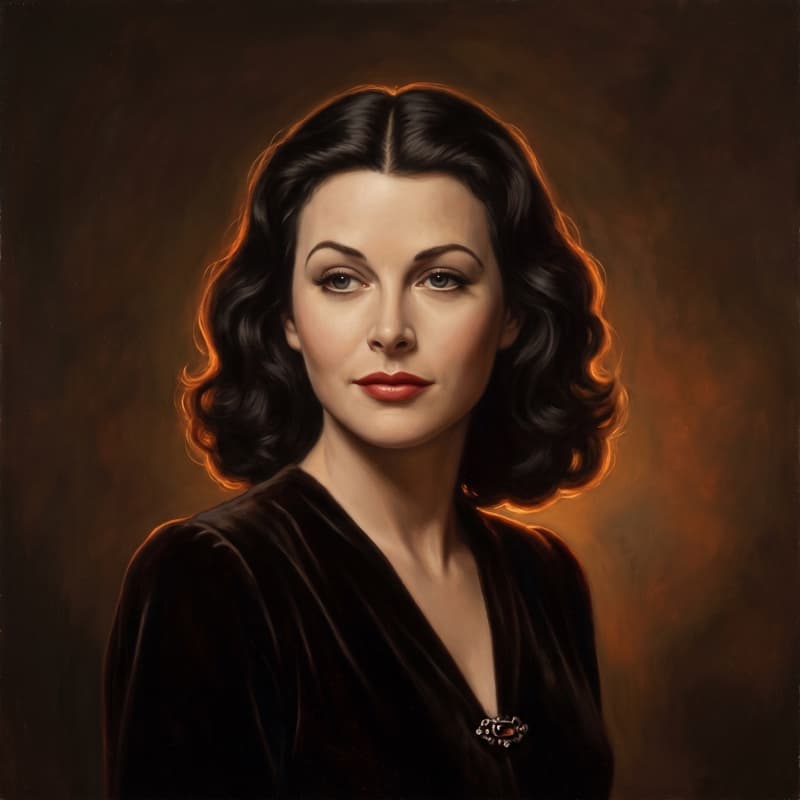
The essential Hedy Lamarr facts: born Hedwig Eva Maria Kiesler in Vienna on November 9, 1914; died in Casselberry, Florida, on January 19, 2000, of congestive heart failure at age 85; a Hollywood film career from her 1930 debut through her final film in 1958; and, with composer George Antheil, a patent for a frequency-hopping "Secret Communication System" — filed June 10, 1941, granted as U.S. Patent 2,292,387 on August 11, 1942. She became a naturalized U.S. citizen in 1953 and was inducted into the National Inventors Hall of Fame in 2014. All verified. This page gives you the facts worth keeping — and flags the popular "facts" that don't survive checking, because a facts page that can't tell you what's false is only doing half the job.
The core facts, with why they matter
Born Hedwig Eva Maria Kiesler in Vienna, November 9, 1914. She left Europe in the late 1930s, signed with MGM under Louis B. Mayer, and arrived in Hollywood billed simply as Hedy Lamarr — a stage name built to erase the trail back to Vienna and an early marriage to Austrian arms manufacturer Friedrich "Fritz" Mandl.
She and George Antheil patented a frequency-hopping radio system in 1942. It proposed synchronizing a transmitter and receiver through matched, shifting frequencies — modeled on the mechanism of a player-piano roll — so a wartime radio-guidance signal would be harder to jam or intercept. The Navy didn't adopt it at the time; engineers only later recognized it as an early ancestor of the spread-spectrum techniques underlying Wi-Fi, GPS, and Bluetooth. This wasn't an idle sketch — it was a filed, granted invention the world wasn't ready to use.
Her film career ran from a 1930 German debut to a 1958 finish. She first appeared on screen in Geld auf der Straße (1930), then became internationally notorious around age 18 for the Czech film Ecstasy (1933). Hollywood followed, opposite Charles Boyer in Algiers (1938), then Boom Town, Ziegfeld Girl, and Samson and Delilah, before her final film, The Female Animal (1958).
She was naturalized in April 1953 and received a Hollywood Walk of Fame star in 1960 — markers that sit quietly beneath the bigger headlines about her invention and her films. In 1997, the Electronic Frontier Foundation gave her its Pioneer Award for the patent; her reported response was three words: "It's about time." Fuller recognition came after her death, when she and Antheil entered the National Inventors Hall of Fame in 2014.
From a conversation with our Hedy
An excerpt from our AI Hedy Lamarr persona — a stylized recreation, honestly labeled; not a historical quotation.
Caller: People only ever want to talk about your face. Does that bother you?
Lamarr: It used to. Now I think of it as a costume I wore very well while the real work happened underneath it — in notebooks, at a drafting table, in my head between takes. Anyone can be told they are beautiful. Fewer people ask what you are thinking about while they tell you.
Popular "facts" that need correcting
"Hedy Lamarr invented Wi-Fi." Not literally. Her 1941 patent describes a jam-resistant frequency-hopping system for wartime radio guidance, not a wireless networking standard. "Mother of Wi-Fi" is later shorthand for how that idea anticipated the spread-spectrum techniques used in Wi-Fi, GPS, and Bluetooth — not a claim she personally built any of them.
"She invented frequency hopping by herself." The patent names two inventors: Hedy Kiesler Markey (her legal name at the time) and composer George Antheil, who brought mechanically linked player-piano experience from his own avant-garde music work. The collaboration is the story, not a footnote.
"Ecstasy and Me is a reliable autobiography." The 1966 book was published under her name, but Lamarr disavowed it, reportedly saying "That's not my book" and calling its contents "fictional, false, vulgar, scandalous, libelous, and obscene." Treat any claim sourced only to it with caution.
"She was arrested and that was the end of her public standing." She was arrested for shoplifting at a May Company department store in 1966 and later acquitted — a dated fact, not a scandal that erased the rest of her record. The EFF Pioneer Award followed in 1997, three years before her death.
Five things Hedy Lamarr did (the honest short list)
- Starred in major Hollywood films from Algiers (1938) through Samson and Delilah to her final film in 1958.
- Co-filed, with George Antheil, the patent application for a frequency-hopping "Secret Communication System" on June 10, 1941.
- Held U.S. Patent 2,292,387, granted August 11, 1942.
- Became a naturalized U.S. citizen in April 1953.
- Received the EFF's Pioneer Award in 1997, later followed by induction into the National Inventors Hall of Fame in 2014.
The fact pages can't hold her
Facts are the skeleton; the voice is the woman who insisted she was more than one thing at a time. Our Hedy — an AI recreation, built from the sourced record and labeled as what it is — can tell you about Vienna before the fame, the marriage that put wartime radio talk in her ear, and what it felt like to file a patent no one wanted yet. Ask her why the world took fifty years to catch up. She's ready when you are.
More in this cluster: Hedy Lamarr hub · her death · verified quotes · biography.