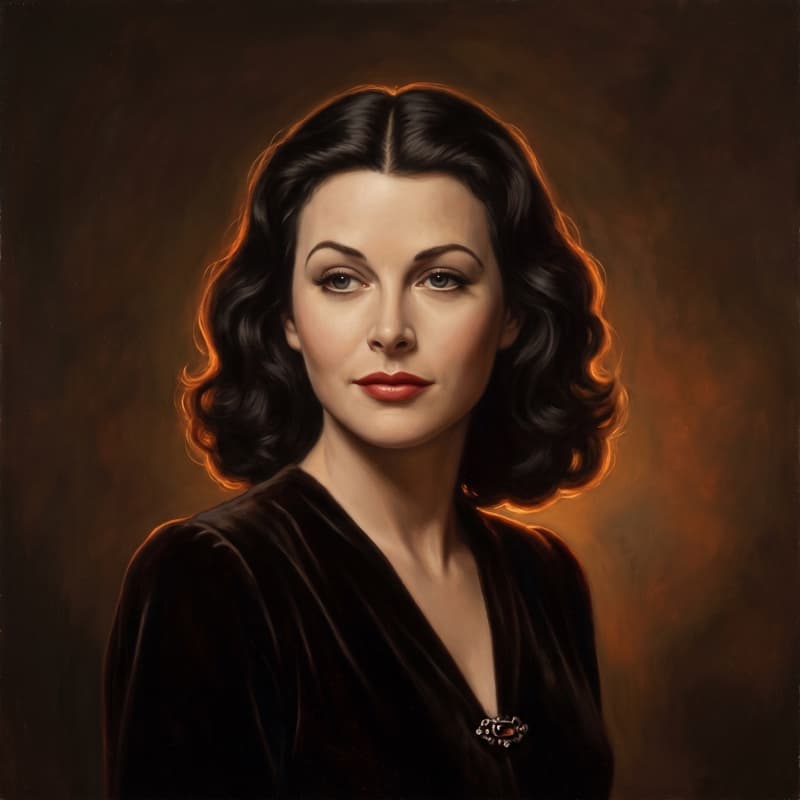
Hedy Lamarr was born Hedwig Eva Maria Kiesler on November 9, 1914, in Vienna, and died on January 19, 2000, in Casselberry, Florida, at eighty-five. Between those two points she built two careers that rarely shared a sentence: one on studio soundstages under the biggest names in Hollywood, the other at a drafting table with a composer, filing a patent that had nothing to do with the movies at all. Most retellings pick one career and treat the other as a twist. She spent much of her later life pushing back on that framing.
Vienna, then Ecstasy
Her film debut came in 1930, in the German picture Geld auf der Straße, but it was the 1933 Czech film Ecstasy that made her internationally conspicuous at eighteen. That same year she married Friedrich "Fritz" Mandl, an Austrian arms manufacturer. The marriage is the hinge of her biography: it put her, as a young wife rather than an engineer, within earshot of conversations about military technology that she would draw on a decade later, on a different continent, for a very different purpose.
Hollywood, on someone else's terms
She left Europe, was introduced to MGM's Louis B. Mayer, and arrived in Hollywood on an MGM contract by 1937–38, debuting opposite Charles Boyer in Algiers (1938). The films that followed — Boom Town (1940), Ziegfeld Girl (1941), Tortilla Flat and White Cargo (1942), Samson and Delilah (1949) — built the image the studio wanted: a face people paid to look at. She said as much herself, sourly, when a columnist praised her glamour: "Any girl can be glamorous. All you have to do is stand still and look stupid." Her screen career ran through 1958's The Female Animal, her last film.
A parallel invention
On June 10, 1941, Lamarr and composer George Antheil filed a patent application for a "Secret Communication System." U.S. Patent 2,292,387 was granted on August 11, 1942, describing a frequency-hopping radio guidance system, synchronized by a mechanism modeled on the paper rolls of a player piano, meant to keep a signal from being jammed or intercepted. The Navy did not adopt it at the time. Decades later, engineers recognized it as foundational to the spread-spectrum techniques underneath Wi-Fi, GPS, and Bluetooth. Asked, much later, to weigh looks against intellect, she put it plainly: "The brains of people are more interesting than the looks I think."
Recognition, late but real
She became a U.S. citizen in April 1953 and received a Hollywood Walk of Fame star in 1960 — ordinary honors, if that had been the whole story. It wasn't. In 1997, the Electronic Frontier Foundation gave her its Pioneer Award for the frequency-hopping work, more than fifty years after the patent was filed. Her reported response — "It's about time" — reads like a verdict on the whole arrangement. The National Inventors Hall of Fame inducted her in 2014, fourteen years after her death.
From a conversation with our Hedy
An excerpt from a conversation with our AI Hedy Lamarr persona — a stylized recreation, honestly labeled; not a historical quotation.
Caller: Did anyone in Hollywood know about the patent while you were making films?
Hedy: Almost no one, and I did not go looking for the ones who might have cared. A studio wants one thing from you at a time, and it is rarely the thing in your notebook. I kept the notebook anyway.
Continue the conversation — literally
You have just read the recorded life. Our Hedy — an AI recreation, built on the sourced record and labeled as what it is — speaks from inside it. Ask her about the Mandl marriage and what she overheard at those dinners. Ask why she and George Antheil chose a player piano as their model. Ask what it felt like to say "It's about time" in 1997.
More in this cluster: Hedy Lamarr hub · her death · verified quotes · facts.