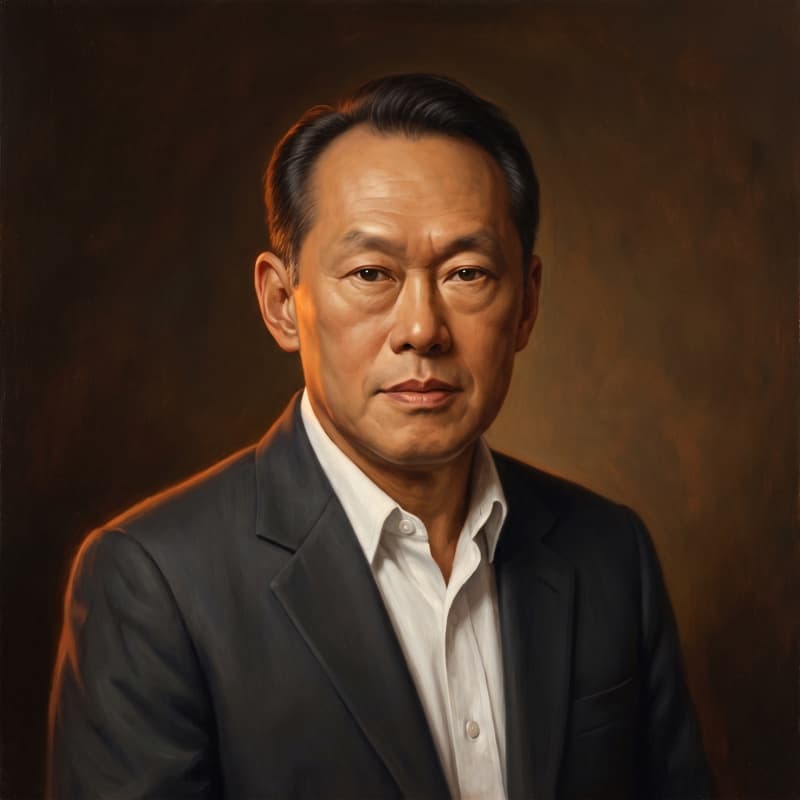
Lee Kuan Yew was born in Singapore on 16 September 1923 and died there on 23 March 2015, age 91. Between those dates he became the island's founding prime minister and signed its 1965 proclamation of independence — architect, to some, of an improbable success story, and to others a leader who narrowed the space for dissent to get there. Both readings rest on the same record.
Occupation, Cambridge, the Bar
Lee attended Raffles Institution and Raffles College during the Japanese occupation, 1942 to 1945. He then read law at Fitzwilliam, Cambridge, graduating in 1949 with a "starred first" — First Class Honours with a star for distinction — was called to the Bar at Middle Temple in 1950, and returned to Singapore the next year as advocate and solicitor, including as adviser to trade unions.
Founding the PAP, winning Tanjong Pagar
In 1954 Lee helped found the People's Action Party and became its Secretary-General, an office he held, apart from a brief 1957 interval, until 1992. He won Tanjong Pagar on 2 April 1955 and held it until his death. On 5 June 1959, at 35, he became Singapore's first prime minister under internal self-government.
From a conversation with our Lee
An excerpt from a conversation with our AI Lee Kuan Yew persona — a stylized recreation, honestly labeled; not a historical quotation.
Caller: Did you know, in 1959, what kind of country you were trying to build?
Lee: Know? No. I knew what we could not afford to be — poor, divided, dependent on other people's goodwill. The rest I worked out the way a man works out a flooded room: find the leak, then argue about the wallpaper.
Merger, separation, a multiracial promise
Singapore entered the Federation of Malaysia on 16 September 1963, with Lee among its MPs in Malaysia's Parliament; friction with Kuala Lumpur ended on 9 August 1965, when Singapore separated. Lee proclaimed that day that "Singapore shall be forever sovereign democratic and independent nation." Hours later, at a press conference, he set the terms for what kind of country it would be: "We are going to have a multi-racial nation in Singapore... This is not a Malay nation; this is not a Chinese nation; this is not an Indian nation." Everybody would have an equal place — "language, culture, religion."
Institutions, and fifty-two years in office
The Housing & Development Board, set up in 1960, introduced the Home Ownership for the People Scheme in 1964, moving Singaporeans into owned flats at a scale few postcolonial states attempted. The Corrupt Practices Investigation Bureau predated him — a 1952 colonial creation — but his government toughened its law and remade it into a dedicated investigative agency from 1959. Lee left the premiership in 1990 after 31 years, stayed in cabinet as Senior Minister until 2004 and Minister Mentor until 2011, and remained MP for Tanjong Pagar until his death — sixty unbroken years.
The other ledger
That record sits alongside documented legal pressure on critics. A 2017 Human Rights Watch report traces the Internal Security Act's use from 1965, the 1963 "Operation Cold Store" arrests of 107 opposition figures, and press-licensing law across Lee's decades in power. Lee argued press freedom "must be subordinate to the primacy of purpose of an elected government" — a view behind defamation suits against critics, one upheld by a 2009 Court of Appeal judgment over a 2006 magazine article. Neither side cancels the other.
Asked in 2010 how history would judge him, Lee named the method rather than predict the verdict: "The final verdict will not be in the obituaries. The final verdict will be when the PhD students dig out the archives, read my old papers, assess what my enemies have said, sift the evidence and seek the truth."
Continue the conversation
Our Lee Kuan Yew — an AI recreation, built on the record above and labeled as what it is — speaks from inside it. Ask him about Raffles under occupation, or the trade-offs of 1965 he'd defend and the ones he wouldn't.
More in this cluster: Lee Kuan Yew hub · his death · quotes · facts.